To test a lithium golf cart battery, check its condition, read any BMS warnings, and compare voltage, current and temperature before and during the problem. A single voltage reading cannot tell you how much usable capacity remains. A cart that stops on a hill may have triggered battery protection, but the cause can also be a connection, controller or mechanical problem.
This guide focuses on LiFePO4 golf cart batteries. It explains what you can learn from the display and normal vehicle operation, and which checks need a qualified technician. Keep the battery closed throughout.
Start with the problem the driver notices
Does the cart refuse to turn on, stop during acceleration, charge incompletely, or cover less distance than before? These are different problems. Note when the change began and whether it followed a repair, charger change, cold weather or a heavier load.
When the fault occurs, record the battery warning and controller code before clearing either. Also note whether the cart was climbing, accelerating, braking or running with electrical accessories switched on. Compare readings from the same event, not screenshots taken on different trips.
| What happens | What to check first | What it may mean | Next step |
|---|---|---|---|
| The cart stops on a hill or during acceleration | BMS warning, battery current and voltage at the stop | Low-voltage or overcurrent protection, excessive demand, or a connection problem | Stop driving if protection trips. Have the warning and vehicle load checked before another test. |
| The charge percentage suddenly drops | Whether the percentage comes from the BMS or a voltage-based gauge | A changing estimate, not necessarily a sudden loss of capacity | Compare charge history and BMS readings; follow the gauge manufacturer’s calibration instructions if required. |
| The cart will not turn on after parking | Battery switch or sleep state, warnings and accessories left on | Standby mode, a discharged battery, or a vehicle-side fault | Use the documented wake-up procedure only. If it fails or a warning returns, contact service. |
| Range is shorter than usual | Charge completion, route, payload, tires and brakes | Less energy at departure, greater energy use, or reduced battery capacity | Compare the same route under similar conditions before requesting a capacity test. |
Check the outside before taking readings
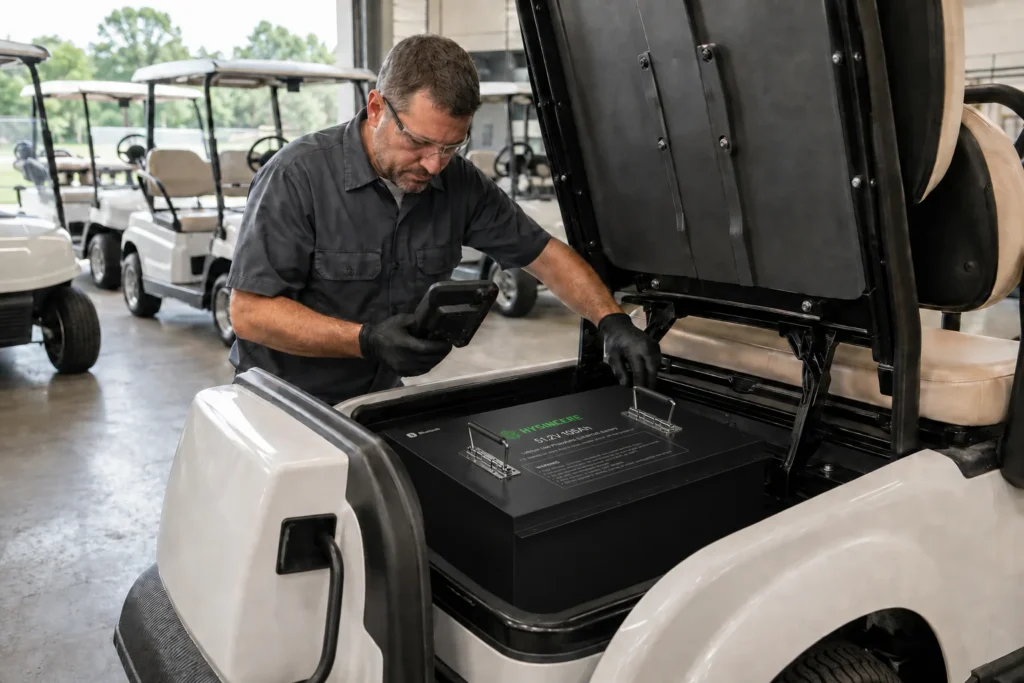
Park on a safe, level service area, secure the cart against movement and follow its shutdown and isolation procedure. Look for a damaged case, loose mounting, corrosion, worn insulation, discolored connectors or signs of water entry. Do not tighten connections or move cables on an energized system.
Stop if there is swelling, smoke, an unusual smell, arcing, water intrusion or abnormal heat. Keep people away and follow the site’s emergency or service procedure. Do not charge a visibly damaged battery or repeatedly reset a returning safety warning.
A visual inspection can reveal a reason to stop, but a clean case does not prove that the battery or its connections are healthy. Electrical checks still require the correct test equipment and service procedure.
Use BMS readings to narrow down the cause
The battery management system, or BMS, monitors the battery and can limit or stop charging and discharging when a limit is reached. Use the app, display or service tool specified for your battery. Available information varies: not every interface shows individual cell voltages or a fault history.
Start with pack voltage, current, temperature, state of charge (SOC) and the exact warning. SOC is an estimate of the charge remaining; it is not a measurement of long-term battery health.
- Low-voltage warning: the pack or a monitored cell has reached a lower limit. Low charge, voltage drop under load or a battery fault may be involved. The warning alone does not identify which.
- Overcurrent warning: the demand has exceeded a limit for that battery. Check the cart’s operating load and controller settings with its service technician; do not raise the BMS limit to keep the cart running.
- Temperature warning: identify whether charging or discharging has been restricted, and compare the reported temperature with the battery manual. Do not assume the air temperature is the cell temperature.
- No app connection: check the documented power and connection procedure. A disconnected app is not proof of a failed battery.
Use the fault definitions, limits and recovery steps for the exact battery model. The same warning label can have different thresholds on another manufacturer’s battery. For a Hysincere battery, check the model’s manual before attempting a reset or putting the cart back into service.
Understand what the voltage reading tells you
LiFePO4 voltage changes relatively little through much of the discharge cycle. Two batteries at different charge levels can therefore show similar resting voltage. A voltage-based gauge may also be misleading if it was designed for lead-acid batteries.
Compare readings taken under the same conditions:
- During charging: the charger affects the measured voltage. A high reading does not, by itself, confirm that charging is complete.
- At rest: a reading taken after the rest period specified by the manufacturer is useful as a reference, but it is not a capacity test.
- Under load: voltage usually falls as current rises. If it recovers when the load ends, that recovery alone proves neither a healthy nor a defective battery.
More current produces more voltage drop across resistance in the battery and circuit. A large drop may involve the battery, an external connection or excessive demand. To distinguish them, a technician needs readings at documented measurement points under comparable conditions—not a universal voltage chart.
A qualified technician may compare an external voltage measurement with the BMS reading at the same time. Use only accessible test points identified in the service documentation and correctly rated equipment. Do not open the pack, pierce insulation or bypass protection. If the output reads zero, a BMS shutdown or disconnect may be involved; it does not mean every cell is at zero volts.
Compare performance during normal driving
If the cart is safe to operate and the service procedure allows it, compare a short, controlled drive with a record from normal operation. Keep the starting charge, route, payload, tire pressure and accessory use as similar as practical. Have a second person or an approved logger capture the data so the driver can watch the route.
Watch for the point where performance changes. Does current rise before voltage drops? Does a temperature warning appear after sustained use? Does the controller report a fault while the battery reports normal operation? The sequence helps choose the next check, although no single pattern confirms the failed part.
Stop if a protection event occurs or the vehicle behaves unpredictably. Do not stall the motor, hold the cart against an obstacle, or attach an improvised load. A short driving check helps reproduce a symptom; it does not measure the battery’s full capacity.
Rule out charger and cart problems
If charging ends early, check the charger’s exact model, selected profile, completion indication and fault code. A battery that did not finish charging can deliver less range without having lost capacity. Our LiFePO4 charging compatibility guide explains what to compare before reusing a charger.
If the problem started after a conversion or repair, have the installer compare the actual system with its approved drawings. The golf cart wiring and conversion guide covers the system checks; it is not a substitute for the specific cart’s service instructions.
Low tire pressure, dragging brakes, extra passengers and steeper routes all increase energy use. If several carts develop the same problem after a charger or controller change, investigate that shared change before assuming several batteries failed at once.
Separate reduced range from lost capacity
Range describes how far the cart travels. Capacity describes how much charge or energy the battery can deliver under defined test conditions. They are related, but they are not the same measurement.
Keep a simple record of completed charging, route, payload, temperature and any warnings. If range remains lower under comparable conditions after charger and vehicle issues have been addressed, ask the battery supplier about a controlled capacity test.
A proper test measures delivered amp-hours (Ah) or watt-hours (Wh) using the manufacturer’s specified starting charge, temperature, discharge rate and stopping limits. Its result is compared with the applicable specification. There is no universal pass percentage or test load for every golf cart battery. Do not discharge the cart until it stops as an informal capacity test.
For fleet replacement planning, compare your operating requirements with the golf cart battery application guide and the current golf cart battery series. A larger capacity rating is not a substitute for checking voltage, current, charger and installation compatibility.
Get useful help without repeating the whole test
Send the battery model, cart model, charger model and a short description of the problem. Include the exact warning or a screenshot, plus the charge level and conditions when it happened. Mention recent repairs or equipment changes.
If logs or external measurements are available, include them with timestamps. You do not need to open the battery or deliberately trigger another shutdown to make a useful first enquiry.
Brauchen Sie Hilfe bei einem Golfcart-Batterieproblem?
Nennen Sie uns Batterie- und Fahrzeugmodell, das Problem und angezeigte Warnungen. Wir helfen, die nächste Prüfung einzugrenzen, ohne Sie zum Öffnen der Batterie aufzufordern.
Häufige Fragen zur Prüfung von Lithium-Golfcart-Batterien
Antworten zu Spannung, BMS-Warnungen und Kapazitätstests.
Zeigt die Spannung, ob eine Lithium-Golfcart-Batterie intakt ist?
Nicht allein. LiFePO4-Batterien können bei verschiedenen Ladezuständen ähnliche Ruhespannungen zeigen. Vergleichen Sie Spannung mit Strom, Temperatur und BMS-Warnungen. Um die tatsächlich lieferbare Ladungsmenge oder Energie zu messen, ist ein kontrollierter Kapazitätstest erforderlich.
Welche BMS-Werte sollte ich zuerst prüfen?
Beginnen Sie mit Packspannung, Strom, Temperatur, geschätztem Ladezustand und der genauen Warnung. Werte vom Zeitpunkt der Störung helfen mehr als Screenshots anderer Situationen. Eine App kann die Ursache eingrenzen, ersetzt aber keine vollständige Diagnose.
Kann ich die Batterie mit einem Multimeter prüfen?
Eine qualifizierte Fachkraft kann mit passend bemessenen Geräten an einem zugänglichen, in der Serviceanleitung festgelegten Messpunkt die Spannung prüfen. Die Batterie bleibt geschlossen. Ein Multimeterwert allein misst keine nutzbare Kapazität. Ein Ausgangswert von null kann bedeuten, dass das BMS den Ausgang getrennt hat.
Muss die Batterie ersetzt werden, wenn das Golfcart bergauf stoppt?
Nicht unbedingt. Niedriger Ladezustand, zu hohe Stromanforderung, ein schlechter Anschluss oder ein Fahrzeugfehler können einen Stopp unter Last auslösen. Sichern Sie BMS-Warnung und Controllercode. Hat eine Schutzfunktion ausgelöst, lassen Sie vor einer weiteren Fahrt die Ursache prüfen.
Wie unterscheide ich Kapazitätsverlust von geringerer Reichweite?
Vergleichen Sie Fahrten mit ähnlichem Startladezustand, Strecke, Zuladung, Temperatur und Fahrzeugzustand. Bleibt die Reichweite nach Behebung von Ladegeräte- und Fahrzeugproblemen geringer, fragen Sie den Lieferanten nach einem Kapazitätstest mit den vorgegebenen Entlade- und Abschaltgrenzen. Fahren Sie für einen Kapazitätstest nicht bis zum Stillstand.
Sollte ich das BMS zurücksetzen, wenn das Golfcart nicht fährt?
Nutzen Sie nur das für diese Batterie dokumentierte Aufweck- oder Wiederanlaufverfahren. Kehrt eine Warnung zurück, stoppen Sie und lassen Sie sie prüfen, statt wiederholt einen Reset auszuführen. Umgehen Sie keine Schutzfunktion und erhöhen Sie keine Stromlimits, um weiterfahren zu können.
Dieser Leitfaden ersetzt nicht die Serviceanleitungen von Batterie und Fahrzeug. Lassen Sie den Pack geschlossen. Elektrische Messungen und Kapazitätstests benötigen eine qualifizierte Fachkraft und das vorgeschriebene Verfahren. Stoppen Sie bei Schäden, ungewöhnlicher Wärme oder wiederkehrenden Schutzabschaltungen. Umgehen Sie niemals das BMS.