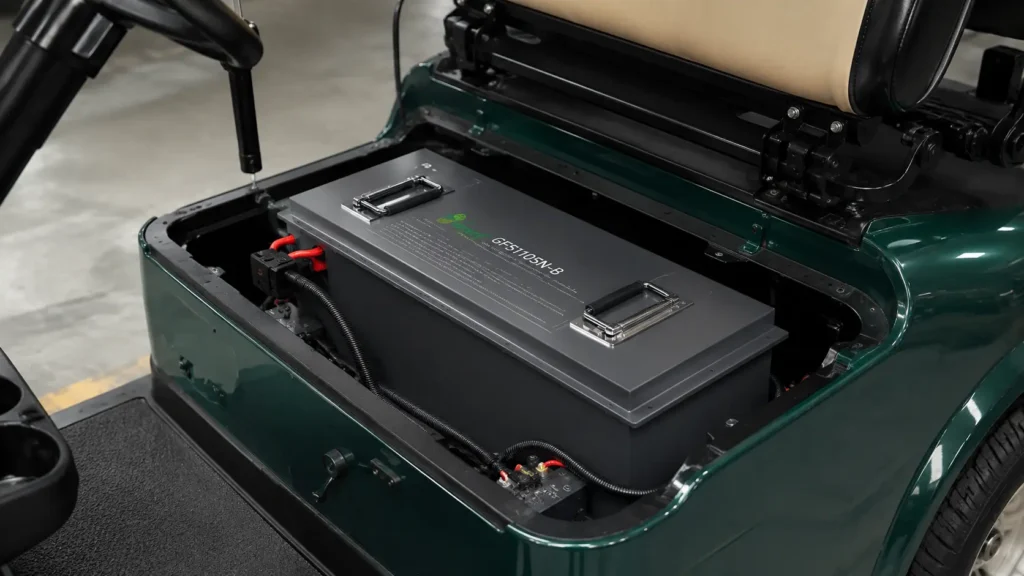
A golf cart can often be converted from lead-acid to LiFePO4, but a reliable conversion replaces a battery system—not only a battery box. Voltage class, motor-controller current, regenerative braking, charger logic, main protection, 12V accessories, state-of-charge display, mounting, and commissioning all need to agree.
The most common mistake is to choose a battery by Ah and advertised “48V compatibility,” then discover that the BMS trips on acceleration, the old charger is unsuitable, or the cart’s lead-acid gauge no longer reports useful range.
The practical answer: yes, after the cart is identified as a complete electrical system
Two carts with “48V” decals can have different controllers, motors, regenerative behavior, accessory wiring, chargers, and battery compartments. Model year and aftermarket modifications matter as much as the brand name. Before selecting a lithium pack, record the cart model, controller label, motor rating, present battery arrangement, charger, and every cable connected to the battery bank.
For a broad project review beyond golf carts, Hysincere’s 10-point lead-acid to LiFePO4 checklist covers load, charging, temperature, mechanical fit, and documentation. The sections below focus on traction-cart details.
36V, 48V, and 51.2V are system labels—not automatic matches
| Existing cart description | Common lead-acid arrangement | Possible LiFePO4 direction | What must be confirmed |
|---|---|---|---|
| 36V lead-acid cart | Often six 6V batteries in series, but the actual cart must be checked | A native 38.4V LiFePO4 pack or a manufacturer-approved series architecture | Controller operating range, charger, BMS current, pack maximum voltage, and accessories |
| 48V lead-acid cart | Common arrangements include six 8V or eight 6V batteries | A 51.2V LiFePO4 pack is a common 48V-class direction | Controller and contactor maximum voltage, charger profile, regeneration, and low-voltage settings |
| “48V lithium” cart | Not applicable | Often 51.2V nominal for a 16-cell LiFePO4 pack | Do not compare the marketing label only; use the full charge/discharge window |
| Multiple 12.8V batteries | May resemble the layout of separate lead-acid units | Series use only when the exact model permits it | BMS switching voltage, state-of-charge matching, bank charging, service isolation, and warranty rules |
A native higher-voltage traction pack can simplify monitoring, protection, and consistency compared with several independent 12V batteries, but it must be designed for the cart. A multi-battery layout can support service goals in some fleets, yet it adds more BMS devices, interconnects, and balancing considerations. There is no universal winner without a maintenance and operating brief.
Size the battery for acceleration and hills, not only cruising power
Traction loads are dynamic. Starting from rest, climbing a hill, carrying passengers, driving on soft ground, or using a modified motor/controller can demand much more current than level cruising. The BMS must support both continuous current and the peak current for the required duration.
For an illustrative calculation, assume a controller is delivering 5,000W and use 90% as a planning efficiency at a 51.2V nominal battery:
This is not a BMS selection by itself. The project still needs measured or manufacturer-provided peak current, acceleration duration, controller current limit, motor modifications, grade, vehicle mass, tire size, and temperature. A battery advertised for 100A continuous output may be too small if the cart repeatedly needs a higher, longer peak.
Also distinguish three separate BMS capabilities:
- Continuous discharge current for sustained driving and hill climbing;
- Peak discharge current and permitted duration for acceleration or transient overload;
- Charge current from the charger and, where applicable, regenerative braking.
The old lead-acid charger normally needs to be replaced or formally validated
A golf-cart lead-acid charger may use bulk, absorption, float, equalization, time-based logic, or a charge algorithm designed around lead-acid voltage response. A LiFePO4 pack needs a profile approved for that exact battery. Even if the plug fits, the electronics may not.
Review charger maximum voltage, current, termination, restart, temperature compensation, interlock, communication, and connector pinout. Some carts enable the charger through a sense wire or disable driving while plugged in. Those functions must remain intact after conversion.
The detailed lead-acid charger and LiFePO4 compatibility guide explains why equalization and repair modes should not be carried into a lithium system. For a cart fleet, standardizing one approved battery/charger pair is safer and easier to service than allowing technicians to choose settings vehicle by vehicle.
Five parts of the cart that are easy to overlook
1. Regenerative braking
Some controllers send energy back to the battery during deceleration or downhill operation. The battery must accept that charge current at the present temperature and state of charge. If a full or cold pack opens its charge path, the controller’s behavior must remain safe and predictable. Confirm cart model, controller type, BMS charge-current limit, and high-voltage coordination.
2. Main fuse, contactor, precharge, and cables
The lithium pack can have a different fault-current capability and terminal layout from the old bank. Review the main fuse interrupt rating, contactor voltage/current, disconnect, cable size, lug quality, bend radius, routing, and protection from abrasion. High-power controllers may also need a documented precharge method to limit capacitor inrush rather than repeatedly stressing the connector or contactor.
3. 12V accessories
Lights, horn, USB outlets, audio, telematics, and accessories may use a DC-DC converter from the traction pack. Do not tap one 12V battery in a series string to supply accessories; that creates imbalance. Verify the converter input range, output current, standby draw, protection, and ignition control.
4. State-of-charge display
A lead-acid bar gauge that estimates capacity from voltage will not reliably represent the flatter LiFePO4 curve. Use a display based on the supported BMS data or a properly configured current-counting monitor. For rental and fleet carts, a clear low-energy warning is part of operational safety, not a cosmetic feature.
5. Battery tray and weight distribution
A lighter pack still needs positive restraint. Review the tray, brackets, cover clearance, terminal protection, vibration, water exposure, and service access. If the weight changes substantially, verify handling, suspension assumptions, and any manufacturer requirements rather than adding unsecured ballast.
A responsible golf-cart lithium conversion workflow
- Identify the vehicle.
Record model, year, serial range, controller, motor, charger, battery layout, wiring changes, tire size, payload, terrain, and duty cycle. - Measure the operating demand.
Capture normal driving current and the highest acceleration or hill-climb current when practical. Define required daily distance and recharge window. - Select the voltage architecture.
Choose a native pack or an expressly approved multi-battery system based on controller range, service strategy, charger, and project support. - Match energy and power separately.
Use Wh and route duty for range; use continuous and peak current for performance. Do not use Ah as the only selection value. - Specify the charger and regeneration behavior.
Approve voltage, current, termination, connector, interlock, and any regenerative charge limits as part of the battery selection. - Design protection and installation.
Confirm the main fuse, contactor/disconnect, cable and lugs, precharge if required, tray restraint, terminal covers, accessory converter, and monitor. - Commission under controlled conditions.
Test no-load power-up, slow driving, full acceleration, hill load, braking/regen, charger completion, low-energy warning, shutdown, and restart. - Release service documentation.
Label the battery and charger, record torque and inspection requirements, train technicians, define diagnostic steps, and control replacement parts.
Commissioning is where a “working” conversion becomes a fleet-ready one
A cart that drives across the workshop has passed only the first test. Fleet acceptance should cover the worst intended route, passenger or cargo load, hot and cold conditions, repeated acceleration, regenerative braking where present, charger turnaround time, parasitic draw during storage, and recovery from a low-energy shutdown.
Record BMS data and controller faults during testing. Investigate every overcurrent, high-voltage, low-voltage, or temperature event instead of increasing limits until the fault disappears. Protection settings are based on cell, pack, and component capability—not on the desire to hide an alarm.
Review Hysincere’s golf-cart application page and golf-cart battery series for available project directions. Model suitability still depends on the cart data and required configuration.
Prepare this brief for a golf-cart battery quotation
- Cart brand, model, year, serial range, controller, motor, and any performance modifications;
- Existing battery voltage, quantity, arrangement, charger, connector, and battery-tray dimensions;
- Normal route, distance per shift, grades, surface, payload, operating hours, and recharge window;
- Measured or documented continuous and peak controller current;
- Regenerative braking type and maximum expected charge current;
- 12V accessories, DC-DC converter, display, telematics, CAN, RS485, Bluetooth, or GPS requirements;
- Minimum/maximum temperature, storage period, washdown, water, dust, vibration, and corrosion exposure;
- Target market, certification, charger plug/interlock, label, packaging, warranty, and service requirements;
- Sample plan, fleet size, annual volume, acceptance route, and responsible technician.
Build the conversion around the cart’s controller and route
Send Hysincere the cart model, controller, motor, original battery layout, charger, peak current, daily route, terrain, temperature, accessories, and fleet quantity. With those details, the discussion can move from “a 48V battery” to a verifiable battery, charger, protection, installation, and commissioning package.
Golf-cart lead-acid to lithium conversion FAQ
Is a 51.2V LiFePO4 battery suitable for a 48V golf cart?
It is a common 48V-class lithium direction, but suitability depends on the cart controller’s full voltage range, charger, motor current, regenerative braking, contactor, accessories, and low-voltage settings. Confirm the specific cart and battery rather than relying on the two marketing labels.
Can I reuse the original golf-cart lead-acid charger?
Only if its complete profile, voltage, current, connector, interlock, and restart behavior are formally validated for the selected LiFePO4 battery. In many conversions, an approved lithium charger is the clearer solution. A matching plug alone does not establish compatibility.
How do I choose the BMS current for a golf cart?
Use controller data and measured duty where possible. Compare sustained hill-climb current, acceleration peak, peak duration, overload behavior, charger current, and regenerative current. Do not size the BMS only from motor nameplate power or battery Ah.
Can three or four 12V lithium batteries be connected in series?
Only when the exact model is approved for the required series voltage. Use matched batteries, follow state-of-charge alignment and charging rules, and confirm each BMS can switch safely in the full bank. A native traction pack may simplify integration for some projects.
Why is the old battery gauge inaccurate after conversion?
Lead-acid gauges often infer state of charge from a steadily falling voltage. LiFePO4 voltage remains flatter for much of the discharge, so the same gauge can look nearly full and then fall quickly. Use supported BMS data or a lithium-configured current-counting display.
High-current traction systems should be installed and commissioned by qualified personnel. Follow the battery, cart, controller, charger, and component manufacturers’ instructions, applicable vehicle requirements, and local electrical and workplace-safety rules.