
Lead-acid to LiFePO4 · Marine house power
Marine House Battery Upgrade to LiFePO4
A 12.8V 200Ah LiFePO4 option for onboard house loads, with charging-source and battery-compartment reviews.
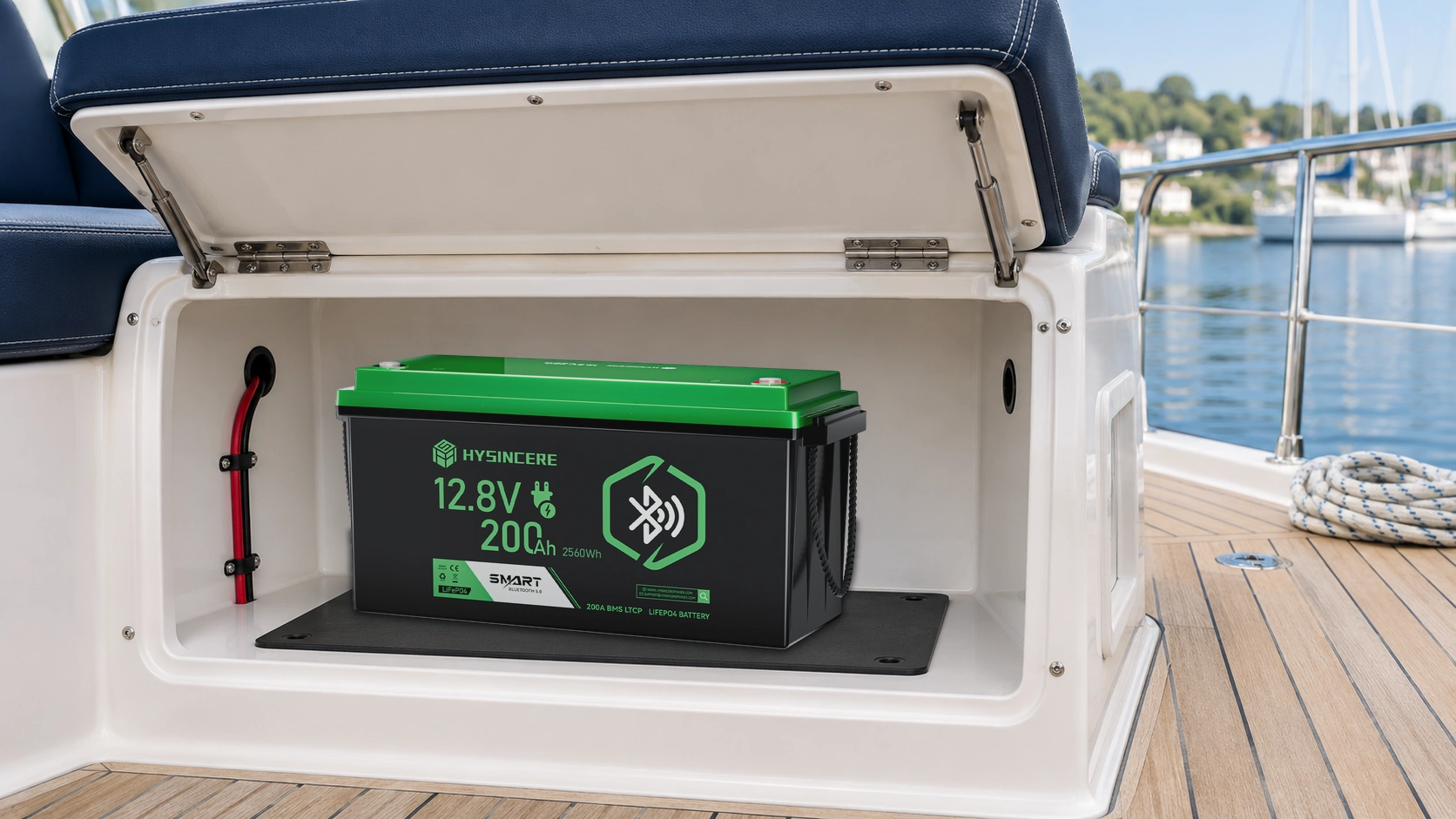
Separate House Loads From Engine Starting
This upgrade approach covers the battery supplying a boat’s living and service loads. It considers a Hysincere 12.8V 200Ah Bluetooth LiFePO4 Battery for replacing a 12V lead-acid house bank after the vessel’s electrical configuration is reviewed.
Cabin lighting, refrigeration and electronics create a different duty from starting an engine. Identify which circuits belong to the house bank and keep engine-starting requirements in a separate assessment. This configuration should not be treated as approval for cranking service.
View the LF12200N-B 12.8V 200Ah Bluetooth LiFePO4 Battery specification →
Plan Around Time Between Charging
List the loads used at anchor and while underway, including overnight equipment. Record both the daily energy demand and the highest combination of loads expected to run together.
The reference battery has 2,560Wh of nominal energy, calculated as 12.8V × 200Ah. Usable energy and time between charging depend on the loads, operating limits and system losses. If an inverter is included, assess its battery-side current as well as the AC appliances it supplies.
Coordinate Shore, Solar and Alternator Charging
Identify every source connected to the house bank. Shore chargers and solar controllers need settings compatible with the selected LiFePO4 battery. An alternator circuit also needs to be assessed for current demand, isolation and the response if the battery stops accepting charge.
Review the existing split-charge or isolator arrangement with the vessel’s installer. A change of battery chemistry should be considered across the charging system, rather than by retaining every component because its nominal voltage matches.
Arrange Mounting and Service Access
Check the compartment footprint, terminal clearance and access for removal. The battery must be restrained for vessel movement, with the connections and cable routing suited to the installation.
- Review the location for water exposure and drainage.
- Confirm cable protection and accessible isolation.
- Check the selected battery’s permitted installation conditions.
- Evaluate charging and the intended combination of house loads.
A product enclosure rating does not replace an assessment of the completed installation.
Share the Boat’s Electrical Arrangement
Useful inputs include the old bank configuration, a house-load list, charger and alternator details, and photos or drawings of the battery compartment. Describe the normal time at anchor and charging opportunities.
Hysincere can use these details to discuss the 12.8V 200Ah option and the installation checks needed with the vessel’s electrical team.
Discuss Your Battery Upgrade
Share the existing battery, equipment and charger details so we can review the replacement configuration.