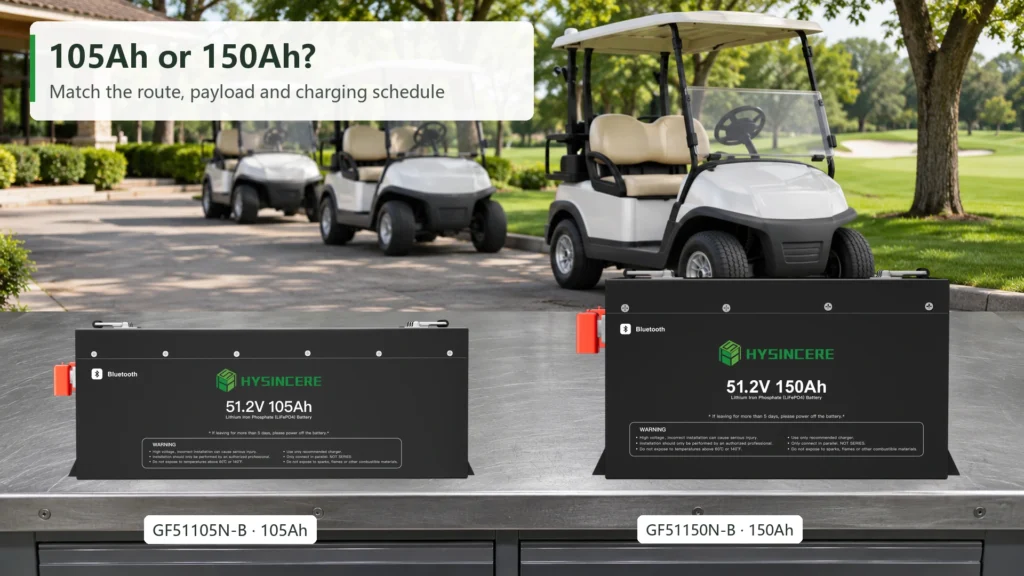
Choosing a 105Ah vs 150Ah golf cart battery? The short answer: if a cart uses a modest amount of energy per shift and can be fully recharged afterwards, try the 105Ah first. If it uses more, or there’s no chance to recharge mid-shift, look at the 150Ah. Both are 51.2V, and the 150Ah stores about 43% more energy, but it’s longer and heavier, and its continuous discharge current is the same 200A as the 105Ah.
Below we compare the Hysincere GF51105N-B (105Ah) and GF51150N-B (150Ah) on the points dealers and fleet buyers usually need to work out before ordering.
Which one to choose
| Your situation | Try first |
|---|---|
| A shift uses up to about 4 kWh, and carts can be fully recharged afterwards | 105Ah |
| The battery compartment is tight, or you want to keep the cart lighter | 105Ah |
| A shift uses about 4–6 kWh, with no chance to recharge mid-shift | 150Ah |
| Long routes, more passengers or plenty of hills, and you want more reserve | 150Ah |
| The main complaint is weak starts or hill climbing | Check current first; more capacity may not help |
Treat this table as a first screen based on keeping a 20% reserve (the calculation is below). Confirm your choice by running a real cart through a full shift.
The specs: only a few real differences
The main specifications of the GF51105N-B and GF51150N-B are below. When ordering, refer to the datasheet version that applies.
| Item | GF51105N-B | GF51150N-B |
|---|---|---|
| Nominal voltage | 51.2 V | 51.2 V |
| Nominal capacity | 105 Ah | 150 Ah |
| Rated energy | 5,376 Wh (5.376 kWh) | 7,680 Wh (7.680 kWh) |
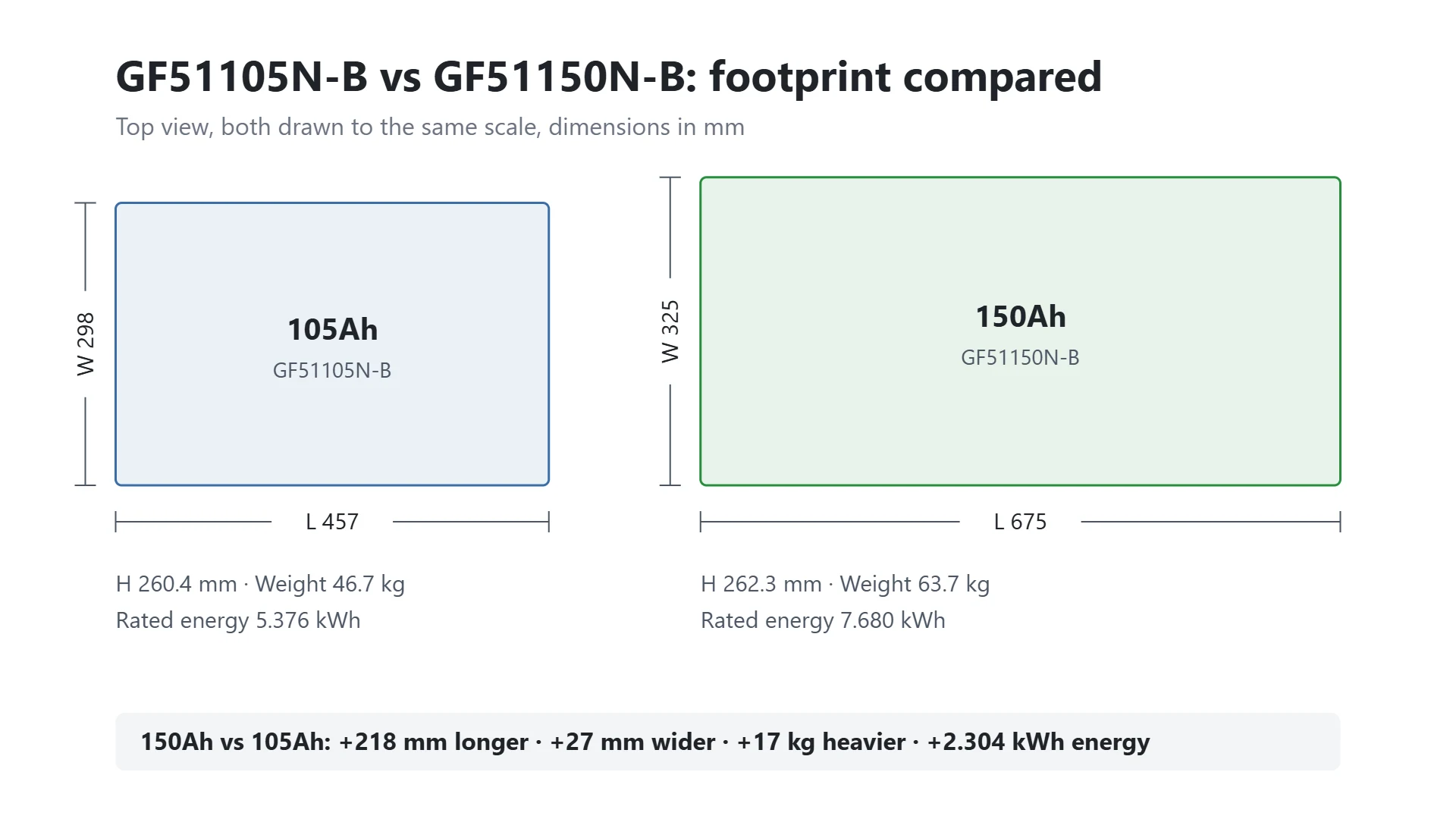
| Dimensions (L × W × H) | 457 × 298 × 260.4 mm | 675 × 325 × 262.3 mm |
| Weight | 46.7 kg | 63.7 kg |
| Max. continuous discharge current | 200 A | 200 A |
| Peak discharge current (5 s) | 300 A | 400 A |
| Max. charge voltage | 58.4 V | 58.4 V |
| Max. charge current | 105 A | 105 A |
| Charge temperature | 0 to 55°C | 0 to 55°C |
| Discharge temperature | −20 to 60°C | −20 to 60°C |
| Communication | RS485 / CAN | RS485 / CAN |
| Terminals / protection rating | M8 / IP65 | M8 / IP65 |
Voltage, continuous discharge current, charge voltage and current, operating temperatures, communication, terminals and protection rating are all the same. Only four things differ:
- Energy: the 150Ah stores 2.304 kWh more, about 43%
- Size: the 150Ah is 218 mm longer and 27 mm wider, at almost the same height
- Weight: the 150Ah is 17 kg heavier
- 5-second peak current: 300A for the 105Ah, 400A for the 150Ah
Will it last a shift? Here’s how to work it out
Don’t choose a battery by hours of use per day. Two carts that are out for eight hours can use very different amounts of energy: one may spend most of the day parked by the tee, the other running fully loaded back and forth.
A more reliable way is to run one cart on the real route for a full day and record how many kWh it uses. Then compare that figure with the energy each battery can deliver:
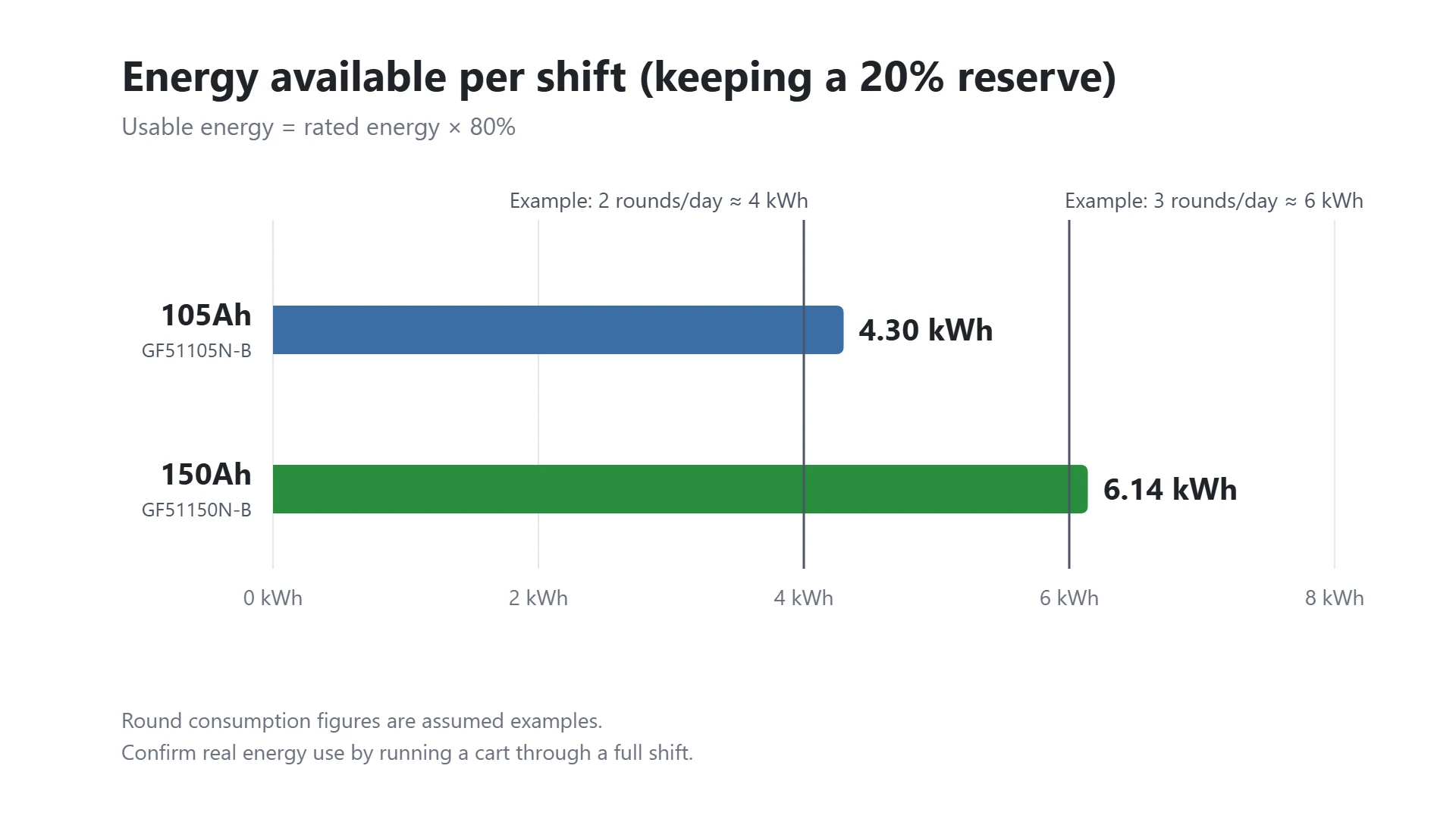
Usable energy ≈ rated energy × planned share used
105Ah: 5.376 kWh × 80% ≈ 4.30 kWh
150Ah: 7.680 kWh × 80% ≈ 6.14 kWh
Here we assume you use 80% each day and keep 20% in reserve. That’s a planning figure, not a discharge limit of the battery. In cold weather and as batteries age, less energy is available, so keep enough margin.
An example with assumed numbers: a course runs each cart for two rounds a day at 2 kWh per round, so 4 kWh a day. The 105Ah just covers it, with little margin. If peak season means three rounds a day with no time to recharge in between, 6 kWh calls for the 150Ah, and even that is close to the limit. On the other hand, if carts can be reliably recharged between rounds, the 105Ah may be enough.
Will it fit? Measure the compartment first
The 150Ah is 218 mm longer than the 105Ah, and that’s where most fit problems start. If the compartment was designed around lead-acid batteries or a 105Ah-size pack, the 150Ah may need a new tray, new cable routing and a different way to remove and install it.
When measuring, include connectors, cable bends, covers and mounting hardware, not just the battery case. The 150Ah is also 17 kg heavier, so the tray and fixings must be able to take it, and there needs to be room to handle it during service.
Starting and climbing: both have the same continuous current
A common assumption is that a bigger battery makes the cart stronger. Starting and climbing actually depend on current. Both batteries have the same 200A continuous discharge current; only the 5-second peak differs, at 300A and 400A.
On a climb that lasts more than a few tens of seconds, the cart relies on the 200A continuous rating, and the peak doesn’t help much. So if a cart already exceeds 200A under normal load, switching from 105Ah to 150Ah won’t solve it. The battery and controller configuration needs to be reviewed as a whole.
When you ask the controller supplier for data, ask for battery-side DC current, not motor phase current; the two can’t be compared directly.
Charging: a bigger battery doesn’t always take longer
Charging time depends on how much energy needs to go back in and on the charging current, not on total capacity. If both batteries need to put back 80Ah from the same starting point, using the same charger at a net 20A, both take roughly 4 hours in theory.
The difference shows up when charging from low. From 20% to full, the 105Ah needs about 84Ah and the 150Ah about 120Ah: roughly 4.2 and 6 hours at 20A, plus extra time as the current tapers off near the end. For fleets that can charge overnight for eight hours or more, the difference matters little. If you rely on lunch breaks or gaps between shifts, work it out carefully.
The 105A in the table is the maximum charge current the battery can accept, not the rating of a matching charger. With many carts, also check the number of charging points and whether the site supply can handle simultaneous charging before deciding on charger size and shift timing.
Four things to check on a 48V cart
A 51.2V LiFePO4 battery is made for 48V carts: 16 cells in series, 51.2V nominal and about 58.4V when full. Most 48V carts can keep their original controller, but check these four things first:
- Controller: maximum operating voltage, undervoltage cutoff and current limit
- Charger: able to charge LiFePO4, with an output no higher than 58.4V
- 12V converter: input range covering about 58V at full charge, with enough power
- Regeneration: what happens to energy from braking or downhill runs when the battery is full
Also note that on some cart models the controller won’t start until it receives a communication signal from the battery, so the protocol has to be matched first. For wiring and conversion steps, see our golf cart lead-acid to lithium conversion guide.
Fleets and dealers: start small, then scale up
For fleets, the safest approach is to convert a few carts first, run them for a while, and then switch over in batches. Use carts and routes in real service, and record the state of charge at departure and return, daily energy use, hill performance and charging time. One light-load run on flat ground says little about fully loaded, hilly routes.
Dealers can record the result for each cart model: which controller, charger, tray, harness and communication settings were used. Customers with the same model can then use it as a reference. Fleets should keep one configuration within each group of carts where possible and label chargers clearly to avoid wrong connections.
When comparing quotes, first confirm whether the battery, charger, display, harness, tray and installation support are each included. The extra energy of the 150Ah is worth it if it saves each cart a recharge or saves you a spare cart. If you’ll never use it, you’re paying for capacity that sits idle.
For a quote, please prepare: cart models and quantities, controller model, compartment dimensions, daily routes and loads, energy use per shift, details of your current chargers, and plans for the first and follow-up orders. If a display or communication link is needed, add the interface and protocol. If you are still comparing other voltages and capacities, start with our lithium golf cart battery range.
Have your details ready? Let's start your quote
We'll use your cart model and operating schedule to decide between 105Ah and 150Ah and arrange sample tests.
Golf cart battery FAQ
Can both batteries use the same charger?
Both have a maximum charge voltage of 58.4V and a maximum charge current of 105A, so sharing a charger may be possible. You still need to check the charging profile, output current, connectors, polarity and communication requirements; a 51.2V label alone isn't enough. With the same charger, the 150Ah takes longer to charge from the same state of charge, depending on how much energy needs to go back in.
My cart is labeled 48V. Can I install these 51.2V batteries directly?
Most 48V carts can keep their original controller, but first check the controller's operating voltage range (especially the maximum), undervoltage cutoff and current limit, as well as the input range of the charger and the 12V converter. The battery is about 58.4V when full and rises briefly during regenerative charging downhill. A few cart models need the controller to communicate with the battery, which requires protocol matching. Send us the cart model and controller model, and we'll check it for you.
Will the original battery gauge still work? Does RS485 or CAN mean it will connect to the original display?
Original gauges that estimate charge from voltage are usually inaccurate after switching to lithium and should be replaced. A gauge that communicates with the battery BMS is best, as it shows charge, temperature and faults. But matching interface names isn't enough: confirm the pinout, baud rate, messages and data definitions, and whether the display or controller supports this battery's protocol, then verify it on the vehicle.
How should the batteries be stored over winter?
Charge to 40–60%, switch off the main disconnect, and check whether a GPS tracker, gauge or DC-DC converter is still drawing power. Check the charge every two to three months. Whether the charger can stay connected depends on its manual; don't carry over the lead-acid habit of constant float charging. Before using the cart in spring, check the terminals and mounting, and charge fully before driving.
Specifications for both batteries are taken from Hysincere's product data as of October 2026; refer to the latest datasheet for each model. Energy use and charging time figures are assumptions used to illustrate the estimation method, not test results, and are not range or charging time guarantees. Conversions and installation should be carried out by people familiar with the cart's electrical system.