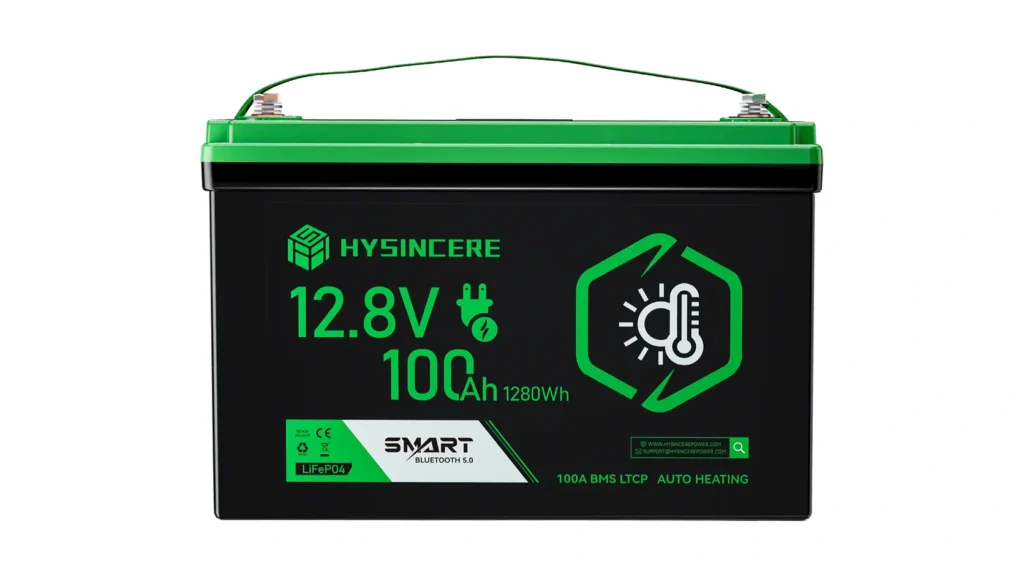
Can you charge a LiFePO4 battery below freezing? Not a standard one. Most LiFePO4 batteries should only be charged when their cells are above 0°C (32°F). They can still run your lights, fridge or fish finder in the cold, and our standard 12.8V batteries list discharging down to -20°C (-4°F). Charging is what has to wait until the cells warm up.
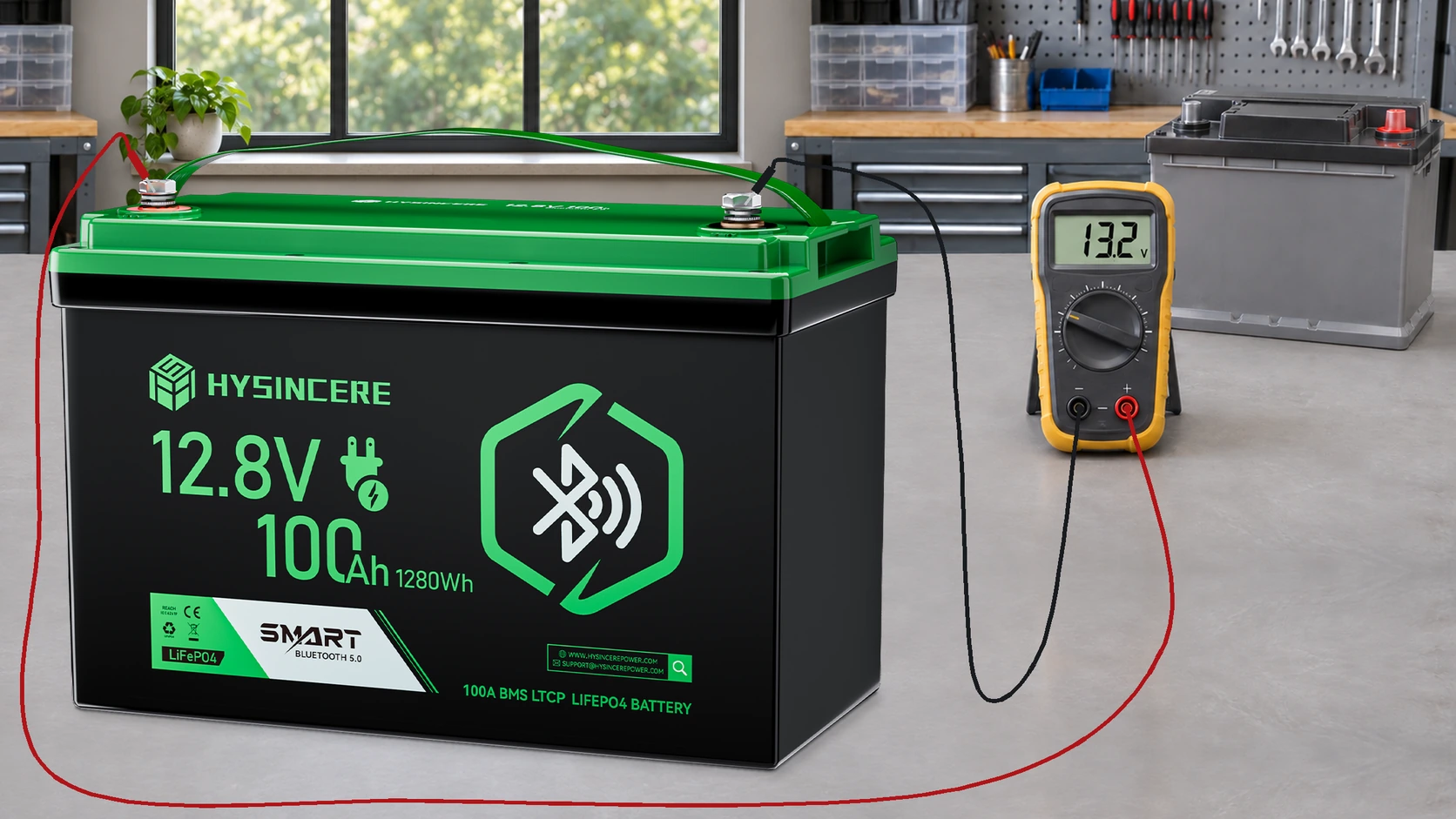
Self-heating batteries change that. When a charge source is connected and the cells are too cold, the battery warms them first and only then lets charging current in. That is why our self-heating models list a charging range of -20°C to +55°C (-4°F to 131°F), while a standard model such as the LF12100N-B 12.8V 100Ah Bluetooth LiFePO4 Battery lists 0°C to +55°C (32°F to 131°F).
One detail trips a lot of people up: what counts is the temperature of the cells, not the air. A battery that spent the night in an outside compartment can stay below freezing for hours after the sun comes up. A battery inside a heated RV or cabin may never get cold enough to matter.
Why Cold Charging Hurts a LiFePO4 Battery, but Cold Use Doesn’t
Charging moves lithium ions out of the cathode and into the graphite anode. Cold slows that movement down. If charging current keeps arriving faster than the anode can take the ions in, lithium starts to collect on the anode surface as metal instead. This is called lithium plating.
Plating does lasting damage. Lithium that ends up as surface metal no longer stores energy, internal resistance goes up, and heavy plating can make a cell less stable. A 2025 study in the Journal of Power Sources names three conditions that push a lithium-ion anode toward plating: sub-zero operation, high charging current and overcharging.
Two practical points follow from this:
- A lower charging current doesn’t make it safe. A smaller charger only charges more slowly; it doesn’t remove the risk. Unless the cell maker specifies a permitted low-temperature charging current and the BMS is set to it, wait for the cells to warm up, or use a battery that heats itself first.
- Discharging in the cold is a different story. Running loads in freezing weather doesn’t cause plating. You simply get less usable energy while the cells are cold, and how much less depends on the temperature and the load.
Standard vs Self-Heating LiFePO4: What the Specs Say
The quickest way to tell the two apart is the charging temperature on the datasheet. Here is how our models compare.
| Model | Type | Voltage / Capacity | Rated Energy | Charging Temperature | Discharging Temperature |
|---|---|---|---|---|---|
| LF12100N-B | Standard (Bluetooth) | 12.8V 100Ah | 1,280Wh | 0°C to +55°C | -20°C to +60°C |
| LF1250N-BJ | Self-heating | 12.8V 50Ah | 640Wh | -20°C to +55°C | -20°C to +60°C |
| LF1267N-BJ | Self-heating | 12.8V 67Ah | 858Wh | -20°C to +55°C | -20°C to +60°C |
| LF12100M-BJ | Self-heating | 12.8V 100Ah | 1,280Wh | -20°C to +55°C | -20°C to +60°C |
| LF12150N-BJ | Self-heating | 12.8V 150Ah | 1,920Wh | -20°C to +55°C | -20°C to +60°C |
| LF2467N-BJ | Self-heating | 25.6V 67Ah | 1,715Wh | -20°C to +55°C | -20°C to +60°C |
| LF3867N-BJ | Self-heating | 38.4V 67Ah | 2,572Wh | -20°C to +55°C | -20°C to +60°C |
In Fahrenheit: -20°C to +55°C is -4°F to 131°F, and -20°C to +60°C is -4°F to 140°F.
Two things stand out. First, the discharge range is the same for every model. Self-heating doesn’t let you run loads in colder weather; what it adds is the ability to take a charge between -20°C and 0°C. Second, the listed range still has a floor. Below -20°C, don’t charge, and plan to keep the battery somewhere warmer.
If you’re replacing a standard battery with a self-heating one, measure the battery box first. The self-heating LF12100M-BJ measures 332 × 172 × 220 mm and weighs 9.46 kg. The standard LF12100N-B is 229 × 144 × 213 mm and 8.95 kg.
How Self-Heating Works, and What to Check
In the most common design, the sequence looks like this:
- You connect a charger, a solar controller or a DC-DC charger.
- The BMS checks the cell temperature.
- If the cells are too cold, the incoming power runs a heater inside the battery instead of charging the cells.
- Once the cells reach a safe temperature, heating stops and normal charging begins.
Some designs can also heat from the battery’s own stored energy. That helps where no outside power is available, but it uses up charge. Whichever design you’re looking at, the datasheet or manual should tell you where the heating power comes from, at what temperature heating starts and at what temperature it stops. Check those three points before you plan the charging side of the system.
Heating takes time and energy. As a rough illustration (assumed figures, not a model specification), a 60W heater running for 30 minutes uses 30Wh, about 2.3% of a 1,280Wh battery. How long a battery takes to warm up from -20°C depends on its size, the heater power and how well it is insulated.
That is why the charge source matters:
- Solar on a cold morning. Weak early sunlight may not deliver enough power to run the heater, so charging can start later than you’d expect.
- Alternator through a DC-DC charger. Starting the engine doesn’t warm the battery. Make sure the DC-DC charger or the battery’s own protection holds off charging until the cells are ready, and test it once with the vehicle cold.
Do You Need a Self-Heating Battery?
Low-temperature charge protection and self-heating are not the same thing. Protection simply blocks charging when the cells are too cold. Self-heating warms the cells and then charges. Which one you need depends on where the battery lives and whether it has to recharge on its own in winter.
| A standard LiFePO4 battery is usually enough if… | Choose a self-heating LiFePO4 battery if… |
|---|---|
| The battery sits inside a heated space, such as an RV living area or a heated cabin | The battery lives in an outside compartment, an exposed tray or an unheated shed |
| You can bring it indoors for the coldest months | The system must recharge unattended from solar or an alternator in sub-zero weather |
| You don’t need to charge while the cells are below 0°C | You camp, fish or work through the winter and recharge every day |
Our 12.8V self-heating models, from 50Ah to 150Ah, suit RV house banks, ice shelters, fish finders and small solar setups. For 24V and 36V trolling motor systems used late in the season, the LF2467N-BJ 25.6V 67Ah and LF3867N-BJ 38.4V 67Ah Self-Heating LiFePO4 Batteries cover those voltages.
Sodium-ion chemistry is another route for cold sites. Our 12V sodium-ion batteries list a charging range that starts at -10°C (14°F). We compare the two chemistries in Sodium-Ion vs LiFePO4 12V Batteries.
Winter Tips for Any LiFePO4 Battery
These apply whether or not your battery heats itself.
- Make sure something stops cold charging. That can be the battery’s low-temperature protection, or a solar controller or DC-DC charger with a temperature sensor that halts charging in the cold. If more than one charge source can run at once, check them all.
- Mount the battery in the warmest practical spot. Inside the living space or an insulated compartment is better than an exposed tray, as long as the location meets the installation requirements in the manual.
- Size for winter, not summer. Cold cells deliver less usable energy, and winter days often bring longer lighting hours and more time with fans or furnaces running. Leave a margin.
- Let a cold battery warm up before charging. If you bring a battery in from outside, wait until it reaches room temperature, then charge it with a charger set for LiFePO4.
- Store it properly if it won’t be used. Charge it to around 40–60%, disconnect every load (including trackers, displays and other standby devices), and check the charge level every three months. Keep it within the storage temperature range on its datasheet. The one thing to avoid is leaving a nearly empty battery sitting all winter, because standby drain can over-discharge it.
- Check before the first spring charge. Make sure the cells are back above 0°C before you reconnect a charger, and look over the terminals and mounting while you’re at it.
Frequently Asked Questions
Can I charge a LiFePO4 battery at a very low current below freezing?
It isn’t recommended. A lower current only slows charging down; it doesn’t remove the risk of lithium plating. Unless the cell maker specifies a permitted low-temperature charging current and the BMS is set to match it, wait for the cells to warm up or use a self-heating battery.
Will a self-heating battery drain itself while my RV is parked?
That depends on where the heating power comes from. If the heater runs on charger power, it stops when the charger is disconnected, and only the BMS’s small standby draw remains. If the design heats from the battery’s own energy, it should have a minimum charge level and a time limit set, so heating stops before the battery runs down. For systems that sit unattended for long periods, the charger-powered approach is the safer choice.
What happens if solar starts charging on a freezing morning?
A battery with low-temperature protection refuses the charge until its cells are back above 0°C. A self-heating battery uses the solar power to warm up first, although weak morning sun may not be enough to run the heater. A standard battery without low-temperature protection depends on the solar controller’s temperature sensor to stop charging.
Can I leave my LiFePO4 battery in the RV over winter?
Usually, yes. If the battery compartment stays within the battery’s storage range and you can fully disconnect all loads, it can stay in the vehicle. If you face long stretches of extreme cold, or nobody will check on the RV, bring the battery indoors. Either way, make sure solar can’t charge it while the cells are below freezing.
Is a self-heating battery the same as low-temperature protection?
No. Low-temperature protection stops charging when the cells are too cold. Self-heating warms the cells first and then charges. If you can bring the battery indoors or don’t need to charge in the cold, protection alone is often enough.
Planning Batteries for Cold Climates?
Hysincere designs and manufactures LiFePO4 battery packs for RV, marine, solar and equipment applications, including self-heating models at 12.8V, 25.6V and 38.4V. If you’re a distributor, installer or equipment maker, tell us where the battery will be installed, the lowest temperature it will see and how it will be charged. We’ll help you match the battery to your charger, solar controller or DC-DC setup. Contact our team to discuss your project.