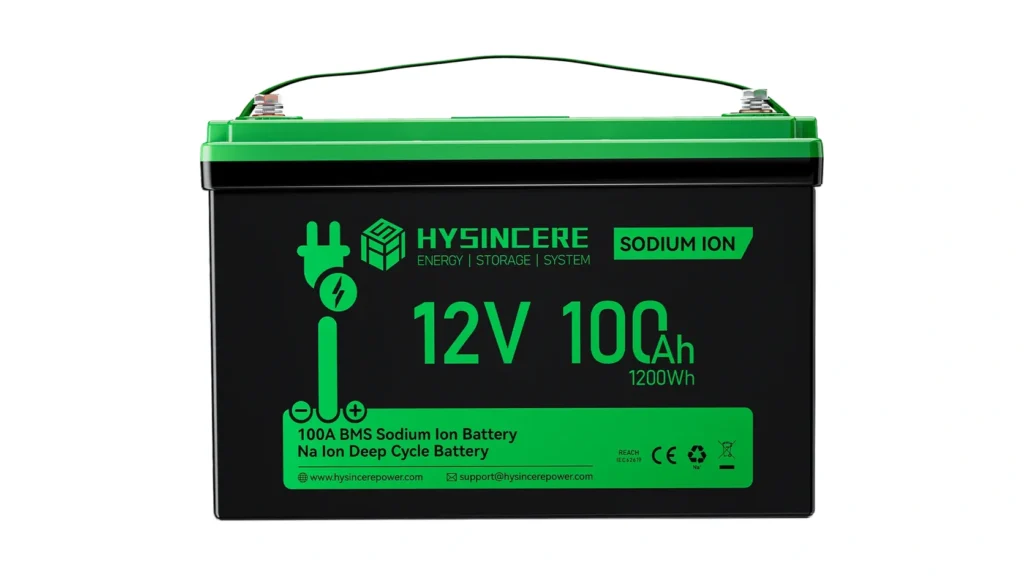
Sodium-ion or LiFePO4 for a 12V battery in a cold climate? Choose sodium-ion when the battery has to take a charge a little below freezing or run loads in deep cold, and when you have room for a larger, heavier battery plus a charger and inverter you can set to its voltage range. Choose LiFePO4 when weight and space matter, which covers most RV, marine and portable systems. If a LiFePO4 battery needs to charge below freezing, a self-heating model closes much of the gap.
Below, we put our 12V sodium-ion battery next to two 12V LiFePO4 batteries of the same capacity, using datasheet figures, and explain what the differences mean once the battery is installed.
What Is a Sodium-Ion Battery, and Why the Attention Now?
A sodium-ion battery works much like a lithium-ion battery, except that sodium ions carry the charge between the electrodes. It doesn’t rely on lithium or graphite, and sodium is plentiful and cheap as a raw material.
The technology is young at commercial scale. According to the International Energy Agency (IEA), the first sodium-ion storage system was installed in 2019 and the first sodium-ion car appeared in late 2023, both in China. In 2025, global sodium-ion production was still less than 1% of lithium-ion production. Large new production lines are what put the chemistry in the news this year.
The IEA also summarizes the trade-offs:
- Cold performance is the main strength. The latest cells keep around 90% of their rated capacity at -40°C and can operate at up to 70°C.
- Energy density is lower. The IEA puts sodium-ion at up to about 175Wh/kg, against up to about 205Wh/kg for LFP.
- It isn’t automatically cheaper. At current lithium prices, sodium-ion doesn’t undercut LFP in most applications.
Those are industry-level figures for leading cells, not the specifications of any one product. The practical takeaway is that sodium-ion isn’t a cheaper, better LiFePO4. It’s a different set of trade-offs, and cold weather is where it earns its place.
12V Sodium-Ion vs 12V LiFePO4: Side by Side
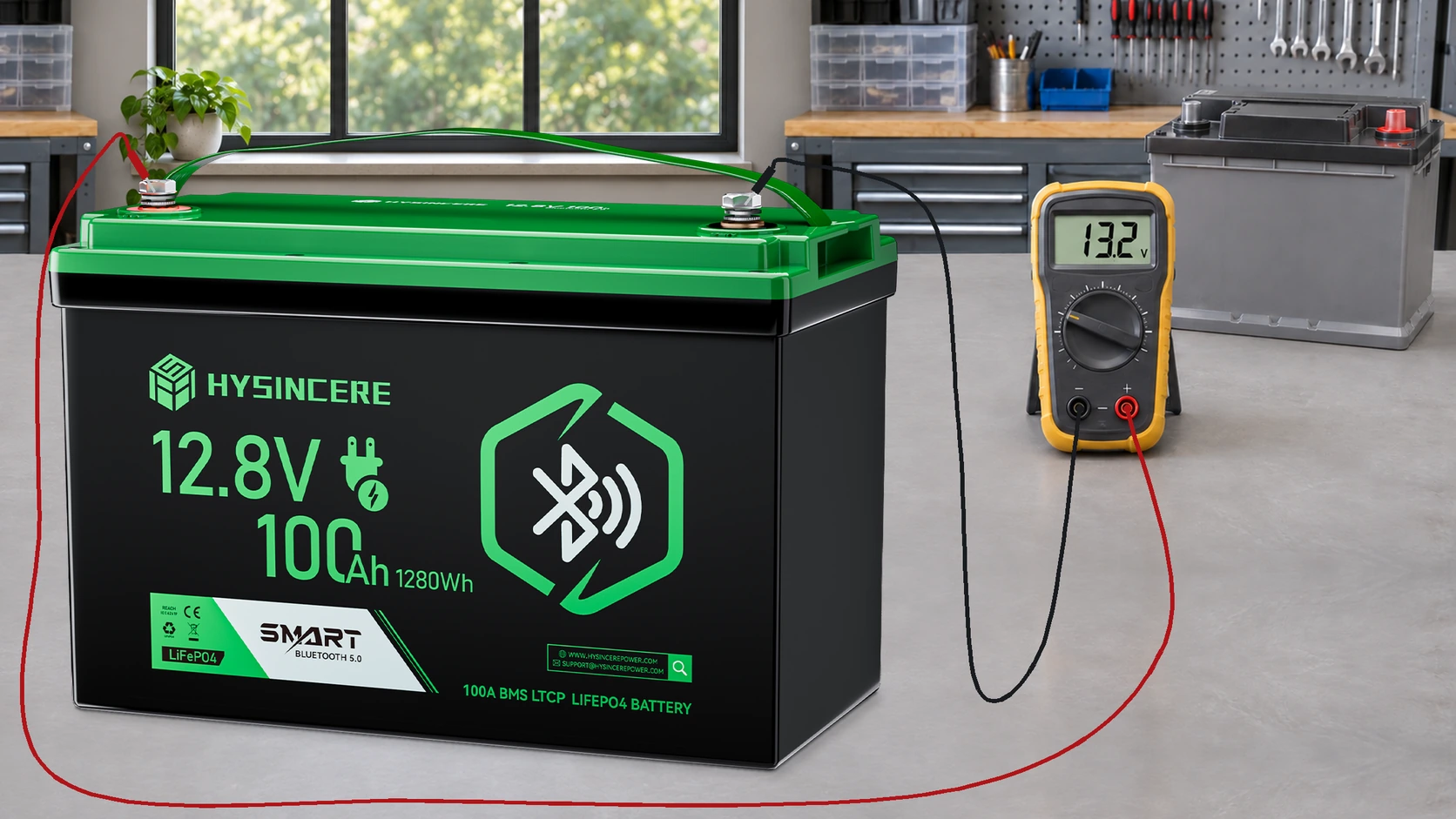
All figures come from Hysincere datasheets. The three batteries share the same 100Ah capacity and the same 100A charge and discharge ratings, so the differences come down to chemistry and, on the LF12100M-BJ, its self-heating function.
| Specification | LN12100N-BL (Sodium-Ion) | LF12100N-B (LiFePO4) | LF12100M-BJ (Self-Heating LiFePO4) |
|---|---|---|---|
| Nominal voltage | 12V | 12.8V | 12.8V |
| Nominal capacity | 100Ah | 100Ah | 100Ah |
| Rated energy | 1,200Wh | 1,280Wh | 1,280Wh |
| Max charge voltage | 15.6V | 14.6V | 14.6V |
| Discharge cut-off voltage | 8V | 10V | 10V |
| Max charge / continuous discharge current | 100A / 100A | 100A / 100A | 100A / 100A |
| Charging temperature | -10°C to +60°C | 0°C to +55°C | -20°C to +55°C |
| Discharging temperature | -30°C to +60°C | -20°C to +60°C | -20°C to +60°C |
| Dimensions (L × W × H) | 332 × 172 × 220 mm | 229 × 144 × 213 mm | 332 × 172 × 220 mm |
| Weight | 13.5 kg | 8.95 kg | 9.46 kg |
What the table tells you:
- Energy is close on paper. It’s 1,200Wh against 1,280Wh. Compare Wh rather than Ah, because the two chemistries have different nominal voltages.
- Sodium-ion is bigger and heavier. The LN12100N-BL weighs 4.55 kg more than the standard LF12100N-B and uses a larger case. It has the same outer dimensions as our self-heating LF12100M-BJ, though, so a battery box sized for one fits the other’s footprint.
- Cycle life looks the same, so check the conditions. All three list 4,000 cycles or more on their datasheets. Cycle-life figures are only comparable when temperature, charge and discharge rate, depth of discharge and the end-of-life point all match.
- Monitoring differs. The sodium-ion battery has a built-in LCD screen, while the LF12100N-B uses Bluetooth.
Cold Weather, Voltage Range and Compatibility
Cold Weather: Where Sodium-Ion Pulls Ahead
Here is what each battery’s listed temperature ranges allow, band by band. The temperatures refer to the cells, not the air around them.
| Cell temperature | Standard LiFePO4 (LF12100N-B) | Self-heating LiFePO4 (LF12100M-BJ) | Sodium-ion (LN12100N-BL) |
|---|---|---|---|
| Above 0°C (32°F) | Charge and discharge | Charge and discharge | Charge and discharge |
| -10°C to 0°C (14°F to 32°F) | Discharge only | Charge after heating, discharge | Charge and discharge |
| -20°C to -10°C (-4°F to 14°F) | Discharge only | Charge after heating, discharge | Discharge only |
| -30°C to -20°C (-22°F to -4°F) | Outside listed range | Outside listed range | Discharge only |
Usable energy falls in the cold for every chemistry, so these bands show what is permitted, not how much energy you’ll get.
Sodium-ion isn’t the coldest-charging option here. The self-heating LiFePO4 battery lists charging down to -20°C because it warms its cells first. What sodium-ion offers is charging from -10°C as a strength of the chemistry itself, plus discharge down to -30°C. For a battery that must keep powering loads through deep cold, that wider discharge range is often the deciding factor.
Voltage Range: Check Your Charger and Loads
This is the detail most people miss. The sodium-ion battery uses a wider voltage window than LiFePO4: it charges up to 15.6V and is discharged down to 8V, while the two LiFePO4 models above work between 14.6V and 10V.
- Charger. A charger set for LiFePO4 usually stops around 14.6V, so it won’t fully charge a sodium-ion battery. Use a charger with a sodium-ion profile, or an adjustable charger set to the values on the datasheet. Don’t leave a charger running and rely on the BMS’s over-voltage protection to stop it.
- Inverter and low-voltage cutoff. Sodium-ion voltage drops more noticeably as the battery discharges. Many devices built for lead-acid shut down at around 10.5V, which leaves energy in the battery that you can’t use. At lower voltage the same power also needs more current, so check the inverter’s minimum input voltage and current limits.
- High-end voltage. Near full charge, connected loads can see up to 15.6V. Confirm that sensitive 12V devices accept that.
- Don’t mix chemistries. Keep sodium-ion, LiFePO4 and lead-acid batteries in separate banks.
Safety and Shipping
Don’t treat any chemistry as fireproof. Some sodium-ion chemistries have good thermal stability, but the cells still contain electrolyte, and short circuits, overcharging or external heat remain risks. Safety depends on the cells, BMS, fusing, enclosure and build quality, whichever chemistry you choose.
You may also read that sodium-ion batteries can be shipped at 0V. Some sodium-ion chemistries can, but not all, and normal transport rules and documents still apply. Never short the terminals to discharge a battery.
Which One Should You Choose?
| Your situation | Better fit | Why |
|---|---|---|
| The battery stays above freezing, for example inside an RV living area or a heated cabin | Standard LiFePO4, such as the LF12100N-B | Smaller and lighter for the same energy |
| The battery sits outside and must recharge unattended from solar or an alternator in sub-zero weather | Self-heating LiFePO4, such as the LF12100M-BJ | Listed charging down to -20°C; confirm your charge source can power the heater |
| A fixed installation with space to spare that needs charging just below freezing and loads running in deep cold | Sodium-ion, such as the LN12100N-BL | Charges from -10°C and discharges down to -30°C; needs a charger and inverter set for its voltage range |
| Small boats, portable gear or a tight battery box | LiFePO4 | Weight and volume matter most |
| Replacing a large fleet of existing LiFePO4 systems | Pilot sodium-ion first | Confirm usable energy, charging and service before scaling up |
Price isn’t a reliable tiebreaker yet. Sodium is a cheap raw material, but production volumes are still small, so a sodium-ion battery doesn’t automatically cost less than LiFePO4 today. Compare cost per kWh and expected service life under your own operating conditions.
Frequently Asked Questions
Is a 12V sodium-ion battery a drop-in replacement for lead-acid?
Our 12V sodium-ion batteries are designed to replace 12V lead-acid batteries, using a lead-acid style case and wiring. Because the voltage range is wider, check two things first: that your charger can reach the right charging voltage, and that your devices don’t shut off too early at the low end.
Can I charge a sodium-ion battery with my LiFePO4 charger?
Usually not to full. LiFePO4 chargers typically stop at around 14.6V, while the LN12100N-BL charges up to 15.6V. Use a charger that matches the sodium-ion charging profile, or reset an adjustable charger to the values on the datasheet.
Is sodium-ion cheaper than LiFePO4?
Not necessarily, at least not yet. The raw material is cheap, but sodium-ion production is still small, so pack prices are close to LiFePO4. The IEA notes that at current lithium prices, sodium-ion doesn’t undercut LFP in most applications.
Does sodium-ion last as long as LiFePO4?
Our LN12100N-BL and LF12100N-B both list 4,000 cycles or more. Across the market, sodium-ion cycle life varies a lot with cell chemistry, so compare figures only when they were measured at the same temperature, charge and discharge rate, depth of discharge and end-of-life point.
Is sodium-ion safer than lithium?
It’s not fireproof. Some sodium-ion chemistries are thermally stable, but safety still depends on the cells, BMS, fusing, enclosure and manufacturing quality. The same is true of LiFePO4.
Testing Sodium-Ion for Your Market or Equipment
Hysincere offers 12V sodium-ion batteries in three sizes: the LN1250N-BL 12V 50Ah (600Wh), the LN12100N-BL 12V 100Ah (1,200Wh) and the LN12200N-BL 12V 200Ah (2,400Wh) Sodium-Ion Lead-Acid Replacement Batteries.
For distributors and equipment makers, we recommend starting with a small pilot. We can run low-temperature comparison tests for your project under the same temperature, load and cut-off conditions, so you see real figures for your application before scaling up. Contact our team to plan a trial.