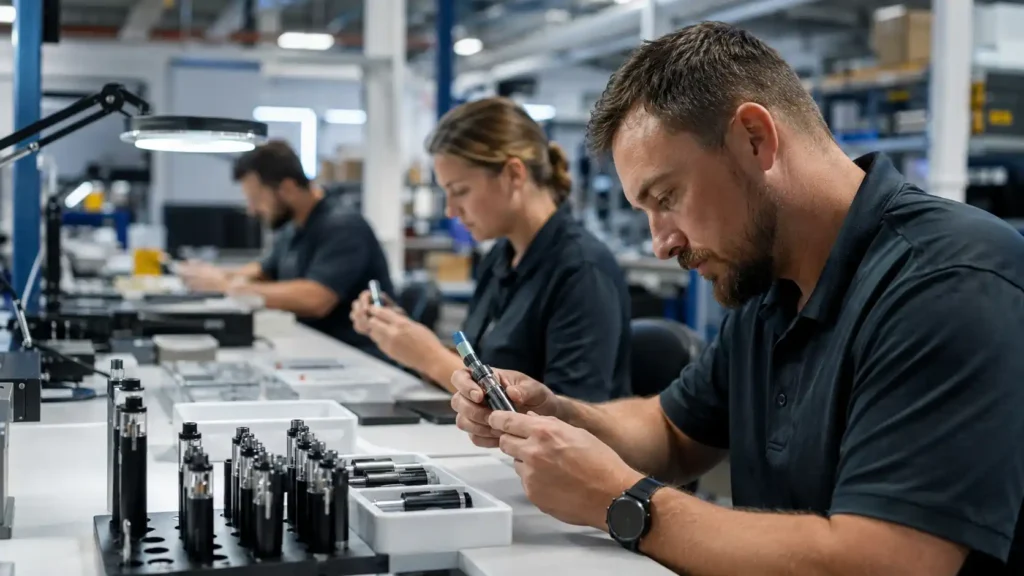
There is no universally safe 21700 cell chosen by capacity or an advertised amp rating alone. A device manufacturer must qualify the cell, electronics, charger and enclosure as a system. This guide concerns OEM engineering, not choosing loose cells for consumer use.
A larger cell format does not make a device inherently safer. Do not substitute cells, bypass protection or use a higher-power setting based on this comparison.
What the 21700 format tells you—and what it does not
The format describes approximate cylindrical dimensions, not an electrical specification. Use the cell drawing and the complete assembly dimensions, including terminals, insulation and any protection parts.
Compared with a smaller format, a 21700 design may offer different capacity and current options. It does not guarantee a particular runtime, current rating or thermal behavior. Those depend on the exact model and device design.
Define the device’s load and charging limits
Record the current drawn from the battery over a complete operating cycle. Output power is not the same as battery input power: conversion losses, battery voltage and controller behavior matter. Qualification must include the lowest permitted battery voltage, repeated operation and the intended ambient conditions.
There is no blanket 30 A requirement for every device. Specify continuous and transient requirements from the actual design, and keep them within the cell manufacturer’s permitted use. Chemistry abbreviations alone are not a safety approval.
- Confirm that the cell manufacturer permits the intended application.
- Use a charger and charge profile approved for the exact cell and assembly.
- Define overcurrent, undervoltage, overtemperature and charging protections with fault responses.
Compare evidence, not a list of recommended brands
A useful evaluation compares complete test conditions and pass/fail criteria. A datasheet current value without its temperature and duration conditions is insufficient.
| Check | Required input | Verification | What it does not prove |
|---|---|---|---|
| Electrical load | Recorded device current and voltage window | Cell and device tests at defined operating limits | A large Ah value does not establish current capability |
| Thermal behavior | Enclosure, repetition rate and ambient range | Temperatures and protection response under the test plan | A larger diameter does not guarantee safety |
| Traceability and documents | Exact model, revision and production lot | Match supplied parts and applicable reports to the approved configuration | An SDS or transport document is not complete device approval |
What to send for an OEM battery assessment
For a custom battery assessment with Hysincere, provide the permitted cell specification, device load records, charging architecture, enclosure drawing and target market. Hysincere’s pack-development work does not constitute blanket approval of a cell for vaping applications.
Agree the qualification scope before sourcing or production. If the cell manufacturer excludes the application, or the device cannot meet the required protection conditions, a larger cell is not a workaround.
Discuss Your Cell Selection and Custom Battery Requirements
Share voltage, capacity, continuous and peak current, dimensions, cycle life, temperature, certification, and annual-volume requirements so Hysincere can evaluate suitable cells and battery-pack options.
For qualified OEM development only. This is not advice to buy loose cells, modify a vape device or bypass its protection. Follow the cell and device manufacturers’ permitted-use instructions.