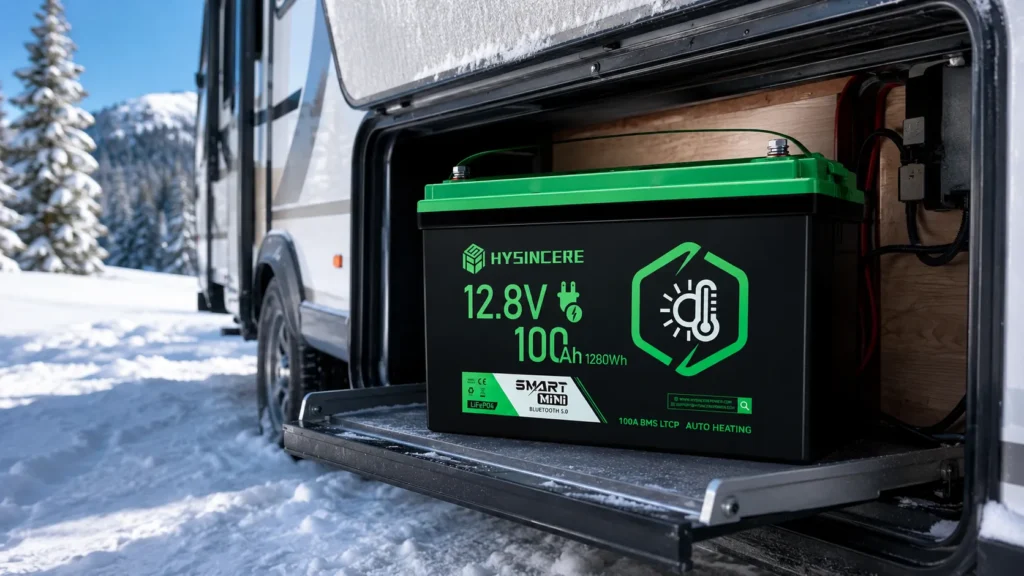
A lead-acid system can be converted to LiFePO4 for cold-weather service, but the design must treat charging and discharging as two different temperature problems. A battery may still power loads in conditions where charging is restricted. If the charger, alternator, or solar controller ignores that distinction, the BMS may repeatedly block charging—or the cells may be exposed to an unacceptable charge condition.
The right solution may be low-temperature charge cutoff, reduced charge current where the battery specifically permits it, internal self-heating, a heated enclosure, or a different battery strategy. The exact temperature thresholds are model-specific and must come from the selected battery documentation.
The practical answer: cold discharge may be available when cold charging is not
Both lead-acid and LiFePO4 batteries lose available performance as temperature falls, but they do not respond in exactly the same way. In many LiFePO4 designs, charging becomes the tighter constraint. A pack may continue to run lights, electronics, a pump, or an inverter while its BMS correctly refuses incoming charge because the cells are too cold.
This surprises operators in three common situations:
- An RV arrives cold, the engine starts, and the alternator or DC-DC charger immediately tries to charge the house battery;
- Morning sun reaches the solar panels while the battery in an outdoor cabinet is still below its permitted charge temperature;
- Grid power returns to an unattended backup site and the charger starts automatically before the battery has warmed.
A successful conversion defines what the system does in each case. It should not depend on someone remembering to unplug a charger on the coldest morning of the year.
Do not combine charge, discharge, and storage temperatures into one number
| Temperature specification | What it governs | Question to ask |
|---|---|---|
| Discharge range | When the battery may supply a load | How much power and capacity remain at the project’s minimum temperature? |
| Charge range | When and at what current the cells may accept charge | Does the BMS stop charge, request lower current, or start heating? |
| Storage range | Permitted temperature while the battery is out of service | For how long, at what state of charge, and with what standby draw? |
| Heater start/stop range | When an internal or external heater is enabled | Which sensor controls it, where does energy come from, and when is charging released? |
| Recovery range | When charge or discharge resumes after temperature protection | Is there intentional hysteresis, delay, or a manual/automatic wake-up requirement? |
The word “operating temperature” is too vague for procurement. A datasheet that does not clearly separate these functions needs clarification before the battery is approved.
What cold changes beyond the BMS temperature alarm
Available energy and voltage under load
At lower temperature, internal resistance rises and available power or capacity can decrease. The result depends on cell design, state of charge, load current, temperature, and how long the battery has been cold-soaked. Size critical winter loads from low-temperature test data, not room-temperature Wh alone.
Startup and surge performance
Inverters, pumps, motors, compressors, and communication transmitters can have a short startup peak. A battery that supports the average load in a warm workshop may reach an overcurrent or low-voltage threshold during a cold start. Compare low-temperature power capability and surge duration with the actual load.
Charging-source behavior
A charger may continue producing voltage while the BMS has blocked the cell charge path. The system must define what the charger reports, whether it retries, and how it resumes after warming. The detailed charger compatibility guide covers profile, equalization, float, temperature compensation, and recovery behavior.
Parasitic consumption during storage
BMS electronics, Bluetooth, displays, communications, heaters, trackers, contactors, and connected equipment can slowly draw energy. In a vehicle or remote cabinet stored for weeks, that consumption can become more important than self-discharge. Define a storage disconnect, inspection interval, and recharge plan that respects the cold-charge restriction.
Self-heating is a control system, not just a heating pad
A well-designed self-heating battery uses temperature sensing and control logic to prevent normal charging until the cells reach the allowed range. Depending on the design, heater energy may come from the charger, the battery, or an external source. These options are not equivalent.
Ask the supplier to explain the full sequence:
- Temperature is measured at a meaningful location.
The controlling sensor should represent cell conditions, not only warm air near the charger or enclosure wall. - The BMS decides whether charging is permitted.
If cells are below the model’s allowed range, charge current is blocked or routed according to the approved heating design. - Heating receives controlled energy.
The source, maximum heater power, fuse/protection, and effect on available charging power are defined. - Charging starts only after the release condition is met.
The design includes a stop temperature, recovery margin, and response if the charger is removed before warming finishes. - Faults remain safe and visible.
A failed sensor, open heater, abnormal temperature rise, or insufficient source should create a documented state rather than silently bypassing protection.
A heater uses energy and time
Assume, only for illustration, that a heater draws 80W for 40 minutes before charging can begin:
The project must account for that energy and the reduced charging power available while warming. Actual heater power and warm-up time vary greatly with battery mass, starting temperature, insulation, airflow, enclosure, and charging source. Do not promise a warm-up time without test data for the selected model and installation.
The cold-weather plan changes with the charging source
| Application | Cold-weather risk | Design questions |
|---|---|---|
| RV / van alternator | Charging begins immediately after engine start while the house battery is cold | Does the DC-DC charger receive a valid low-temperature permission signal? Can it limit or stop current and restart automatically? |
| Boat with shore power | A cold battery compartment may receive continuous charger output | Are starting and service banks separated? How are temperature, charger, heater, ventilation, and moisture managed? |
| Off-grid solar | Panels produce limited morning energy while the cold battery needs heating | Is there enough power to warm and still charge? What happens through several cloudy cold days? |
| Stationary backup | Grid restoration can trigger unattended charging in a cold cabinet | Will the system block charge safely, report status remotely, warm if designed, and return to service without a site visit? |
| Seasonal storage | Parasitic loads may slowly deplete the battery, but the site may be too cold for immediate recharge | What is disconnected, how often is state of charge checked, and where/when can the battery be charged safely? |
See Hysincere’s RV, marine, and cold-weather battery application pages for system directions. The application page is a starting point; the selected model’s temperature and heating specification controls the final design.
Battery enclosure and sensor design can decide whether heating works
- Measure the cold-soaked cell environment. Ambient weather data does not necessarily match the battery temperature inside a box, under a floor, near an engine room, or in an insulated cabinet.
- Control water and condensation. Melting frost, warm humid air, washdown, and salt exposure can affect terminals, electronics, insulation, and connectors. Use the required enclosure and ingress strategy.
- Protect airflow and clearances. Do not pack insulation against components that require cooling, pressure relief, service access, or clearances.
- Place sensors deliberately. A charger-mounted sensor, enclosure air sensor, BMS cell sensor, and remote thermostat may read different temperatures. Define which device has authority to permit charge.
- Review cable loss in the cold. Long cables and connectors can reduce heater and charge power. Verify voltage at the battery under the actual winter current.
- Plan for warm-season operation. Insulation, sealed boxes, and heater controls must not create excessive temperature when weather becomes mild or when the battery is charging at high current.
Hysincere lists a dedicated self-heating battery series within its broader lead-acid replacement range. Confirm heating trigger, power source, charge release, dimensions, BMS current, and communications for the exact project model.
Cold-weather commissioning should recreate the worst credible morning
- Cold-soak the battery and relevant equipment to an agreed test temperature within their permitted storage conditions.
- Record cell/battery, enclosure, and ambient sensors before any load or charger is enabled.
- Apply the defined load and observe voltage, current, power, BMS status, and temperature.
- Connect each real charging source separately, then in combinations that can occur in service.
- Verify charge inhibit, heater start, heater power, warm-up, charge release, and removal/reconnection of the source.
- Test low state of charge, insufficient heater input, sensor fault, communication loss, and unattended recovery.
- Repeat the critical tests at warm temperature to confirm that insulation and heating changes did not create a summer problem.
- Save logs and use them as acceptance evidence for the sample, charger settings, and installation.
Prepare this information for a cold-weather conversion inquiry
- Application, existing lead-acid battery, system voltage, load, surge, and required runtime;
- Minimum battery temperature during charging, discharge, and storage—not only regional air temperature;
- Duration of cold soak and number of consecutive cold/cloudy days expected;
- AC charger, alternator/DC-DC, solar controller, inverter/charger, and their available current;
- Whether charging must begin automatically and how quickly the system must return to service;
- Battery-bay dimensions, insulation, airflow, moisture, salt, dust, vibration, and cable length;
- Low-temperature cutoff, self-heating, display, Bluetooth, CAN, RS485, alarm, and remote-monitoring needs;
- Series/parallel arrangement, target market, certification, sample test, annual volume, and acceptance criteria.
Design around the coldest charge event, not the average winter day
Send Hysincere the actual battery-bay temperature, cold-soak duration, charging sources, available heater power, load and surge, runtime, enclosure, and monitoring requirements. Those details allow the battery, BMS, heating strategy, charger, and test plan to be evaluated together.
Cold-weather lead-acid to LiFePO4 conversion FAQ
Can LiFePO4 batteries discharge below freezing?
Many models can discharge at temperatures where charging is restricted, but available power and capacity may be lower. The permitted temperature, current, and duration are model-specific. Use low-temperature performance data for the selected battery and validate the real load.
Can a LiFePO4 battery be charged below 0°C / 32°F?
Do not apply one universal answer. Many standard designs restrict charging around freezing; some permit reduced current, and self-heating models can warm before charging. Follow the exact battery specification and BMS logic rather than bypassing temperature protection.
Does self-heating mean the battery can charge immediately in any cold weather?
No. Heating needs a defined energy source and time, and the battery starts normal charging only after its release condition is reached. Warm-up depends on battery mass, starting temperature, insulation, enclosure, heater power, and available charger power.
Is insulation enough without a heater?
Insulation slows temperature change but does not create heat. It may keep a recently operated battery warm for longer, yet a cold-soaked battery will remain cold without another heat source. The enclosure must also avoid overheating and moisture problems in warmer conditions.
What happens when solar power arrives but the battery is too cold to charge?
The system should block cell charging and, if designed for it, use available input to warm the battery before releasing charge. Confirm controller behavior, heater priority, available morning power, status reporting, and recovery through several low-sun days.
Temperature limits and self-heating behavior are model-specific. Final installation and settings must follow the selected battery, BMS, charger, vehicle, vessel, solar, inverter, and enclosure documentation plus applicable local requirements.