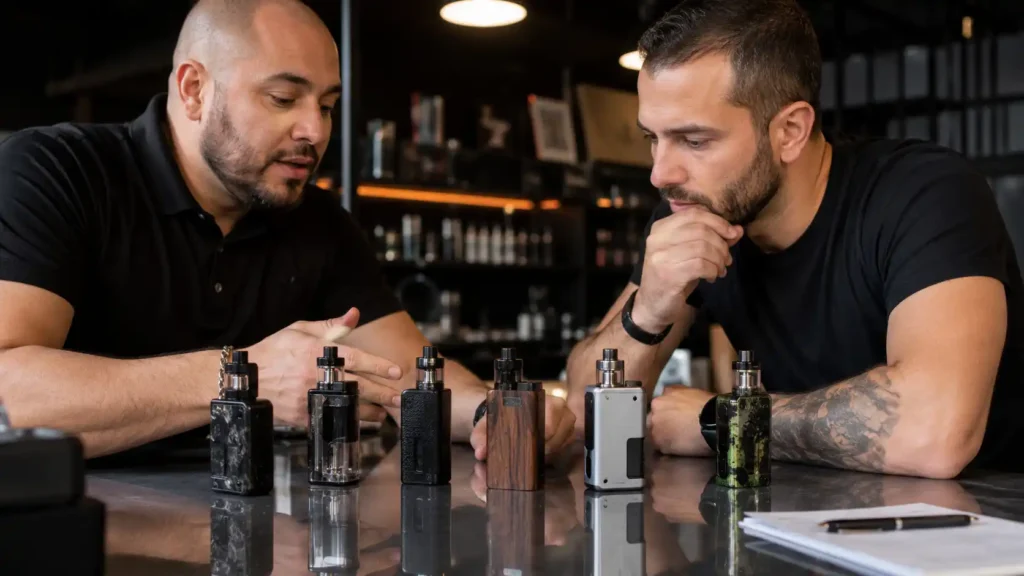
For a device using 21700 cells, the relevant questions are which cell is approved, how much current the device draws and how its protection works. The cell format alone does not establish output power, runtime or safety.
This guide compares Boro, mechanical, Squonk and dual-cell designs for manufacturers and technical buyers. It focuses on construction and procurement checks rather than recommending a particular device or cell.
1. Why Choose a 21700 Mod?
The larger 21700 format can accommodate more active material than 18650. The benefit depends on the actual cell and device:
- Capacity: Compare usable energy at the intended current and temperature. A larger cell does not guarantee longer runtime in a device that also draws more power.
- Current: Check the continuous discharge rating and its temperature limits for the exact model. Do not substitute an unspecified pulse rating.
- Voltage under load: Internal resistance, contacts, state of charge and temperature affect voltage drop. Evaluate the complete device at its intended load.
Before procurement, confirm the approved cell, contact shape, actual dimensions, charging method and evidence for the complete device configuration.
2. Understanding 21700 Boro Mods
A Boro mod combines a battery compartment and a tank system in one enclosure. This describes its construction, not a safety approval or a recommendation to modify the device.
Features of a 21700 Boro Mod
- A tank and battery compartment share the enclosure.
- Changes to components can change the device’s electrical and thermal risks.
- Room for an approved 21700 cell; runtime depends on usable energy and operating power.
Boro Construction and Safety
A replaceable tank does not make other parts interchangeable. Do not treat the device’s form factor as permission to alter its components.
3. Mechanical 21700 Mods: Design and Protection
A mechanical mod connects the cell and atomizer through a mechanical circuit. Electronic power regulation and protective functions may be absent. A high-current cell alone does not make this configuration safe; evaluate the exact device design and its approved cell.
Advantages & Safety Considerations
- Electrical load: The complete circuit determines current. Cell limits, contacts, insulation and the approved configuration must be assessed together.
- Mechanical construction: Fewer electronic parts do not guarantee reliability. Contact wear, accidental activation and damaged insulation remain relevant failure modes.
- Protection: Use only a cell specifically approved for the device. A continuous discharge rating does not protect against a short circuit or an installation fault.
Procurement check: Request the device documentation, exact cell specification and evidence for the approved combination. Do not assume that pairing a mechanical mod with any high-current cell establishes safety.
4. 21700 Squonk Mods: Reservoir Construction
A Squonk device includes a liquid reservoir within the enclosure. Liquid containment, electrical insulation and the condition of the complete device are safety concerns; the reservoir is not a performance or safety guarantee.
Features of the Reservoir Design
- Liquid is supplied from an integrated reservoir rather than only by manual filling at the atomizer.
- Reservoir volume, filling and cleaning arrangements are model-specific.
- The 21700 cell must be approved for the actual electrical load; its format does not establish a full-day runtime.
5. Devices with Two 21700 Cells
Two comparable cells can store more energy than one. In series, voltage adds while the Ah rating stays the same; in parallel, Ah adds at the same voltage. Use only the configuration designed by the device manufacturer, without changing its wiring.
Advantages of Dual 21700 Setups
- Output power: Cells, electronics, contacts and temperature limits determine the permissible output. Two cells do not establish a particular wattage.
- Runtime: More stored energy can extend operation, but higher power consumption can offset the benefit. A fixed number of days cannot be inferred from cell count.
- Procurement: Check the approved cell pair, matching requirements, charging arrangement and protection. Two cells do not automatically make a device safe.
6. Summary of Device Construction
The table summarises construction differences and safety concerns. It is not a buying recommendation or a guide to modifying a device.
| Mod Type | Construction | Safety Context |
|---|---|---|
| 21700 Boro Mod | Integrated tank and battery enclosure | Component changes can alter electrical and thermal behaviour. |
| 21700 Mech Mod | Projects with an explicitly approved mechanical design | Confirm the exact circuit, contacts and missing or available protection. |
| 21700 Squonk Mod | Integrated liquid reservoir | Liquid containment and electrical insulation need attention. |
| Dual 21700 Mod | Two-cell battery compartment | Confirm cell pairing, charging, permitted load and temperature limits. |
Keep Device Safety Separate from Cell Size
Whether the device uses Boro, mechanical, Squonk or dual-cell construction, compare its requirements with the exact cell specification. Device type alone does not determine the right battery.
Do not use a damaged cell or assume that a higher current rating replaces device protection. Follow the complete device’s safety documentation and stop using equipment with damaged insulation, abnormal heat or other faults.
Discuss Your Cell Selection and Custom Battery Requirements
Share voltage, capacity, continuous and peak current, dimensions, cycle life, temperature, certification, and annual-volume requirements so Hysincere can evaluate suitable cells and battery-pack options.
Misuse of lithium cells can cause fire, overheating, or injury. Use only cells approved for the device, follow the device and cell manufacturers’ current and temperature limits, inspect wraps and insulators, and use a suitable charger. This article is for B2B technical reference and does not replace model-specific safety documentation.