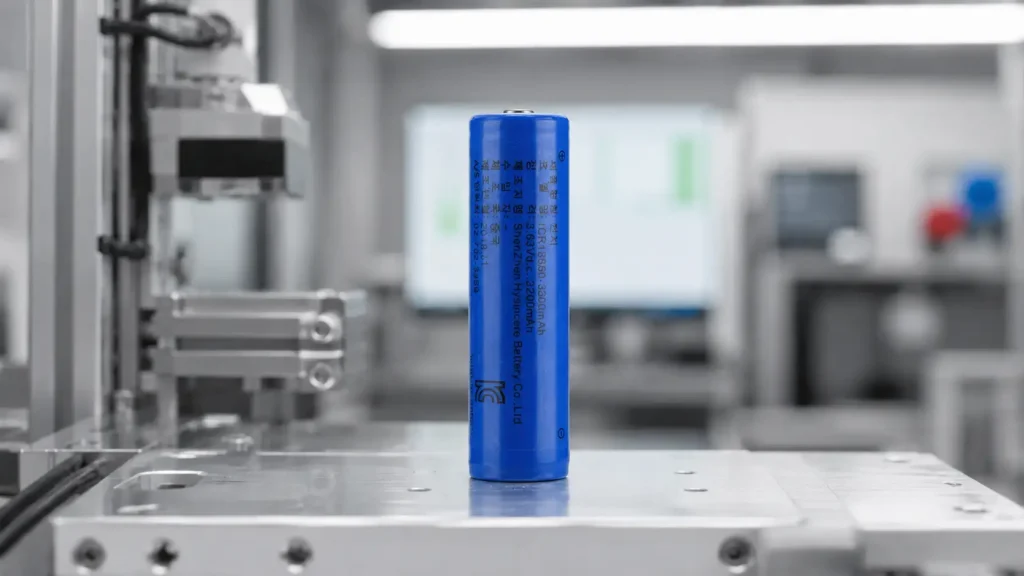
A suitable 18650 cell is one that meets the device requirements and can be supplied consistently in the approved configuration. A familiar label or a promising sample does not establish the quality of every production lot.
For an OEM pack, qualification needs two linked decisions: whether the cell works in the design, and whether incoming deliveries remain equivalent to the approved sample.
Start with an identifiable, testable specification
Record the exact cell designation, revision, supplier, production lot and manufacturer’s permitted use. Keep the approved datasheet and drawing with the project specification. Cell appearance is useful for inspection, but wrapper color cannot prove identity or authenticity.
Define capacity, resistance, voltage and dimensional checks with their measurement conditions. Resistance measured by different instruments or methods cannot simply be compared as though it were the same value.
- Use the same state of charge, temperature and rest period for comparable electrical checks.
- Set acceptance limits from the approved design and qualified cell data, not arbitrary universal tolerances.
- Quarantine unexplained changes in markings, dimensions or measured behavior.
Separate sample qualification from production inspection
Development tests show whether the candidate can meet the intended duty. Incoming inspection checks whether a delivered lot matches the approved specification. Neither replaces the other.
A sampling plan can miss isolated defects, so retain traceability and process controls alongside testing. Do not call a lot qualified solely because one cell reached its labeled capacity.
| Stage | Purpose | Useful record | Boundary |
|---|---|---|---|
| Development samples | Evaluate the intended load, charge and environment | Test setup, raw results and failure criteria | A sample result does not qualify every future lot |
| Incoming inspection | Check delivery consistency | Lot identity and agreed inspection results | A quick voltage check is not complete qualification |
| Completed pack | Verify the integrated assembly | Electrical, protection and mechanical test records | Cell-level evidence does not prove complete pack compliance |
Validate matching and protection in the actual pack
Cells in a pack must be selected and grouped using the approved process. Matching initial capacity or resistance alone does not guarantee identical aging. Check the assembled pack’s voltage behavior, temperature, protection response and current distribution where parallel cells are used.
The BMS is part of the protection architecture, not a cure for unsuitable or damaged cells. Wiring, fuses, connections, insulation and mechanical support must also fit the design. After a cell, BMS or layout change, assess which validation results need to be repeated.
Specify what Hysincere should verify before production
For Hysincere custom pack development, provide your operating window, load profile, installation drawing and acceptance requirements. Agree the cell configuration and required reports for that project; this is not a promise that every product carries the same certification.
Before a repeat order, confirm whether the approved bill of materials has changed. Ask for the change description, affected lots and validation decision rather than accepting an undocumented substitution.
Discuss Your Cell Selection and Custom Battery Requirements
Share voltage, capacity, continuous and peak current, dimensions, cycle life, temperature, certification, and annual-volume requirements so Hysincere can evaluate suitable cells and battery-pack options.
Frequently Asked Questions
Does a matching wrapper prove that cells are genuine?
No. Use a traceable supply chain, exact model records and appropriate incoming inspection. Appearance alone cannot authenticate a cell.
Can the same resistance limit be used for every tester?
Not without checking the method and conditions. Instrument type, state of charge, temperature and rest time can affect the result. Define the method in the acceptance specification.
Does a BMS make an unsuitable cell acceptable?
No. The cell must meet the intended duty. The BMS, wiring, fuses, insulation and mechanical design must then be validated as an integrated system.
Acceptance limits and test scope are model- and application-specific. No universal cell rating, certification or production-lot guarantee is implied.