If your team already has a battery design, you need a manufacturer that can review it, build it and keep production consistent. If you know what the equipment needs but do not yet have a battery design, you need more engineering input from the supplier.
That is the practical starting point for choosing between OEM and ODM battery packs. The terms help describe a project, but they do not replace a clear agreement about who designs, tests and approves the battery.
What OEM and ODM usually mean for battery projects
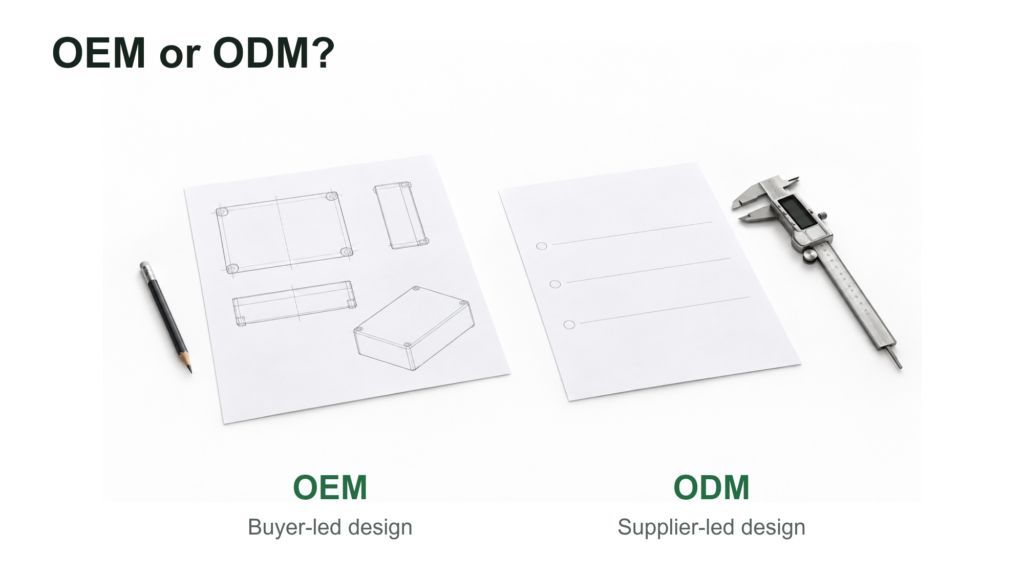
OEM stands for Original Equipment Manufacturer; ODM stands for Original Design Manufacturer. In battery sourcing, an OEM arrangement often starts with buyer-defined specifications or a buyer-led design. In an ODM arrangement, the supplier usually contributes the underlying battery design or an existing platform that can be adapted.
The usage varies between suppliers. An OEM project may still involve substantial supplier engineering, and an ODM project can require more work than changing a label. Descriptions such as ACE Battery’s OEM/ODM comparison show how buyer designs and supplier platforms lead to different starting points, but its commercial terms should not be assumed to apply elsewhere.
A useful first question is: what part of the battery design is already decided, and who will finish the rest?
| Project question | Buyer-led design, often called OEM | Supplier-led design, often called ODM |
|---|---|---|
| Starting point | Buyer specifications, drawings or a defined battery design | Equipment requirements and a supplier design or platform |
| Engineering task | Review the design and resolve gaps before manufacture | Select or develop a design that meets the equipment needs |
| Buyer’s role | Provide current, approved design documents and approve agreed changes | Define performance and integration requirements; approve the proposed design |
| Sample approval | Verify the build against the agreed design and real equipment | Verify the proposed solution against the same agreed requirements |
| Commercial details | Confirm scope, charges, documentation and change control | Confirm the same details, including limits on platform changes |
Start with the information you already have
You have a developed battery design
Provide the current drawings, specification, component requirements and relevant test results. Identify which parts are fixed and which may be changed. A manufacturer still needs to check whether the design can be built consistently and whether any missing details affect performance.
A voltage, an Ah value and an outline drawing are useful inputs, but they do not necessarily make a production-ready design. BMS settings, connections and acceptance limits may still need work.
A standard battery is close to what you need
An existing platform may be the most practical starting point. Separate presentation changes, such as an agreed label, from changes that affect the electrical or mechanical design.
Moving a terminal, changing a connector or adding a communication requirement can affect more than appearance. Have the supplier explain what needs checking again before describing the change as minor.
You have an equipment requirement, but no battery design
Describe what the equipment must do: its voltage range, working and startup load, available space, charging method and required runtime. The supplier can then assess whether an existing battery fits or whether design work is needed.
For a LiFePO4 lead-acid replacement, start with the available replacement battery range. If the fit or interface requires changes, use the custom battery engineering process to define that work.
Agree on responsibilities before ordering samples
Before placing a sample order, put the important responsibilities in writing. Who supplies and approves the drawings? Who defines BMS settings? Who provides the charger or equipment information? Who carries out each test, and who decides whether the sample passes?
Also confirm what documentation will be delivered and how drawings, firmware versions or tooling will be handled. The words OEM and ODM alone do not establish ownership, access rights or permission to reuse a design.
Be specific about interfaces. A requirement for CAN or RS485 should include the messages, data and equipment behavior expected, not only the interface name. A connector drawing should include the agreed pin assignment, not just a photograph of its shape.
When a requirement is still unknown, identify who will supply it and when. A short list of unresolved inputs is more useful than a quotation based on different assumptions on each side.
Ask what drives the price and schedule
An existing design can reduce some development work, but ODM does not automatically mean a short lead time. A buyer-led design may already be well validated, while a change to a supplier platform may need new components or additional testing.
Ask the supplier to separate battery unit price from any engineering, tooling, sample, testing and documentation charges. Confirm which costs apply once and which repeat with each order or design revision.
Minimum order quantity can also depend on what changes. A label requirement, a different enclosure and a new electronic configuration need not have the same purchasing or production constraints.
Request a schedule with clear milestones: design review, sample build, equipment testing, any corrections and readiness for production. A date that leaves no time to test the sample may not be a useful delivery commitment.
Approve the sample in the equipment it will power
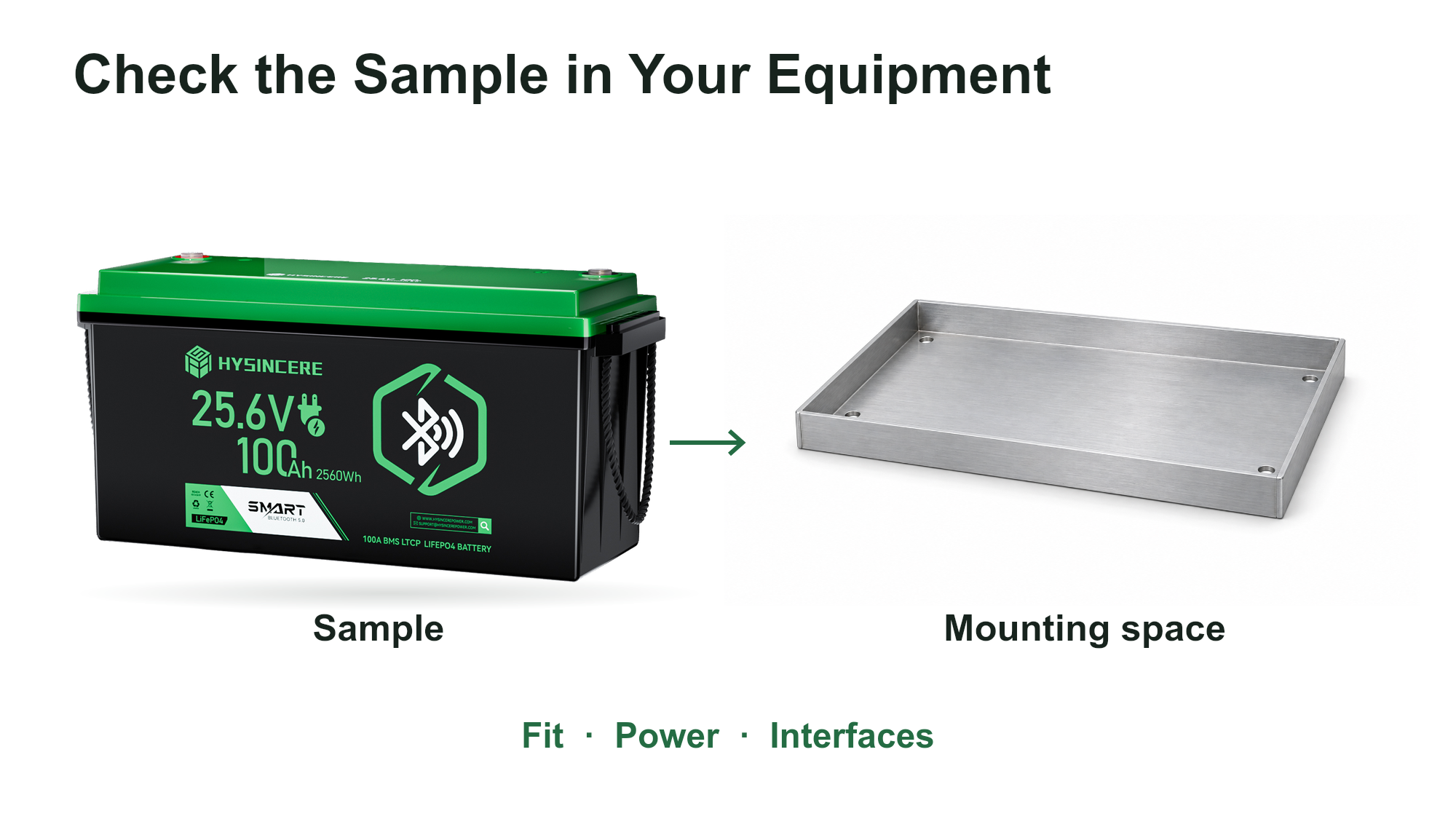
Consider an illustrative project: a buyer needs a 24V-class LiFePO4 battery that fits an existing battery tray. One proposal adapts a supplier’s standard battery; another builds to the buyer’s drawing. Either proposal still needs to meet the same installation, operating and charging requirements.
The LF24100N-B photo below shows a 25.6V 100Ah Bluetooth battery beside an illustrative tray. It is not a record of an approved installation. If the equipment requires CAN or RS485, confirm that separately; Bluetooth monitoring does not establish compatibility with those interfaces.
A sample that charges on the bench may still fail to start the equipment, fit the tray with its cables attached or report the information the controller expects. Sample approval should therefore include the real operating conditions where practical.
Agree on the required voltage window, continuous and startup loads, charging behavior, mechanical fit and any display or communication functions. Record the results against the exact sample configuration.
If a test reveals a problem, record the change and repeat the affected checks. The LiFePO4 OEM and bulk buying guide provides a broader checklist for comparing the battery itself; this approval record connects those requirements to the supplied sample.
Keep repeat orders tied to the approved configuration
Once the sample is accepted, identify the version that production must follow. Depending on the project, that record can include the battery specification, drawings, agreed components, BMS configuration, connectors, labels and test limits.
Ask how component substitutions and configuration changes will be communicated. An apparently equivalent part can affect fit, performance or documentation, so the approval process should be agreed before an urgent production decision is needed.
Discuss the target market and required documents with the supplier using the exact configuration. A report associated with a base model should not be assumed to cover every modified battery. Confirm which evidence applies and who will resolve any gaps.
Hysincere’s custom lithium battery solutions page explains the available design, BMS and enclosure integration, prototype testing and production support. Send the information you already have, describe what still needs to be developed, and state your expected order volume. That gives the discussion a concrete starting point, whichever sourcing label you use.
Tell us what is already defined
Send your existing drawings or equipment requirements, and explain which parts of the battery project need engineering support.
Frequently Asked Questions
Do OEM and ODM mean the same thing as custom and standard batteries?
Not exactly. OEM and ODM describe how design and manufacturing work are organized. A standard platform can be part of an ODM project, while either arrangement may involve customization.
Do I need complete drawings before contacting a battery supplier?
No. If the design is not developed, provide the equipment requirements and identify what is still unknown. The supplier can assess the engineering work needed rather than assuming the pack is ready for manufacture.
Is an ODM battery always cheaper or faster?
No. Reusing a suitable platform can reduce development work, but changes, component availability and testing still affect cost and schedule. Compare the actual work included in each proposal.
Can I add my brand to a standard battery without changing its design?
Label and packaging work may be possible within an agreed scope. Confirm exactly what changes and whether any product information or documentation needs updating. Branding alone does not establish a new electrical design.
Who owns the battery drawings in an OEM or ODM project?
The label alone does not answer that. Agree on ownership, access and permitted use of the relevant drawings, firmware and tooling in the project documents before work begins.