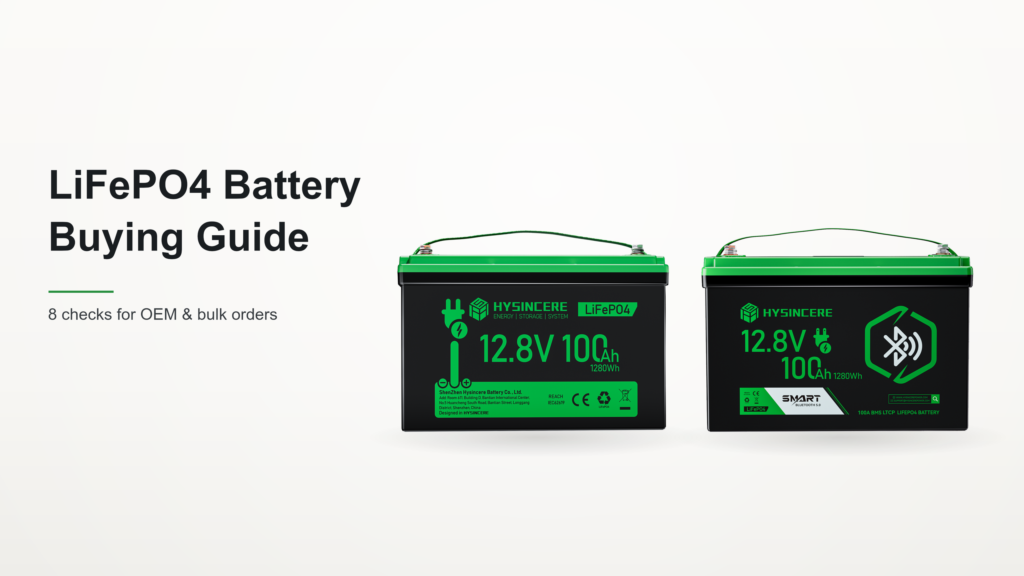
Buying LiFePO4 batteries for an OEM product, distribution program or bulk project requires more than comparing voltage, Ah and unit price. The correct battery must match the electrical system, load profile, charging method, installation space, operating environment and commercial requirements of the project.
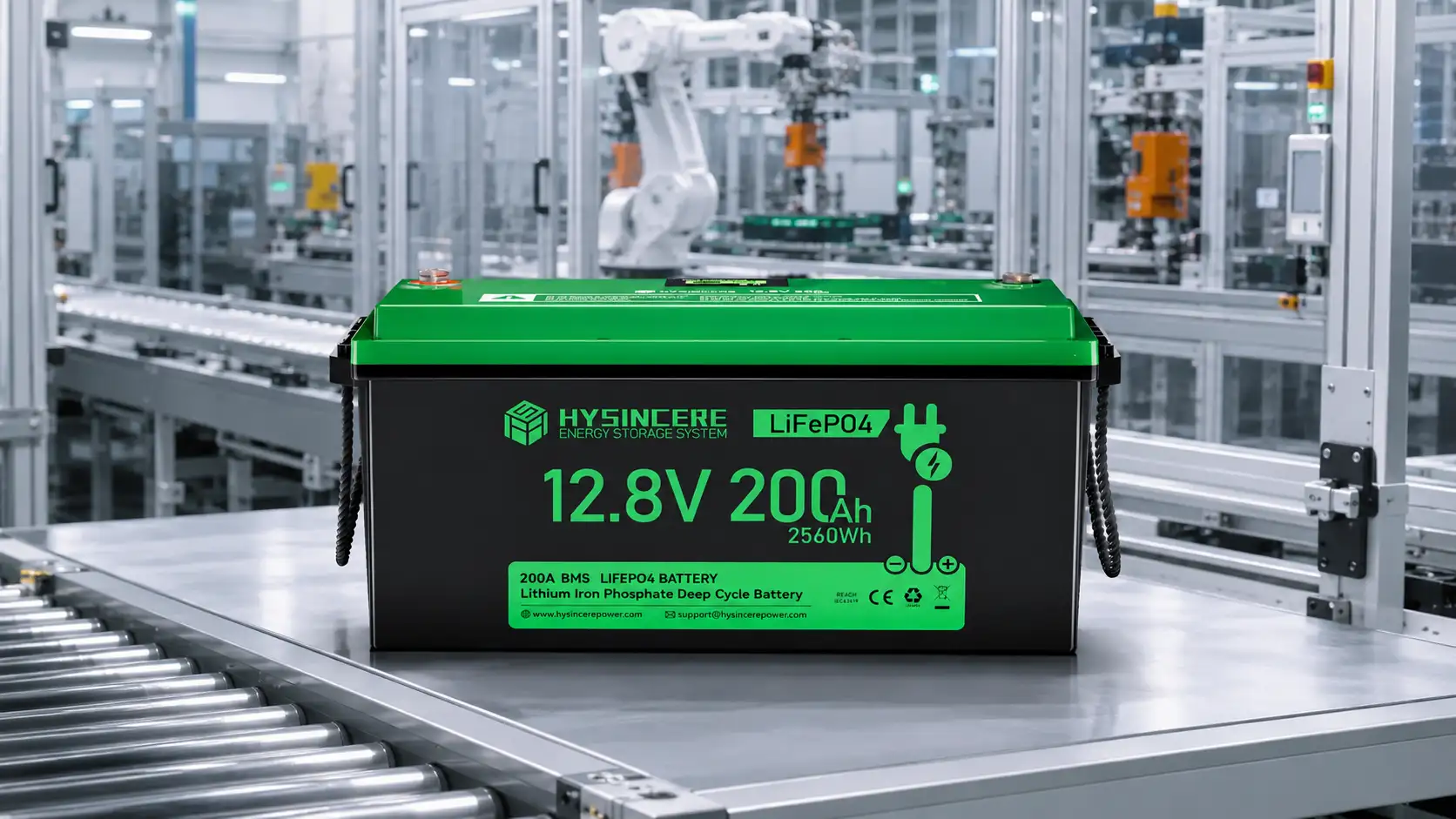
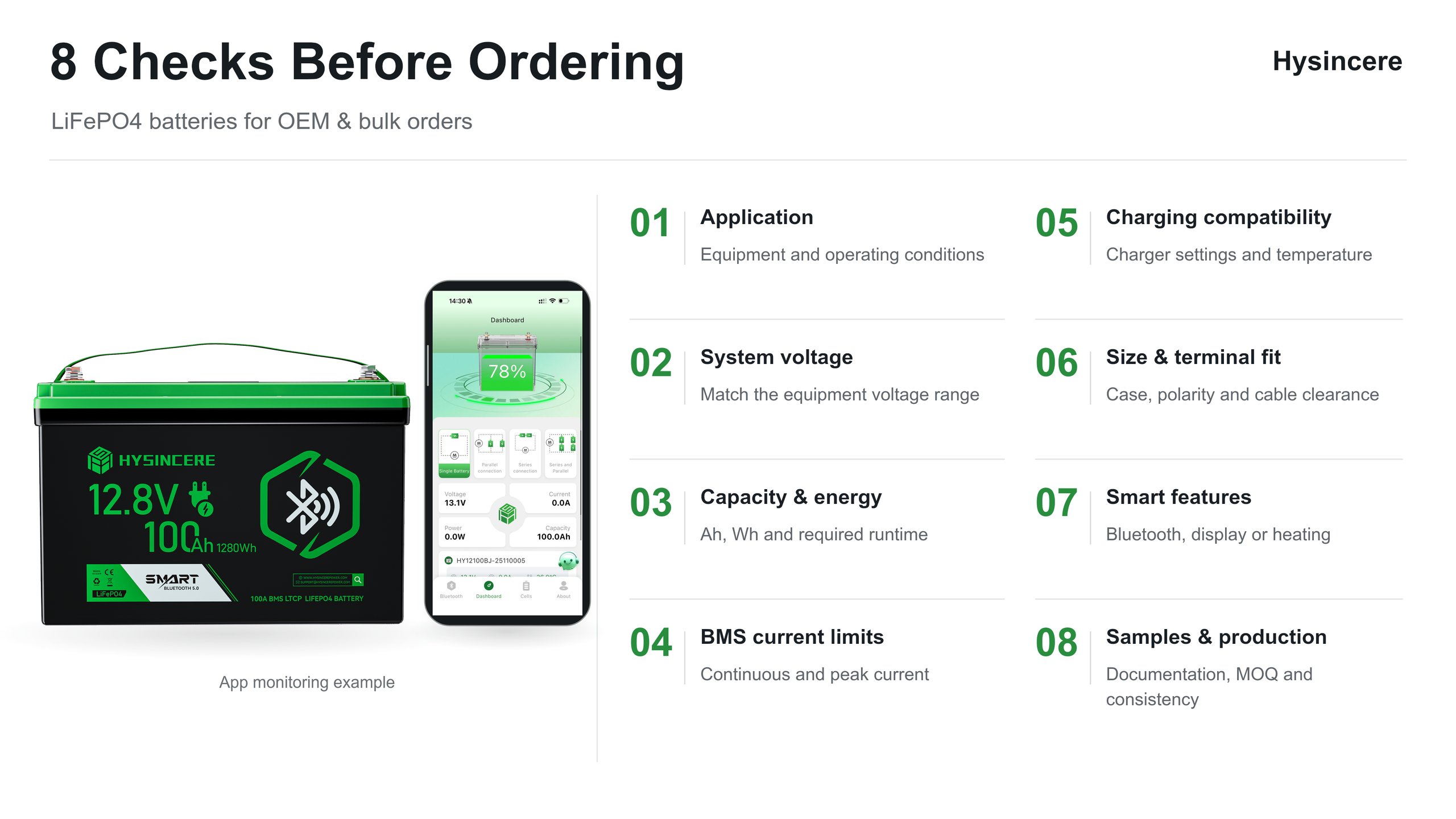
Two batteries may both be labeled 12V 100Ah while using different BMS current limits, peak-current capability, enclosure sizes, terminals, smart functions and production configurations. This guide covers eight areas B2B buyers should check before approving a sample or placing a bulk LiFePO4 battery order.
1. Define the Application Before Choosing a LiFePO4 Battery
The first purchasing question should not be “Which 100Ah battery is cheapest?” It should be “What does the battery need to do inside the actual system?”
A battery used for low-power backup equipment has very different requirements from one powering an inverter, electric motor, marine system, RV, industrial device or mobile equipment.
| Project item | Information to prepare | Why it matters |
|---|---|---|
| Application | Equipment type and operating scenario | Defines the actual battery duty |
| System voltage | 12V, 24V, 36V, 48V or other architecture | Determines the battery voltage platform |
| Runtime | Required operating time between charges | Helps determine required energy |
| Continuous load | Normal current or power draw | Determines continuous BMS requirements |
| Peak load | Motor start, inverter surge or other transient load | Determines peak-current requirements |
| Charging system | Charger, alternator, solar controller or inverter-charger | Determines charging compatibility |
| Installation | Maximum dimensions, terminals and cable routing | Confirms mechanical fit |
| Commercial requirement | Sample quantity, forecast volume and destination market | Helps determine the supply and customization path |
For replacement projects: if you are replacing an AGM, GEL or flooded lead-acid battery, also provide the original battery label and charger model. You can compare your requirements with Hysincere’s LiFePO4 lead-acid replacement battery range.
2. Choose the Correct Battery Voltage
Battery voltage should follow the system architecture. Capacity should not be used to compensate for an incorrect voltage platform.
Common LiFePO4 nominal battery platforms include:
| System class | Typical LiFePO4 nominal voltage | Typical consideration |
|---|---|---|
| 12V-class system | 12.8V | Common in RV, marine, backup and equipment applications |
| 24V-class system | 25.6V | Reduces current compared with a similar-power 12V system |
| 36V-class system | 38.4V | Used in selected mobility and equipment platforms |
| 48V-class system | 51.2V | Common in higher-power and energy-storage systems |
Nominal voltage is only the starting point. Buyers should also confirm the complete charging and discharging voltage window supported by the battery and connected equipment.
Do not assume batteries can automatically be connected in series or parallel. The selected battery model and BMS must explicitly support the intended configuration.
3. Compare Capacity and Usable Energy, Not Ah Alone
Amp-hours are useful, but Ah alone does not describe the total energy available to the equipment.
A simple energy calculation is:
Energy (Wh) = Nominal Voltage (V) × Capacity (Ah)
For example, a nominal 12.8V 100Ah battery contains approximately 1280Wh of nominal energy, while a 25.6V 100Ah battery contains approximately 2560Wh.
For B2B projects, the more useful questions are:
- How many watt-hours does the equipment require?
- How much runtime is required?
- What reserve margin is needed?
- Will the battery operate under high current?
- What are the inverter and system losses?
A larger Ah rating does not solve a current-limit problem. A battery can contain enough energy for the required runtime but still be unsuitable if the BMS cannot support the load.
4. Check BMS Continuous and Peak Current
The Battery Management System is one of the most important specifications in a commercial LiFePO4 battery project.
When comparing batteries, buyers should separately confirm:
- maximum continuous discharge current;
- peak discharge current;
- how long the peak current is allowed;
- continuous charging current;
- over-current protection behavior;
- temperature protection requirements.
This becomes particularly important for applications using motors, pumps, compressors, inverters and other loads with high startup demand.
For example, two 100Ah batteries may contain similar stored energy but use different BMS current ratings. They should not automatically be treated as equivalent products.
If your project includes a high-power inverter, review the LiFePO4 battery sizing guide for 1000W, 2000W and 3000W inverters before finalizing the required BMS current.
5. Verify Charger and System Compatibility
The battery cannot be evaluated separately from the charging system.
Depending on the application, charging may come from:
- an AC battery charger;
- an alternator;
- a solar charge controller;
- an inverter-charger;
- an onboard DC charging system;
- other equipment-specific power electronics.
Provide the supplier with the charger model or charging parameters and confirm:
- maximum charging voltage;
- maximum charging current;
- charging stages;
- equalization settings;
- temperature compensation;
- low-temperature charging behavior.
A charger originally designed for lead-acid batteries should not automatically be assumed compatible with every LiFePO4 battery.
The battery, charger, inverter, controller and equipment should be reviewed as one system.
6. Confirm Dimensions, Terminals and Installation Space
Mechanical fit is a purchasing specification, not only an installation issue.
Before approving a battery, confirm:
- case length;
- case width;
- case height;
- terminal height;
- positive and negative terminal position;
- terminal type;
- cable clearance;
- handle clearance;
- mounting or hold-down method;
- service and removal space.
A battery can match the electrical specification and still fail the project because of mechanical interference. Check the complete installation envelope rather than only the nominal case dimensions.
For retrofit projects, the battery measurement guide for LiFePO4 replacement explains how to measure the enclosure, terminals and installation clearance before sample approval.
7. Select Smart Features According to the Application
Additional features should solve a defined project requirement rather than simply increase the number of specifications on the datasheet.
| Feature | Where it may add value | What buyers should verify |
|---|---|---|
| Bluetooth monitoring | RV, marine, fleet and service applications | Available data, app support and service expectations |
| LCD display | Equipment requiring local battery-status information | Display position, visibility and enclosure integration |
| Self-heating | Cold-region charging applications | Heating logic, trigger temperature and available charging power |
| Custom terminals | Existing equipment interfaces | Current rating, polarity and cable routing |
| Communication | Integrated equipment and intelligent energy systems | Required protocol, interface and system compatibility |
Hysincere’s current battery platforms include standard, smart display, Bluetooth and self-heating configurations. For projects requiring a different interface or product structure, additional requirements can be evaluated through the custom lithium battery solutions process.
8. Check Samples, Compliance, MOQ and Production Readiness
The final purchasing decision should evaluate the supplier’s ability to deliver the same approved configuration consistently—not only whether one sample works.
Sample validation
For OEM and equipment projects, test the sample in the real system whenever possible.
Depending on the application, sample validation may include:
- mechanical installation;
- charging compatibility;
- continuous load;
- peak or startup load;
- temperature conditions;
- Bluetooth or display functions;
- communication;
- accessories and wiring.
Documentation and target market
Tell the supplier the destination market during the quotation stage. Required technical and shipping documentation can vary according to model, configuration, market and transportation method.
Confirm which documents and reports apply to the exact battery configuration being purchased rather than assuming documentation for one model automatically covers another customized version.
MOQ and production terms
Ask whether MOQ changes according to:
- standard battery configuration;
- custom labels;
- custom packaging;
- terminal changes;
- custom enclosure;
- BMS or electronic changes.
Configuration control
Once the sample is approved, the final product specification should be clearly recorded. For repeat orders, the buyer should know how the supplier controls changes to important components and settings.
A good sample is only the beginning. For long-term OEM and distribution programs, repeatability between the approved sample, pilot order and future production batches is equally important.
Standard LiFePO4 Battery or Custom OEM Battery?
A standard LiFePO4 battery is usually the better choice when an existing model already matches:
- voltage;
- required energy;
- continuous and peak current;
- charging system;
- installation dimensions;
- terminals;
- temperature conditions.
OEM or semi-custom development becomes more appropriate when the project requires changes to the enclosure, terminals, connectors, BMS, communication, smart functions, branding or equipment interface.
The objective should not be to customize as much as possible. The objective is to use the simplest battery configuration that fully meets the technical and commercial requirements.
What to Send a LiFePO4 Battery Supplier for an Accurate Quote
A structured RFQ makes supplier comparison much easier.
- Application: describe the equipment and use case.
- System voltage: provide the required voltage architecture.
- Capacity or runtime: provide Ah, Wh or expected operating time.
- Continuous load: provide normal current or power.
- Peak load: provide startup or surge current and duration.
- Charging: provide charger, inverter or controller specifications.
- Installation: provide maximum dimensions, terminals and cable routing.
- Environment: provide charging and discharging temperature ranges.
- Features: specify Bluetooth, display, heating, communication or other requirements.
- Commercial information: provide sample quantity, estimated order volume, destination market, packaging and branding requirements.
This information allows the supplier to determine whether an existing product can be used or whether the project should move into an OEM/ODM development process.
LiFePO4 Battery Projects With Hysincere
Hysincere supports LiFePO4 battery projects covering standard battery platforms and OEM/ODM requirements, including BMS integration, terminals, enclosure dimensions, smart battery functions, prototype testing and production preparation.
For applications specifically replacing AGM, GEL or other lead-acid batteries, buyers can first review the lead-acid replacement battery range.
For projects requiring a different electrical, mechanical or functional configuration, review the custom lithium battery solutions process before submitting the project specifications.
Prepare the application, voltage, capacity, load, charging system, dimensions, temperature, destination market and expected quantity before requesting a quotation. Complete project information helps shorten the selection process and reduces unnecessary sample revisions.
Planning an OEM or Bulk LiFePO4 Battery Project?
Send us your application, system voltage, required capacity or runtime, continuous and peak load, charger or inverter information, installation dimensions, operating temperature, target market and expected order quantity. Hysincere can review whether a standard battery platform fits or whether your project requires an OEM/ODM configuration.
LiFePO4 Battery Buying FAQ
Common questions from OEMs, distributors and project buyers when sourcing LiFePO4 batteries for equipment integration and bulk orders.
What information should I send when requesting a LiFePO4 battery quote?
Provide the application, system voltage, required capacity or runtime, continuous and peak current, charger or inverter specifications, maximum installation dimensions, terminal requirements, operating temperature, destination market, sample quantity, expected order volume and any OEM requirements. Complete project information allows the supplier to recommend a more appropriate battery configuration.
How do I choose between 12V, 24V, 36V and 48V LiFePO4 batteries?
Choose the battery voltage according to the equipment or system architecture rather than battery capacity alone. Common LiFePO4 platforms include approximately 12.8V, 25.6V, 38.4V and 51.2V nominal systems. The battery operating voltage, charger, inverter, controller and connected equipment should all be checked for compatibility before selection.
Is Ah capacity enough to choose a LiFePO4 battery?
No. Amp-hour capacity describes charge capacity but does not define whether the battery can supply the required load. Buyers should also check usable energy, system voltage, continuous discharge current, peak current, BMS limits, required runtime and charging conditions.
When should I choose a custom LiFePO4 battery instead of a standard model?
A standard model is usually preferable when voltage, capacity, BMS current, dimensions, terminals and charging conditions already match the project. Customization becomes useful when equipment requires a different enclosure, terminal arrangement, current capability, connector, communication function, Bluetooth, display, heating or other application-specific features.
What should be verified before placing a bulk LiFePO4 battery order?
Before mass production, verify the approved sample configuration, electrical performance, charging compatibility, dimensions, terminals, required functions, documentation, packaging, labeling, quality-control requirements, MOQ, production lead time and change-control process. The approved specification should be clearly defined so future production remains consistent.
Technical note: LiFePO4 battery suitability depends on the exact equipment, system voltage, load profile, charger or inverter settings, wiring, protection devices, installation conditions, temperature, destination-market requirements and selected battery model. The examples in this article are intended for project screening and procurement planning and do not replace model-specific datasheets, engineering validation, compliance requirements or installation instructions.