Before requesting a bulk quote for LiFePO4 RV batteries, establish three things: which loads the battery must supply, the space available for installation, and how it will be recharged. Batteries with the same capacity can have different current limits, terminal positions and charging requirements. A successful sample installation in one vehicle does not establish compatibility with a different inverter or battery compartment.
This checklist helps RV manufacturers, converters and distributors turn those requirements into a specification for product selection, sample testing and repeat orders. Here, “12V” refers to the RV house electrical system; the LiFePO4 models discussed have a nominal voltage of 12.8V. Engine starting requires a separate battery assessment.
Build the product mix around the vehicles
An OEM can usually specify the battery compartment, inverter, chargers and wiring for a known vehicle model. Distributors serve a wider mix. Group customers by how they use their RVs: regular shore-power access, extended off-grid stays, winter travel or substantial inverter loads. Then prepare a checked battery configuration and fitment notes for each group.
A stock plan based only on “100Ah entry level, 200Ah mid-range and 300Ah premium” can miss those differences. Customers who recharge every day may gain little from a larger battery. Those who stay off-grid need enough energy, but also a practical way to recharge it. See the 100Ah, 200Ah and 300Ah RV battery sizing guide for capacity calculations.
List each vehicle or usage configuration separately in the RFQ. State the first-order quantity, estimated annual demand and planned delivery batches as separate figures. An annual forecast is not the same as a committed first order.
Confirm the electrical and installation requirements
Use the following table to prepare a sourcing specification. If a measurement is not available yet, equipment model numbers, nameplate photographs and compartment photographs are more useful than “standard configuration.”
| Item | Information to provide | What it helps confirm |
|---|---|---|
| Vehicle and market | Vehicle model, house-system voltage, destination market and minimum operating temperature | Battery platform, environmental conditions and documentation needs |
| Energy and capacity | Daily energy use, time between reliable charging opportunities and required reserve | Candidate capacities and product mix |
| Inverter and loads | Inverter model, continuous output, starting loads and simultaneous DC equipment | Continuous current, peak current and permitted duration |
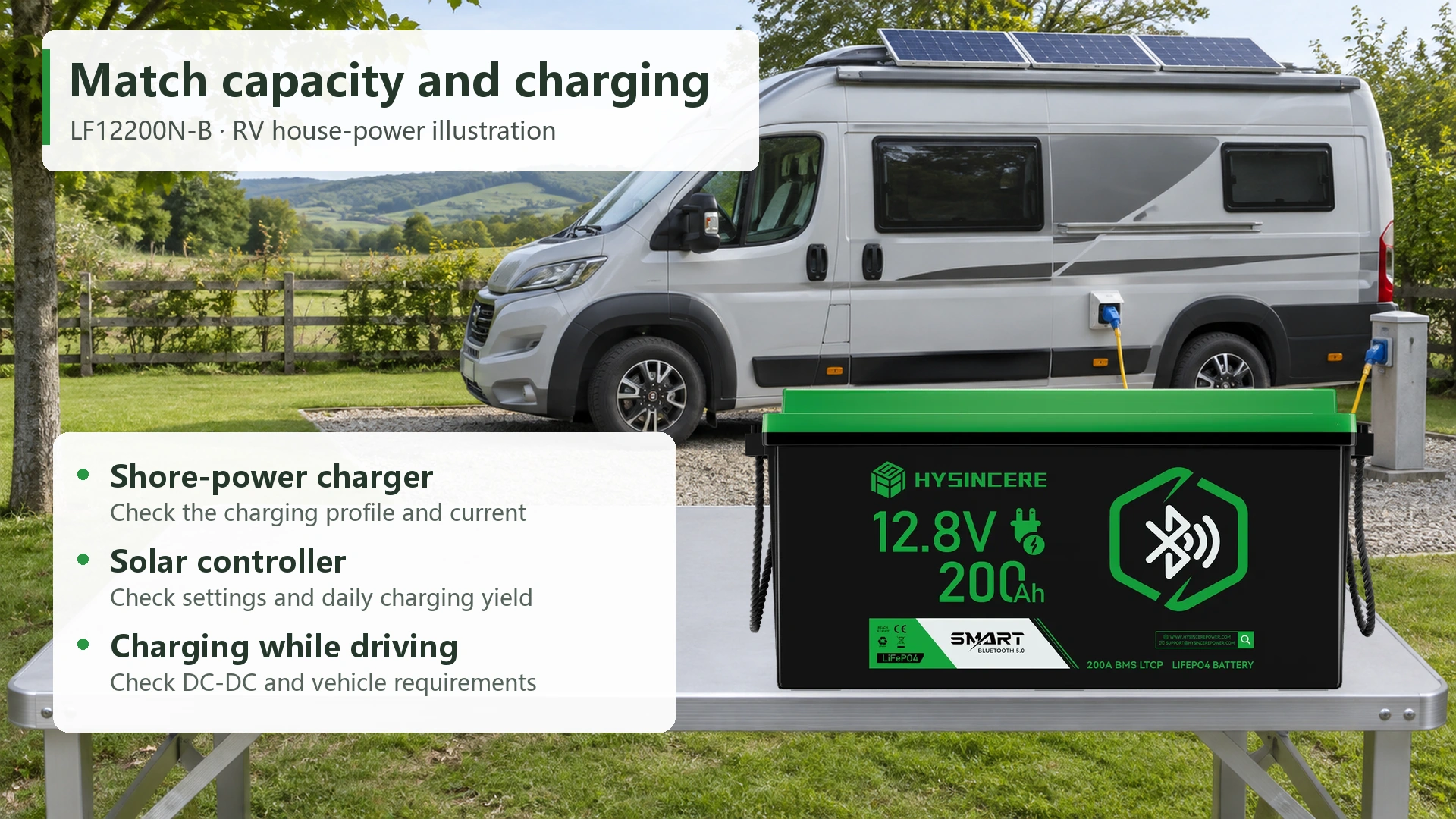
| Charging equipment | Shore-power charger, solar controller and vehicle-charging equipment, including settings | Charging profile, current and energy that can be restored each day |
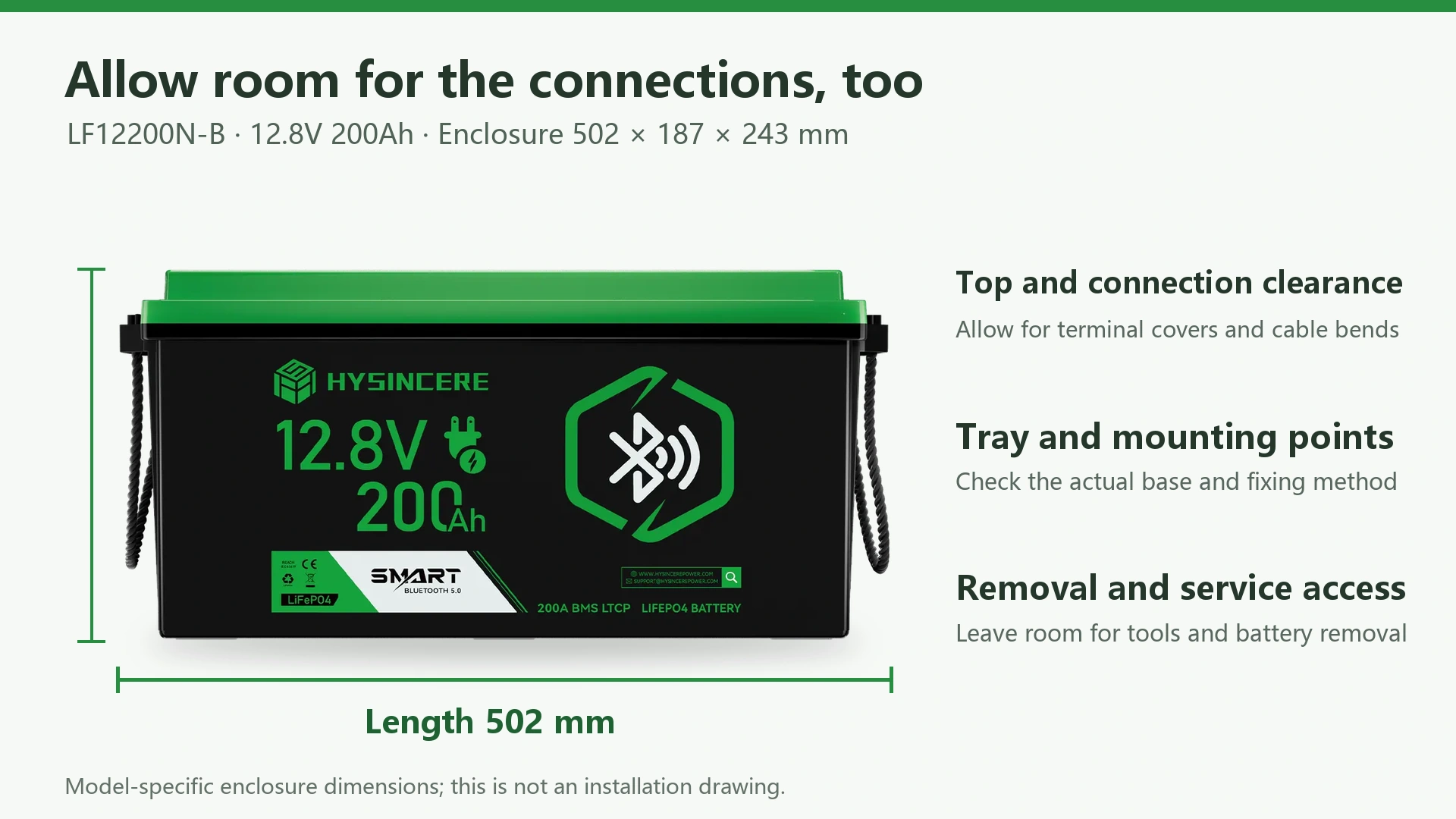
| Installation space | Clear compartment dimensions, terminal and cable orientation, mounting, load capacity and removal access | Space for connections and servicing as well as the enclosure |
| Features and interfaces | Bluetooth, display and self-heating requirements; any connection to vehicle controls or displays | Monitoring, cold-weather charging and vehicle communication requirements |
| Battery-bank arrangement | Single battery or multiple units; quantity, wiring and protection plan | Model-specific permission and requirements for series or parallel use |
| Order and delivery | Sample quantity, first order, annual forecast, delivery location, branding and packaging | Comparable quotations and sample, stock and delivery planning |
Check capacity and current separately. For example, an inverter delivering 2,000W continuously at an assumed efficiency of 90% draws about 174A at a battery-terminal voltage of 12.8V. At 12.0V under load, the calculated draw rises to about 185A. Simultaneous DC loads such as pumps and lighting must be added. This is a load calculation, not approval of a particular battery or wiring installation.
A 200Ah battery limited to 100A continuous discharge cannot support that continuous inverter load simply because its energy capacity appears sufficient. The battery, BMS, inverter, cables and protective devices must all suit the installation.
Choose features that solve a specific operating problem
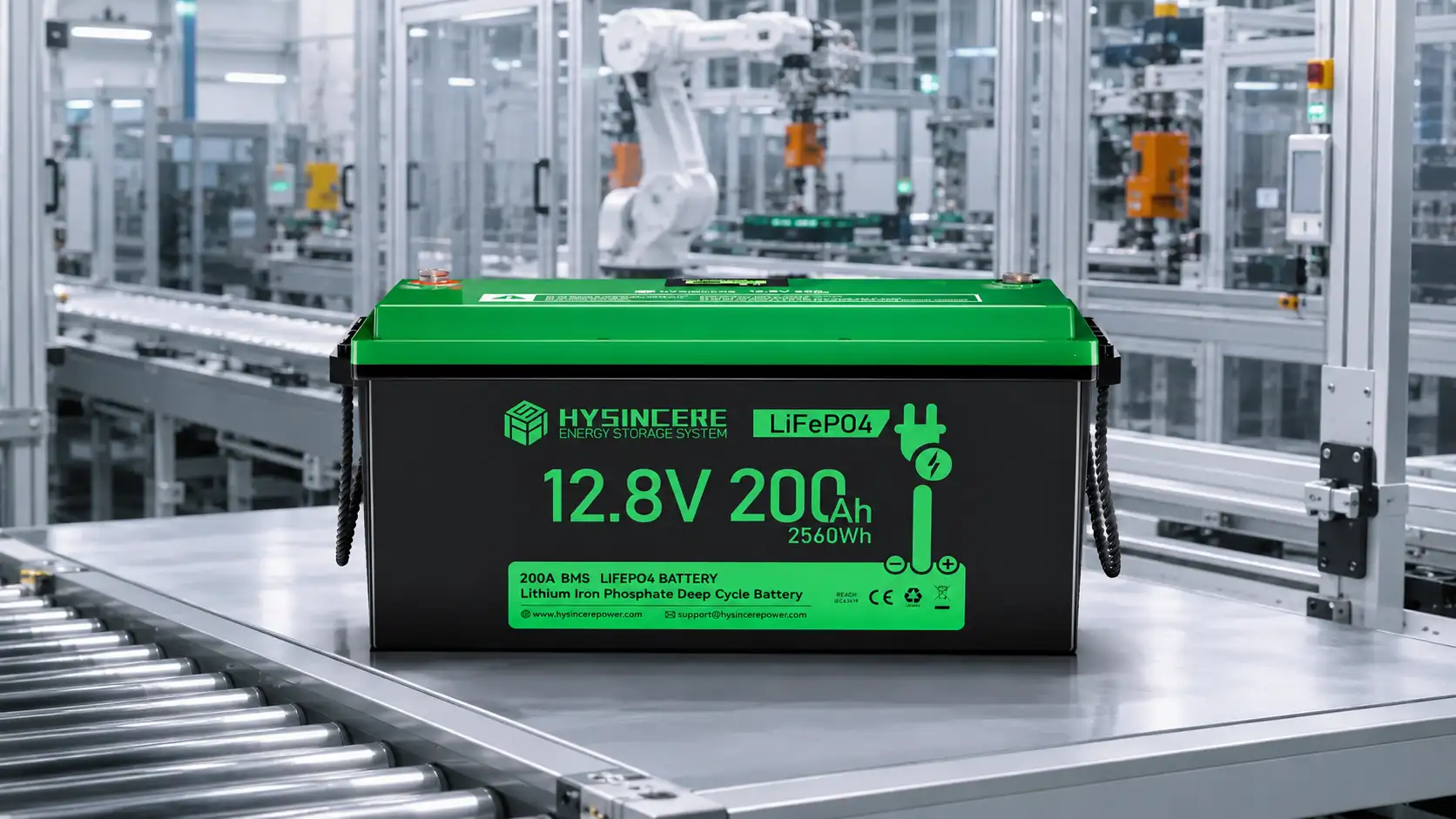
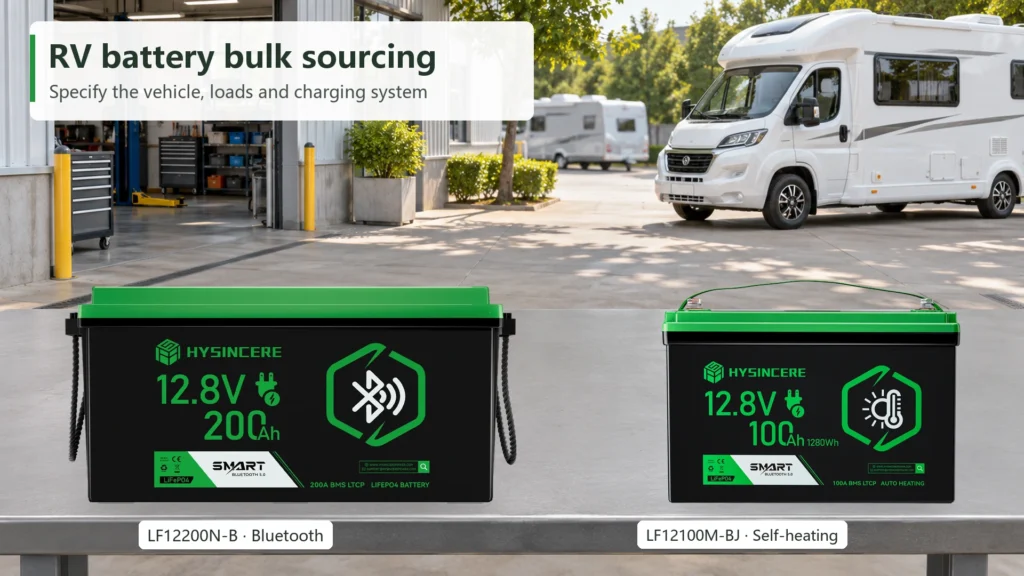
Bluetooth monitoring can be useful when the battery compartment is difficult to access. The Hysincere LF12200N-B 12.8V 200Ah Bluetooth LiFePO4 Battery, for example, has a nominal energy of 2,560Wh and a continuous discharge limit of 200A. Confirm which data can be read, the app requirements and connection performance once the battery is inside a metal compartment.
A display can make local checks convenient, provided it remains visible after installation. Connecting battery data to the RV’s central display is a separate requirement: verify the wired interface, data protocol and integration requirements. Bluetooth support alone does not establish compatibility with the vehicle’s control system. Compare specific configurations in the 12V LiFePO4 Battery range.
For winter use, distinguish low-temperature discharge from low-temperature charging. The Hysincere LF12100M-BJ 12.8V 100Ah Self-Heating LiFePO4 Battery is a candidate when self-heating is required. Ask where the heater gets its power, what triggers it, when cell charging is allowed, and whether a small solar charging current can meet the heating and charging requirements.
These features are not necessarily mutually exclusive, and enclosure symbols do not define the complete specification. Record the full model, BMS configuration and agreed functions in the order. Check repeat orders against that same version.
Check whether the charging system can restore daily use
Review the shore-power charger, solar controller and vehicle-charging path individually. A lithium mode is a starting point; charging voltage, current, temperature controls and termination behavior must still match the battery. Check whether any lead-acid equalization or repair mode can be disabled and whether the equipment is suitable for the replacement battery.
For alternator charging, the alternator’s rated current is only one input. Consider chassis requirements, charging management, wiring and battery limits when selecting a suitable DC-DC charger or another arrangement accepted by the relevant equipment supplier. If several charging sources operate together, check their combined current at the battery.
A simple planning example helps expose a shortfall: restoring 100Ah at a constant net battery-charging current of 20A takes an ideal five hours. “Net” means current remaining after simultaneous onboard loads. Sunlight, temperature and current taper near the end of charging can extend the actual time, so five hours is not a charging-time guarantee.
Validate a representative vehicle before fixing the production specification
Test samples in vehicles representative of the intended production or sales programme. Go beyond checking whether the system starts: run the inverter and main appliances in the expected combinations, complete a representative discharge and recharge cycle, and inspect the cables, terminals and mounting. Results from one vehicle do not automatically cover a different inverter, compartment or charger.
For a programme with several vehicles, start with configurations that have higher loads, tighter installation space or more demanding cold-weather conditions. Then define which results can be shared across the range. The custom battery pack sample-approval guide can help you plan the installation checks and records.
Before the bulk order, freeze the validated battery model, datasheet revision, BMS configuration, harness and terminals, labels and packaging. Agree how changes will be reported, when retesting is required, how batches will be identified on arrival, and which photographs and operating records are needed if a problem occurs.
Check market and transport documentation against the actual model and its coverage. Put the MOQ, sample and production lead times, warranty start and handling procedure, and shipment-document list into the quotation or order agreement. Terms agreed for another project should not be assumed to cover a new vehicle.
What to include in a bulk RFQ
Prepare the following information in one project brief or enquiry:
- Company, destination market and whether the batteries are for OEM production, conversions or distribution stock.
- Vehicle model, system voltage, candidate capacities, daily energy use and main loads.
- Inverter and charger models, nameplates or specifications.
- Clear battery-compartment dimensions, cable direction, mounting points and photographs.
- Minimum operating temperature and Bluetooth, display, self-heating or communication requirements.
- Sample quantity, first-order quantity, annual forecast, requested arrival date and label and packaging requirements.
If capacity is still undecided, start with the loads and available charging opportunities. Hysincere can use those inputs to assess battery, installation and charging options and identify what needs an in-vehicle sample test. You can also review the RV lithium battery solutions before preparing your sourcing requirements.
Send us your RV battery requirements
Share your company, target market, vehicle, candidate capacity, inverter and chargers, installation dimensions and quantities. Hysincere can help check the configuration and define the sample tests.
Frequently asked questions
Can distributors request different capacities in one order?
You can request a mixed-model order, but minimum quantities, availability and lead times need to be confirmed for each model. List the quantity, features, labels, packaging and arrival requirements by model rather than providing only a total.
Can a Bluetooth battery connect directly to an RV central display?
Bluetooth support alone does not establish compatibility. Phone monitoring and wired vehicle communication are different requirements. Check interfaces, protocols, data definitions and integration arrangements before connecting the battery to a central display.
Can we start sourcing before deciding the capacity?
Yes. Provide daily energy use, the time between reliable charges, the maximum simultaneous load, charging equipment and compartment dimensions. These inputs help define a capacity range before specific models are compared.