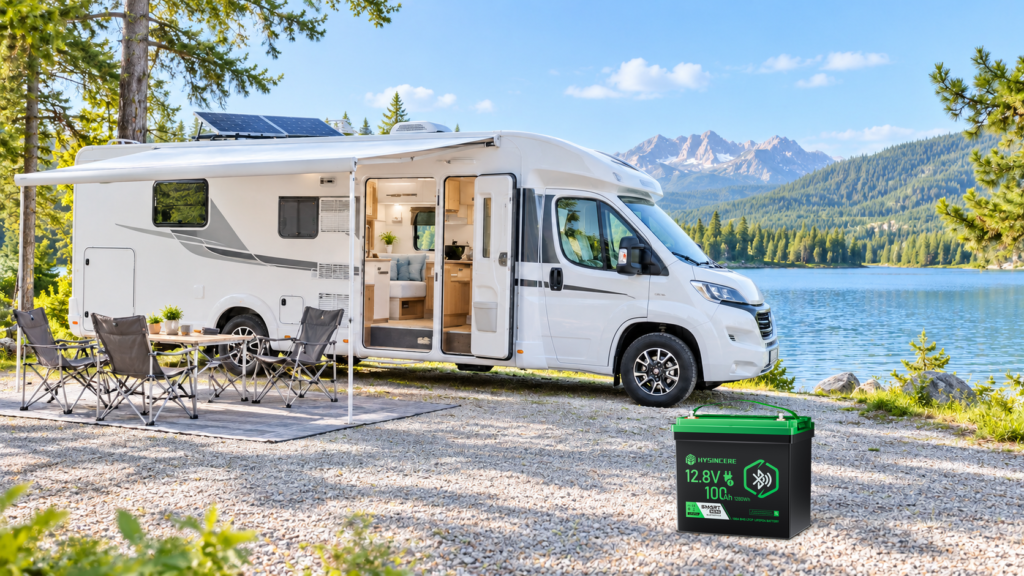
A 100Ah lithium battery can suit a lightly used RV, but a compressor fridge, several days without hookups, or regular inverter use can change the answer. Choose the battery from your daily energy use and the time between reliable charges—not from the size of the vehicle alone.
This guide compares 100Ah, 200Ah and 300Ah LiFePO4 house batteries for a nominal 12V RV system. In the worked example below, daily battery use is about 1.3kWh: with a full battery, no recharging and a 20% reserve, 200Ah covers one day and 300Ah covers roughly two. Your own loads and charging schedule may lead to a different choice. The house battery supplies the living area; engine starting needs a separate check.
What do 100Ah, 200Ah and 300Ah actually give you?
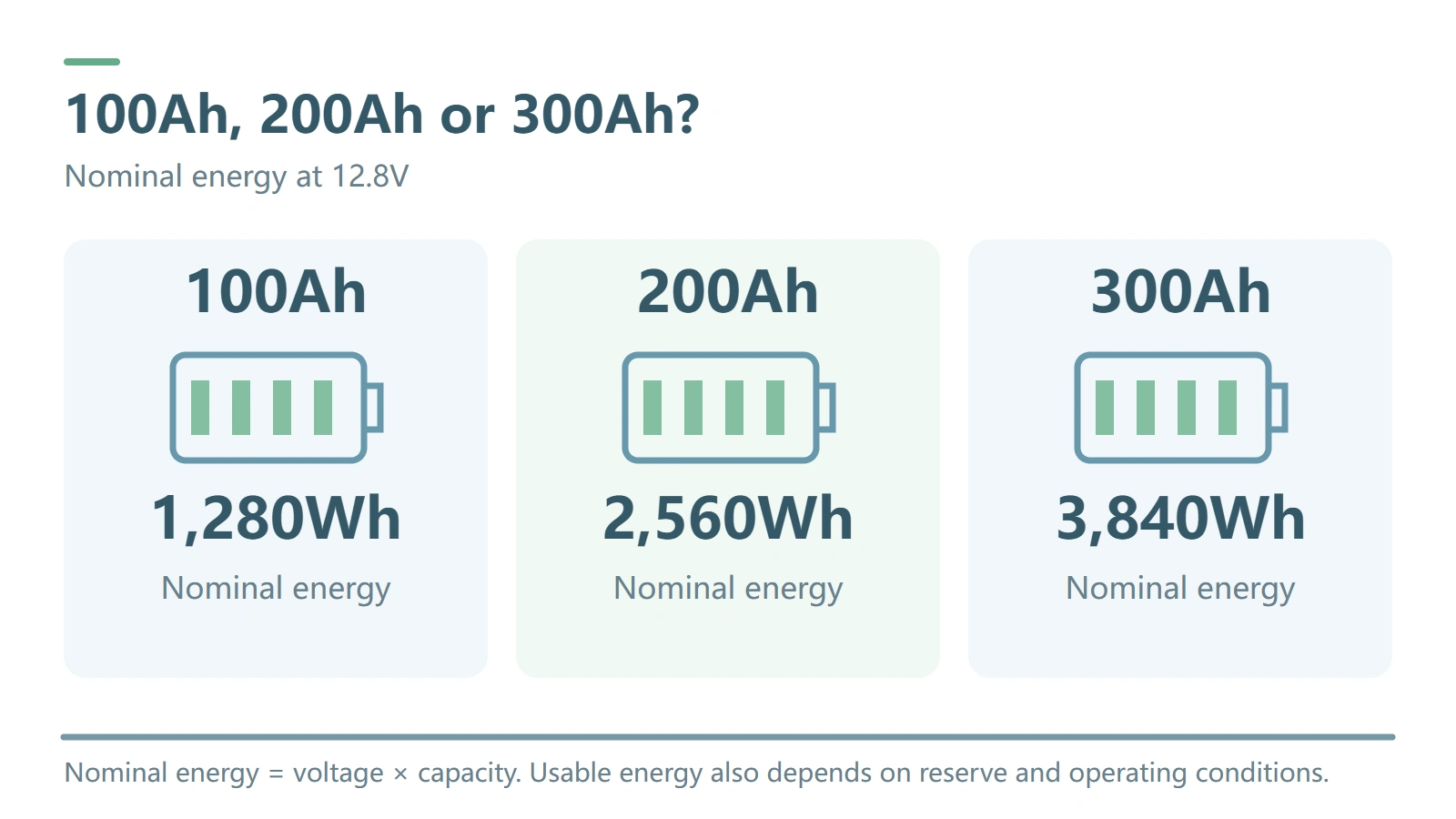
A typical nominal 12V LiFePO4 pack is rated at 12.8V. Multiplying its nominal voltage by its amp-hour capacity gives an approximate energy figure in watt-hours (Wh). Watt-hours make it easier to compare the battery with the appliances it needs to run.
| Battery capacity | Nominal energy | Planning budget | At 1.3kWh per day |
|---|---|---|---|
| 100Ah | 1,280Wh | 1,024Wh | About 0.8 day |
| 200Ah | 2,560Wh | 2,048Wh | About 1.6 days |
| 300Ah | 3,840Wh | 3,072Wh | About 2.4 days |
The table starts with a full battery, assumes no recharging, and reserves 20% of nominal energy. That 80% budget is a planning choice, not a universal discharge limit or a claim about a particular model. Use the manufacturer’s operating limits and allow for temperature, aging and the reserve you want to keep.
The daily figure already includes estimated conversion and standby losses. Do not deduct those same losses a second time. A 24V battery with the same Ah rating stores a different amount of energy, so this table must not be applied to it unchanged.
Build a daily RV energy budget
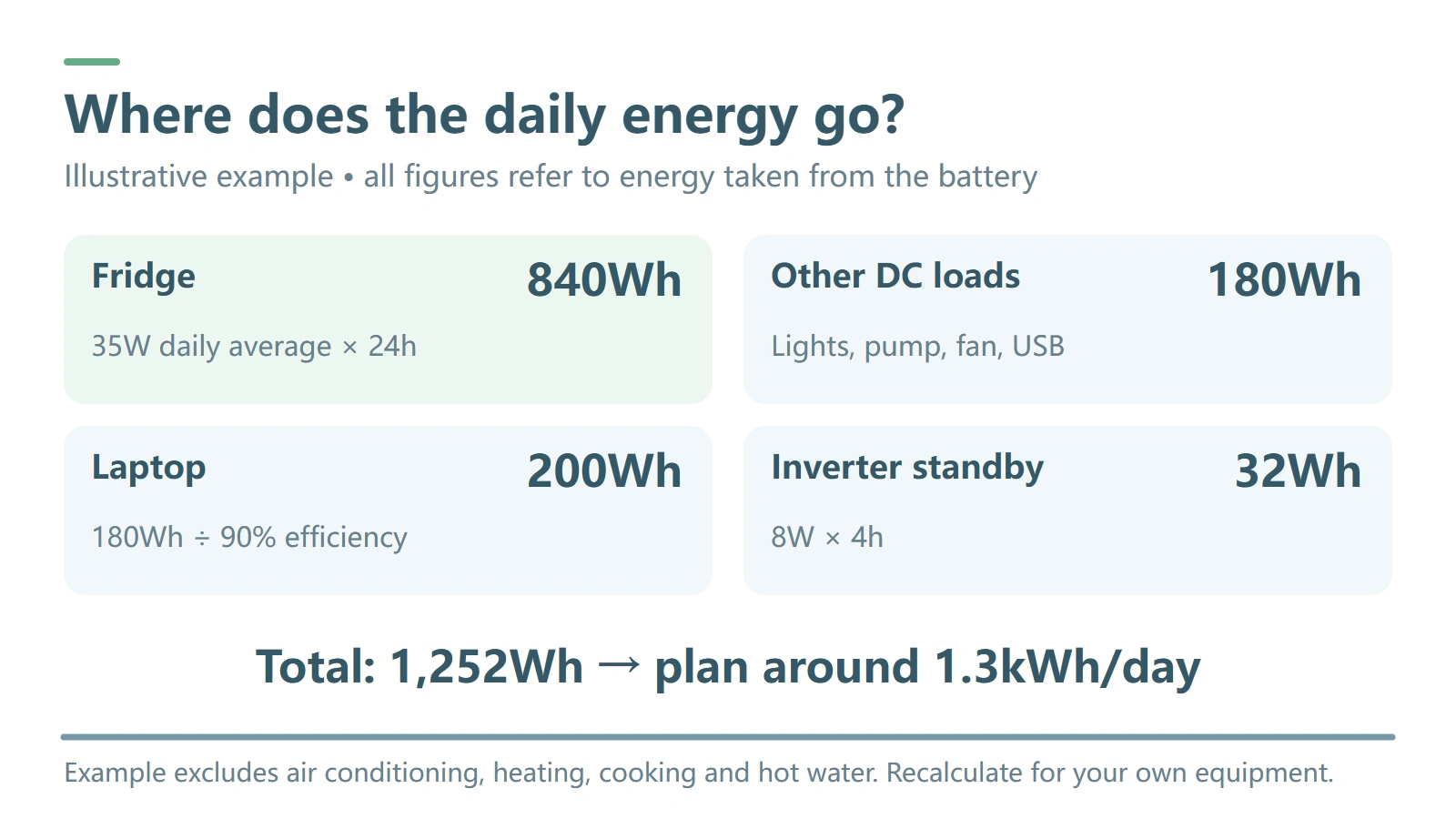
List the devices you actually use, their input power and their daily running time. A fridge cycles on and off: use measured daily energy or a realistic average over the whole day, rather than treating its maximum running wattage as a constant load.
| Load | Assumed input | Time per day | Energy |
|---|---|---|---|
| DC compressor fridge | 35W daily average | 24 hours | 840Wh |
| DC lights | 12W | 4 hours | 48Wh |
| DC water pump | 60W | 12 minutes | 12Wh |
| DC ventilation fan | 15W | 6 hours | 90Wh |
| DC USB charging | 15W input | 2 hours | 30Wh |
| Laptop through inverter | 60W AC input | 3 hours | 180Wh at the AC side |
The DC loads total 1,020Wh. At an assumed 90% inverter efficiency, the laptop takes about 200Wh from the battery during its three hours of use. Suppose the inverter then stays on for four additional hours with no AC load, drawing 8W: that adds 32Wh. Those idle hours are separate from the laptop hours, so we do not count the same operating losses twice. The total is 1,252Wh per day, which we round to 1.3kWh for sizing.
This example excludes electric space heating, air conditioning, induction cooking and water heating. Add those separately if you use them. Check the input rating on a microwave or other appliance; its advertised cooking output is not the battery load.
Choose capacity for the time between charges
For a trip with no dependable recharging, multiply daily energy by the number of days, then divide by your planned usable fraction and nominal battery voltage.
For the example above, two days require about 2,600Wh. With an 80% energy budget, the calculation is 2,600 ÷ 0.80 ÷ 12.8 ≈ 254Ah. A 300Ah option is therefore a sensible capacity candidate; a 200Ah option would need some recharging or reduced use. This is an energy calculation, not approval of a particular battery’s current rating or installation.
- Consider 100Ah when measured consumption is modest and charging is frequent. Under this example’s assumptions, it would not cover a full 24 hours.
- Consider 200Ah when you want more time away from hookups, or enough capacity for the example day with a useful reserve.
- Consider 300Ah when you need roughly two days at the example consumption, or have a larger daily energy budget.
You can enter your own loads in the battery capacity and runtime calculator. For a closer look at smaller setups, see the examples in our 12V 100Ah battery application guide.
Check output current as well as capacity
A larger Ah number does not automatically mean that the battery can supply a larger inverter. Check the battery’s continuous discharge rating, allowed peak current and peak duration against all loads that can run together.
For example, a 2,000W AC load at an assumed 90% inverter efficiency draws approximately 174A at 12.8V. At 12.0V under load, that rises to about 185A. Other DC loads add to the demand. A battery limited to 100A continuous discharge would not support this steady load, even if it had plenty of stored energy.
Motor and compressor starting demands also need checking. The battery, battery management system (BMS), inverter, cables, connections and protection must work together. Our inverter battery sizing guide covers those checks in more detail.
Make sure you can put the energy back
More storage extends the time before charging; it does not increase the output of your existing charger or solar array. Returning 100Ah to the battery would take five hours at a steady net charging current of 20A. Net current is what reaches the battery after running loads take their share. Charging takes longer if that current falls or tapers near full charge.
For solar, use a conservative estimate for the season, location, shade and available roof area. Panel nameplate watts are not the amount of energy you will collect every day. If a cloudy day is part of the trip you want to cover, size the reserve for it.
Check the shore charger, solar controller and alternator charging route individually. Alternator charging may need a compatible DC-DC charger or another manufacturer-approved control arrangement. See the LiFePO4 charging compatibility guide.
Check fit, temperature and future expansion
Before ordering, measure the usable compartment, including terminal clearance, cable bend space and the mounting arrangement. Check weight as well as dimensions. A battery that fits the tray can still be awkward to connect or service.
For winter trips, read the exact model’s charging and discharge temperature limits. Cold-weather discharge capability does not by itself permit cold charging. If you choose a self-heating model, confirm how the heater receives power and when charging is allowed to resume.
Two approved 100Ah batteries in parallel can provide the same nominal Ah capacity as one 200Ah battery at the same voltage, but the layouts differ. Confirm that the exact models permit parallel use, follow the specified wiring and protection, and do not assume that advertised current limits simply add under every condition.
What to send when asking for an RV battery recommendation
A useful request includes system voltage, daily energy use, days between charges, largest simultaneous load, inverter model, each charging source, lowest expected temperature and available installation space. For an OEM RV or camper project, include expected build quantity and any communication requirements.
Those details let the battery supplier check both runtime and electrical compatibility. Start with the RV battery application page and compare the available 12V LiFePO4 batteries once the energy budget is clear.
Plan your RV battery capacity
Send Hysincere your load list, days between charges, charging sources and battery compartment dimensions so we can review capacity and fit.
Frequently asked questions
Is a 100Ah lithium battery enough for an RV?
It depends on daily energy use and charging frequency. At the illustrative 1.3kWh per day and 80% energy budget used here, 100Ah does not cover a full day. Lighter use or frequent charging can make it suitable.
Will a 200Ah battery run an RV for two days?
At 12.8V, 1.3kWh per day and an 80% energy budget, it provides about 1.6 days without charging. Two days would require some recharging, less consumption or more capacity.
Can a 300Ah battery run an RV air conditioner?
Capacity alone does not answer that. Check the air conditioner input and startup demand, inverter rating, and battery continuous and peak current. Runtime then depends on actual energy use and available battery energy.
Is one 200Ah battery better than two 100Ah batteries?
Two approved 100Ah batteries in parallel have the same nominal capacity at the same voltage. Compare installation space, wiring and protection, expansion needs and model-specific parallel limits.
Numerical examples explain the selection method; they are not test results or compatibility guarantees for a Hysincere model. Follow the requirements of the specific battery, charger and equipment manufacturers.