Yes, a 36V golf cart can be converted to a 48V-class lithium system, but a 48V battery is not a direct drop-in replacement for an unchanged 36V electrical system. Before the conversion, verify the controller voltage range, motor limits, contactor/solenoid, charger, DC-DC converter, accessories, cable and fuse ratings, battery compartment, and BMS current capability.
For LiFePO4, a battery marketed for a “48V” golf cart is commonly a 51.2V nominal pack. The entire vehicle must therefore be checked against the battery’s real operating and charging voltage range—not only the label “48V.”
Quick answer: can you put a 48V battery in a 36V golf cart?
You can upgrade the cart to a 48V-class system if the electrical system is engineered for that voltage. You should not connect a 48V/51.2V battery to a stock 36V cart and assume the original components will tolerate it. Some components may be reusable after verification, while others normally need replacement or reconfiguration.
The key question is not “Will the battery fit?” It is: Can every component connected to the traction battery safely operate across the new system voltage and current envelope?
Compatibility warning: do not connect a 48V-class / 51.2V LiFePO4 pack to an unchanged 36V system. Verify the controller, charger, contactor, DC-DC/accessories and motor operating limits first.
Why is a “48V” LiFePO4 golf cart battery usually 51.2V?
LiFePO4 cells have a nominal voltage of about 3.2V per cell group. A common 48V-class LiFePO4 pack uses 16 cell groups in series:
16 × 3.2V = 51.2V nominal
That is why a golf cart owner may search for a “48V lithium battery” but find a 51.2V LiFePO4 product. The terminology describes the system class; the engineering check must use the battery’s actual nominal voltage, maximum charging voltage, BMS settings, and the vehicle component ratings.
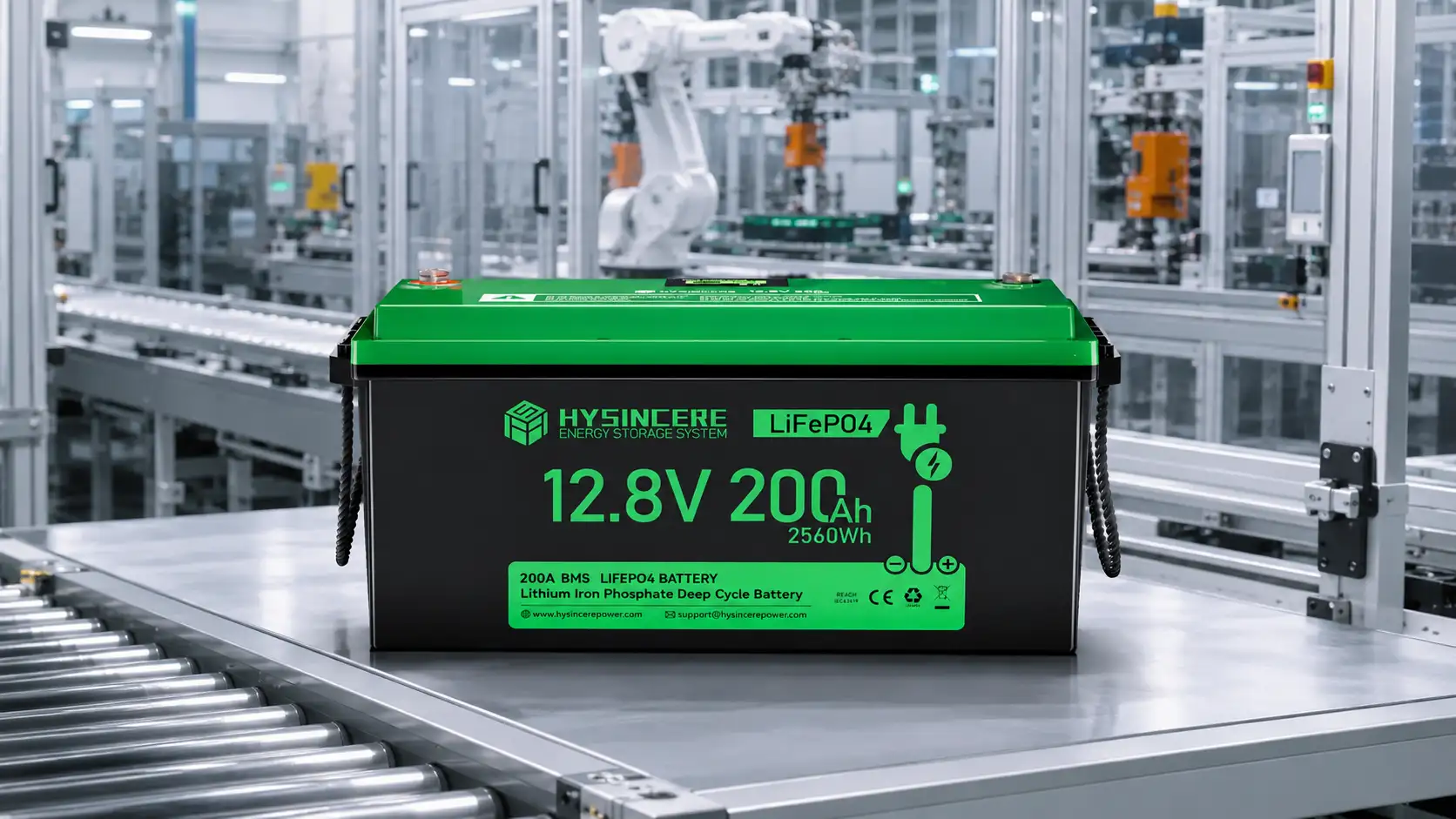
Hysincere’s current GF51105N-BW 48V-class golf cart battery, for example, is rated at 51.2V, 105Ah and 5,376Wh. Its listed maximum continuous discharge current is 200A. These specifications still need to be matched to the specific cart, controller and duty cycle.
36V to 48V golf cart upgrade compatibility checklist
| Component | What to verify before upgrading | Typical action |
|---|---|---|
| Battery | Actual nominal/charge voltage, capacity, continuous and peak BMS current, connector and dimensions | Replace with a compatible 48V-class / 51.2V pack |
| Motor controller | Input-voltage range, current limit, regenerative-braking behavior and programming | Replace or reconfigure unless 48V-class operation is explicitly supported |
| Motor | Rated voltage, speed, current, thermal limits and manufacturer guidance | May be reusable in some systems; do not assume compatibility |
| Solenoid / contactor | Coil voltage and contact voltage/current rating | Use a 48V-compatible device if the original is not rated for the new system |
| Charger | Battery chemistry, charge voltage and charge profile | A 36V lead-acid charger must not be used for a 51.2V LiFePO4 pack |
| DC-DC converter / 12V accessories | Input-voltage range and accessory power demand | Confirm the converter accepts the new traction-battery voltage |
| Cables and fuse | Actual continuous/peak current, cable length, terminal rating and fault-current protection | Recalculate; do not choose cable size from system voltage alone |
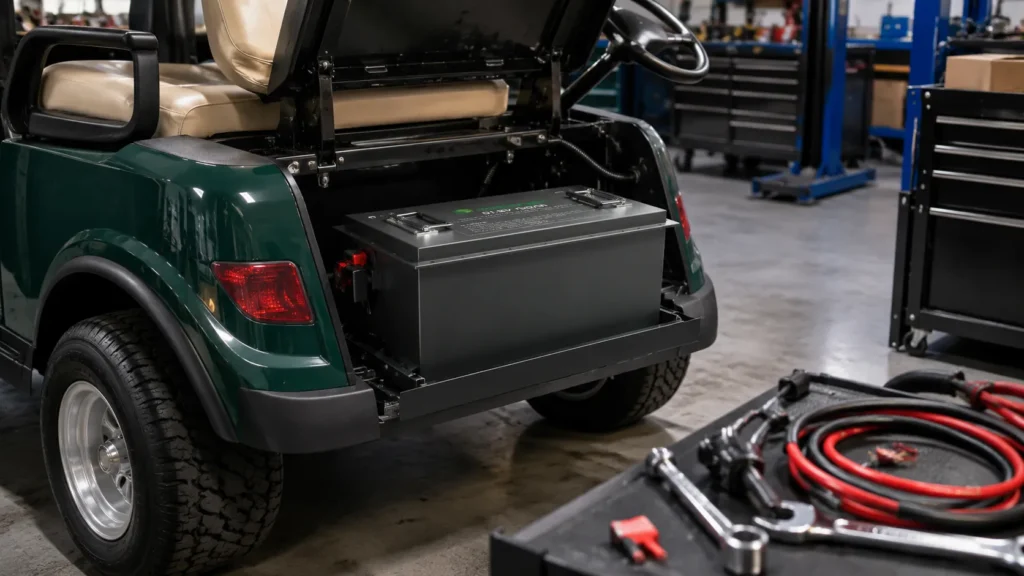
| Battery tray / connector | Pack dimensions, mounting, terminal layout, vibration and service access | Modify only if required by the selected pack |
Can a 48V battery be used with the original 36V golf cart motor?
Sometimes, but this cannot be decided from the battery voltage alone. A motor that was designed around a 36V drivetrain may spin faster, run hotter or see different current and duty conditions after the system voltage is raised. The controller also determines how much voltage and current the motor actually receives.
Before retaining the original motor, verify its rated voltage, continuous and peak current, speed limits, thermal performance, gearing and the controller strategy. If the motor manufacturer does not approve the higher-voltage operating range, treat the motor as a component that requires engineering validation or replacement.
Does a 48V upgrade automatically require thicker battery cables?
No. Cable size should be selected from current, cable length, temperature, allowable voltage drop, terminal rating and protection strategy—not from the voltage label alone.
For the same mechanical/electrical output power, a higher system voltage can reduce current:
Power ≈ Voltage × Current
However, a 48V upgrade is often performed to obtain more power, acceleration or hill-climbing performance, so the new controller may also allow a higher peak power level. Recalculate the actual continuous and surge current before choosing the cables, terminals and fuse.
A safer 36V-to-48V upgrade workflow
- Document the existing cart: model, controller, motor, charger, contactor, accessory system and battery compartment.
- Define the target duty: passengers, payload, hills, route length, maximum speed and daily cycles.
- Select the battery platform: voltage, Ah/Wh, continuous current, peak current, physical size and communication requirements.
- Verify every component: do not assume a “36V” part is safe at a 48V-class operating voltage.
- Set charger and protection correctly: confirm the charger profile, fuse, contactor and BMS limits.
- Validate the vehicle: test acceleration, hill climbing, temperature, regenerative braking, low-state-of-charge behavior and charging before fleet deployment.
When is a 36V-to-48V lithium conversion worth considering?
The upgrade is more defensible when the existing 36V fleet is limited by hill-climbing performance, payload, voltage sag, charging turnaround, lead-acid maintenance or usable energy. It can also make sense when the fleet is already due for a controller/charger refresh and the owner wants to standardize on a modern lithium platform.
It may be less attractive when the cart is lightly used, the existing 36V system already meets the duty cycle, or the cost of controller, charger, motor and accessory changes is high relative to the remaining vehicle life.
For current 48V-class and 72V-class options, see Hysincere Golf Cart Batteries.
Related: If you are also evaluating higher-voltage fleets, read 72V Golf Cart Range: capacity, Wh and real-world range factors.
Plan Your Golf Cart Lithium Upgrade
Provide cart voltage, controller range, motor power, peak current, charger, wiring, installation space, and communication details to evaluate the battery platform and vehicle compatibility.
36V to 48V Golf Cart Upgrade FAQ
Common questions about voltage, motor, charger and system compatibility when converting a 36V golf cart to a 48V-class / 51.2V LiFePO4 system.
Can I put a 48V lithium battery in a stock 36V golf cart?
Not as a direct battery-only swap. The controller, charger, contactor, motor, DC-DC/accessories and protection system must be checked for the new voltage.
Is a 51.2V LiFePO4 battery the same as a 48V golf cart battery?
51.2V is a common nominal voltage for a 48V-class LiFePO4 pack. Compatibility must be based on the battery's complete operating and charging voltage range and the cart component ratings.
Will a 48V battery make a 36V golf cart faster?
Potentially, but speed depends on the motor, controller, gearing, tire size, programming and vehicle limits. Increasing voltage without engineering the drivetrain is not a safe speed-up method.
Do I need a new charger when converting from 36V to 48V LiFePO4?
Yes, if the original charger is a 36V unit. Use a charger whose voltage and charge profile match the selected 48V-class / 51.2V LiFePO4 battery.
Do I need to replace the 36V motor?
Not always. Some motors may operate in a higher-voltage conversion when the controller and duty cycle are appropriate, but the motor's voltage, speed and thermal limits must be validated.
What information should I send a battery supplier before upgrading?
Provide the cart model, existing system voltage, controller model/range, motor rating, maximum current, charger, battery-bay dimensions, route/payload, target range and any CAN/RS485/Bluetooth requirements.
Vehicle battery upgrades require validation of controller voltage range, charger, current, wiring, contactor, fusing, communications, mounting, and regenerative-braking behavior. Final configuration must follow the vehicle and battery documentation and pass vehicle-level validation.