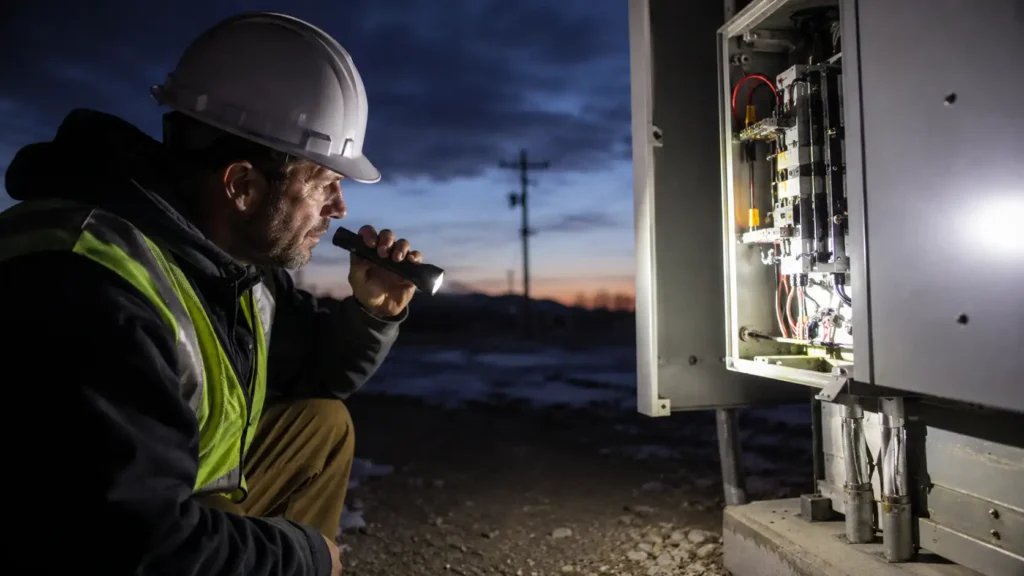
A 21700 battery for a flashlight must match the driver current, battery compartment and protection design. Compare usable energy at the intended brightness, voltage drop under load and temperature limits; capacity alone is not enough.
This guide explains the checks for flashlight manufacturers and technical buyers: current, runtime, actual dimensions and protection in the complete device.
Why 21700 Batteries Are Ideal for Flashlights
The 21700 format has more cell volume than 18650. Depending on the model, this can support more stored energy or a higher load current. Assess these properties separately:
- Usable energy: Compare energy delivered at the intended current and device cutoff, rather than assuming that a larger cell always has higher energy density.
- Current: Obtain the flashlight driver’s battery-side current, including peaks. Lumens alone cannot establish the required discharge rating.
- Temperature: Cell resistance, contacts and heat dissipation determine temperature rise. A larger cell does not guarantee sustained Turbo operation.
- Life: Compare cycle-life results with their charge, discharge, temperature and retained-capacity conditions. A 500-cycle claim is not a universal property of this format.
Test runtime, brightness regulation and protective cutoff on the complete light. A capable cell alone does not establish a safe flashlight.
Key Features to Evaluate When Selecting 21700 Batteries
- Capacity (mAh): Compare usable capacity at the expected load and confirm actual dimensions, including the positive terminal and any added protection board.
- Continuous discharge rating (CDR): Match the measured current and peaks to the cell’s specified limits and operating temperature. Not every industrial flashlight needs 10–20 A.
- Protection: A protected cell adds a board that can disconnect under specified faults. Its length and cutoff current must suit the light. An unprotected cell needs an appropriate protection design in the device or pack and is not automatically approved as a loose replacement.
Three Selection Priorities for Flashlight Projects
The following comparison describes selection priorities, not available cell models. Set the required capacity and permissible current using the chosen model’s datasheet and complete-device testing.
| Selection Priority | Energy and Runtime | Current Requirement | Device Check |
|---|---|---|---|
| High Output | Compare usable energy at high load. | Confirm continuous and peak current limits. | Verify voltage drop, contacts and temperature at high brightness. |
| Balanced Operation | Compare runtime at normal brightness. | Allow for permitted short load peaks. | Test brightness regulation and protective cutoff with the actual duty cycle. |
| Long Runtime | Compare usable energy at moderate load. | Include startup and Turbo demand. | Check runtime, fit and charging together. |
Industrial Applications & Hysincere Sourcing
For maintenance, inspection and rescue work, battery performance affects available lighting time and reliability. In hazardous locations, the complete device needs the applicable approval; selecting a particular 21700 cell does not supply that approval.
At Hysincere, we can assess cell and pack requirements for your lighting project. Send the load profile, charging method, available space, temperature range, required documents and planned quantity. A specific model, its availability and suitability need confirmation before procurement.
Discuss Your Cell Selection and Custom Battery Requirements
Share voltage, capacity, continuous and peak current, dimensions, cycle life, temperature, certification, and annual-volume requirements so Hysincere can evaluate suitable cells and battery-pack options.
Choosing the Best 21700 Battery for Flashlights FAQ
How should I choose a 21700 cell for a flashlight?
Start with the flashlight manufacturer’s approved cell requirements. Check driver current, usable energy, actual cell dimensions, terminal shape and protection. Test runtime and temperature in the complete light.
Does a higher capacity guarantee longer Turbo operation?
No. High brightness is also limited by driver current, voltage drop and heat dissipation. Compare usable energy at the actual load; a larger capacity figure does not establish sustained Turbo output.
Should a flashlight use a protected 21700 cell?
Follow the device manufacturer’s specification. An added protection board changes cell length and has its own cutoff current. An unprotected cell requires suitable protection in the device or pack and is not automatically an approved replacement.
This article is intended for technical reference and preliminary project evaluation. Battery compatibility, charging limits, current capability, temperature range, BMS behavior, certifications, and installation requirements vary by model and application. Final selection and system configuration must follow the selected product datasheet, equipment-manufacturer requirements, and system-validation results.