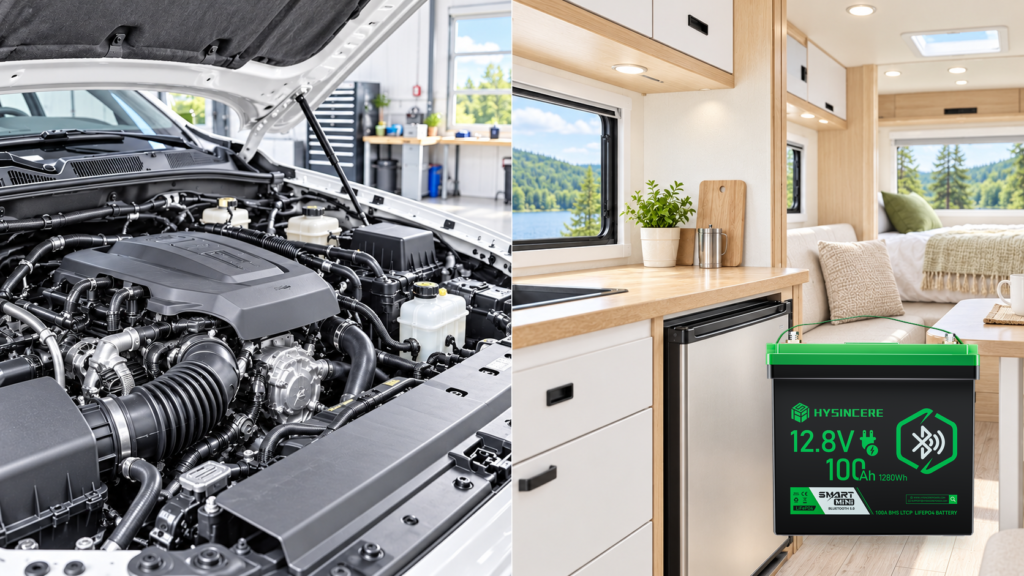
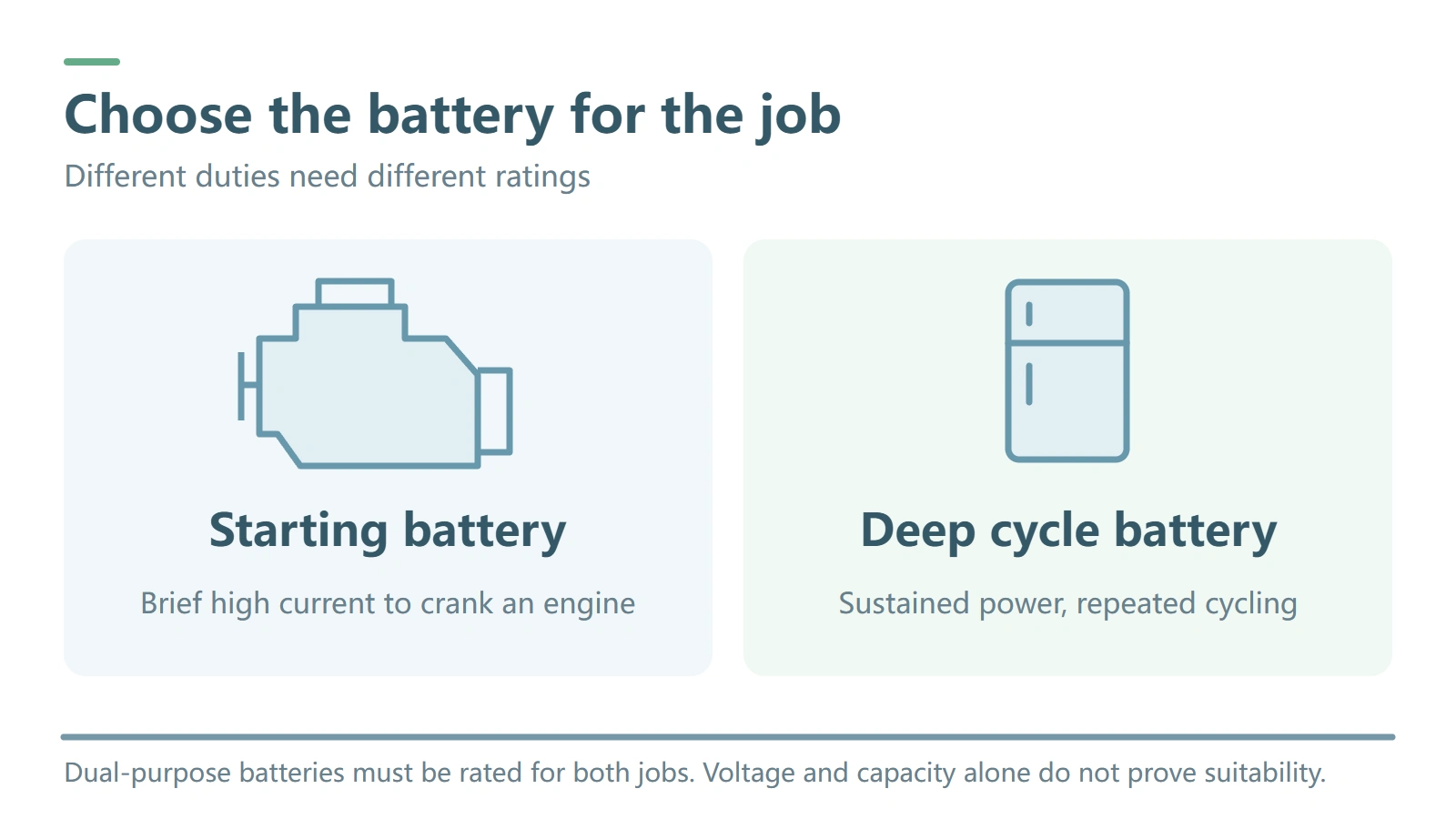
A deep cycle battery is designed to power equipment through repeated discharge and recharge cycles. A starting battery is designed to deliver a brief, high-current burst to crank an engine. Some batteries are designed for both duties, but neither a “12V” label nor a large Ah rating proves that they are interchangeable.
For an RV or boat, identify the job first: starting the engine, supplying lights and refrigeration, or running a trolling motor. Then check the ratings that describe that job.
Deep cycle, starting and dual-purpose batteries
| Battery type | Main job | Ratings to check | Typical use |
|---|---|---|---|
| Deep cycle | Repeated, sustained energy supply | Ah or Wh, discharge current, cycle conditions | RV house loads, boat service loads, trolling motors |
| Starting | Brief high-current engine cranking | Required cranking rating, voltage and engine approval | Vehicle or boat engine starting |
| Dual-purpose | Starting and cycling within specified limits | Both cranking and energy ratings | Approved combined-duty installations |
These are descriptions of use, not battery chemistries. Flooded lead-acid, AGM and lithium products must still be selected by their actual design and ratings. In particular, “AGM” does not automatically mean starting-only, and “LiFePO4” does not automatically mean suitable for starting.
Ah, Wh and cranking amps answer different questions
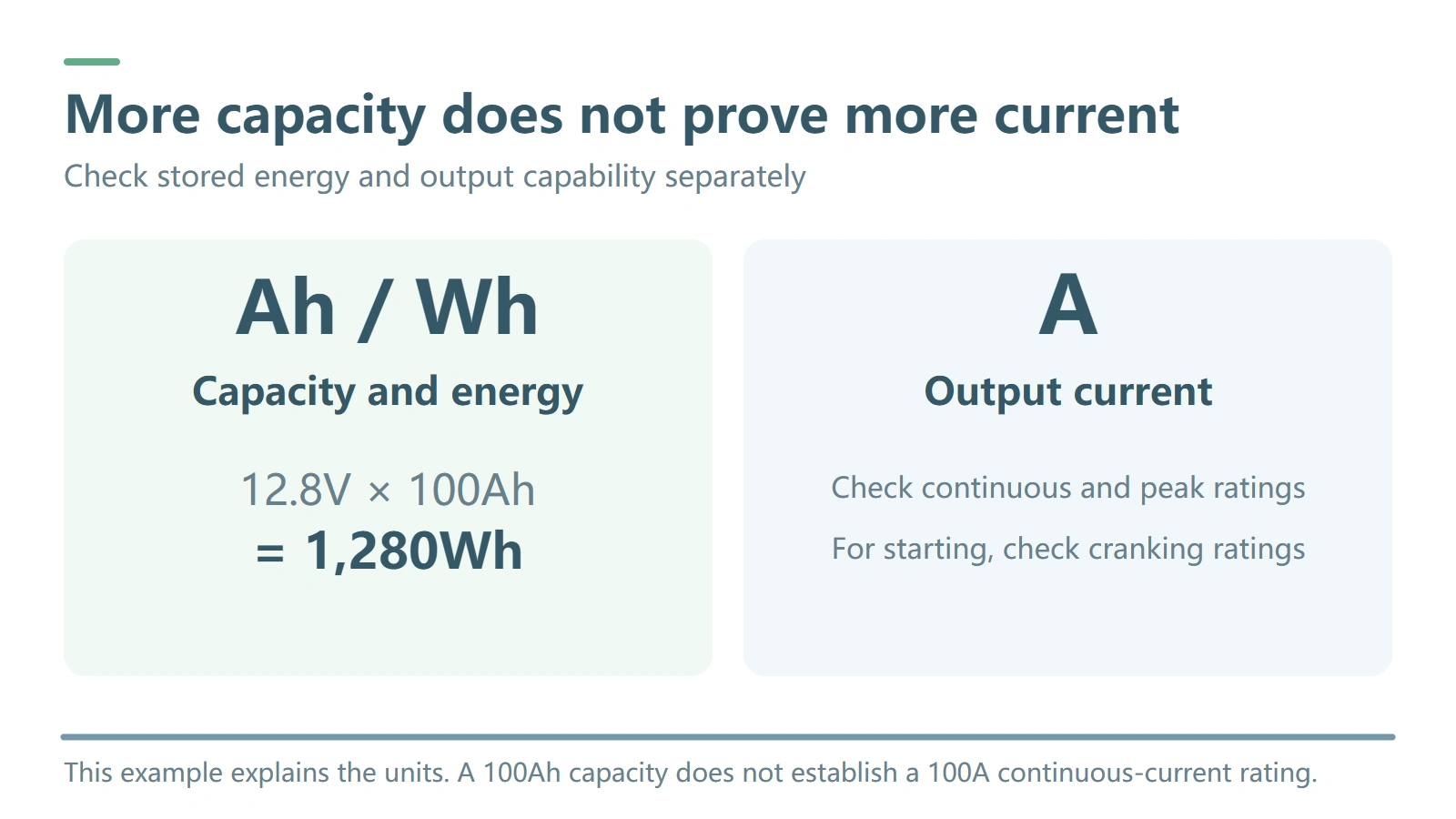
Amp-hours (Ah) describe charge capacity under stated test conditions. Watt-hours (Wh) describe energy. For example, a 12.8V 100Ah battery has about 1,280Wh of nominal energy. Neither number tells you the maximum current it can deliver to a starter motor.
Cold cranking amps (CCA) describe starting performance under a specified cold test. The common CCA test uses −18°C (0°F), while standard marine cranking amps (MCA, also called CA) use 0°C (32°F). A 600 MCA rating is not the same as 600 CCA.
Match the engine manufacturer’s required rating and test standard. Check the temperature, duration and minimum voltage behind any cranking or peak-current claim, especially if a lithium battery uses a manufacturer-specific test. A brief “peak amps” figure does not replace the required starting rating.
Continuous discharge current matters when an inverter, pump or motor draws power for longer periods. For a lithium battery, also check the peak-current limit set by the battery management system (BMS), how long that peak is permitted, and the temperature and state-of-charge conditions attached to the ratings.
Can a deep cycle battery start an engine?
Only select it for that job when its manufacturer permits engine starting and its specifications meet the engine’s requirements. Being able to crank an engine once is not evidence that the battery will do so reliably in colder weather, at a lower state of charge or throughout its service life.
A lithium deep cycle battery can have plenty of stored energy while its BMS limits the current below what the starter needs. If protection opens during cranking, the result may be a failed start. Do not bypass the BMS or treat a protection shutdown as a reason to remove it.
Some lithium batteries are designed for both starting and cycling, but approval must cover the exact battery and engine combination.
Before making a change, confirm battery type approval, minimum cranking requirement, permitted system voltage and charging compatibility with both the engine and battery suppliers.
Can a starting battery power lights and a fridge?
It can supply electrical loads, but repeatedly using a starting-only battery as a deeply cycled house battery is a poor match for its intended duty. It also uses energy you may need for the next engine start.
In an RV, the chassis battery normally serves the engine and vehicle systems, while the house bank serves the living area. On a boat, the starting battery, service bank and trolling-motor supply may be separate. The actual arrangement depends on the vehicle or vessel design.
Keep enough starting reserve and use an approved charging and isolation arrangement. Do not simply join unlike batteries to obtain more capacity. For application-specific selection, see the RV battery solutions and marine battery solutions.
Why a bigger Ah rating may not run a bigger load
Capacity affects how much energy is available. Output-current limits affect whether the battery can run the equipment at all. Treat them as two separate checks.
Consider an illustrative 2,000W AC load supplied by an inverter operating at 90% efficiency. At 12.8V, the battery current is approximately:
A battery with a 100A continuous limit is not suitable for this steady load simply because its label says 200Ah. Voltage drop, other loads and equipment startup can increase the demand further. This example concerns an inverter load; it must not be used to estimate an engine’s required cranking current.
Use the inverter sizing guide for current checks, and the capacity and runtime calculator for energy planning.
Choose by the equipment the battery will supply
- RV lights, fridge and ventilation: start with a deep cycle house battery, then size daily energy, current and charging.
- Boat engine: start with the engine manufacturer’s approved battery type and cranking requirements.
- Trolling motor: check its required system voltage, maximum current and intended operating time. This is different from cranking a combustion engine.
- One battery for starting and accessories: use a specifically approved dual-purpose option and keep enough reserve for starting.
If your project is mainly sustained power for equipment, compare the available LiFePO4 deep cycle battery options. If it involves engine starting, request explicit confirmation for that duty; do not infer it from capacity or product appearance.
What to check before changing battery type
Record the equipment or engine model, system voltage, existing battery specification, daily load, maximum current, lowest operating temperature and charging sources. Then check physical fit, terminal position, mounting and the required electrical protection.
A change in battery chemistry can also require different charging controls. Review the LiFePO4 charger compatibility checks before reusing a shore charger, solar controller or alternator connection.
For OEM and fleet projects, include both starting and service-load requirements in the enquiry, even if separate batteries will serve them. That avoids selecting a large-capacity battery for a job it was never designed to perform.
Match the battery to the job
Send Hysincere the equipment model, starting or cycling duty, load requirements and charging details to discuss a suitable battery specification.
Frequently asked questions
What is the main difference between a deep cycle and a starting battery?
A deep cycle battery is intended for repeated, sustained energy supply. A starting battery is intended for brief high-current engine cranking. A dual-purpose model can serve both duties within its specified limits.
Can a 100Ah lithium battery start an engine?
The Ah rating is not enough to decide. The exact model must permit starting and meet the engine cranking, temperature and charging requirements, including the BMS current and time limits.
Are all marine batteries deep cycle batteries?
No. Marine describes the application. A battery may be intended for starting, cycling or both. Select separately for the engine, service loads and trolling motor.
Can I replace a battery with any other 12V battery?
No. Check the duty, operating voltage range, charging requirements, current limits, terminals, physical fit and equipment manufacturer requirements as well as nominal voltage.
Numerical examples explain the selection method; they are not test results or compatibility guarantees for a Hysincere model. Follow the requirements of the specific battery, charger and equipment manufacturers.