In Chinese battery-size naming, No. 5 usually means AA, and No. 7 means AAA. AA is larger, but size alone does not determine whether a battery can be used in a device.
Check dimensions, chemistry, voltage and the device manufacturer’s approval together. In particular, an ordinary 3.6–3.7 V 14500 lithium-ion cell is not a direct replacement for a 1.5 V AA battery.
1. Size and Dimensions
AA and AAA identify size families, not an assurance that every cell has exactly the same dimensions. Use the complete product drawing, including contacts and tolerances, when designing the battery compartment.
- No. 7 Battery (AAA): The size envelope is approximately 10.5 mm in diameter and 44.5 mm in length. R03 and LR03 identify different primary-cell chemistries; check the exact model rather than treating these figures as dimensions without tolerances.
- No. 5 Battery (AA): The size envelope is approximately 14.5 mm in diameter and 50.5 mm in length. Confirm the drawing and terminal shape for the selected R6 or LR6 product.
2. Chemistry and Rechargeable Equivalents
Both sizes are available with different chemistries. Rechargeability, voltage and charging requirements must be checked separately. Do not put ordinary non-rechargeable alkaline or zinc-carbon cells in a charger intended for rechargeable batteries.
- NiMH (Nickel-Metal Hydride): Rechargeable AA and AAA NiMH cells typically have a nominal voltage of 1.2 V. Confirm device compatibility, required current and the correct charger. Capacity and current capability are model-specific, not a universal multiple of another chemistry.
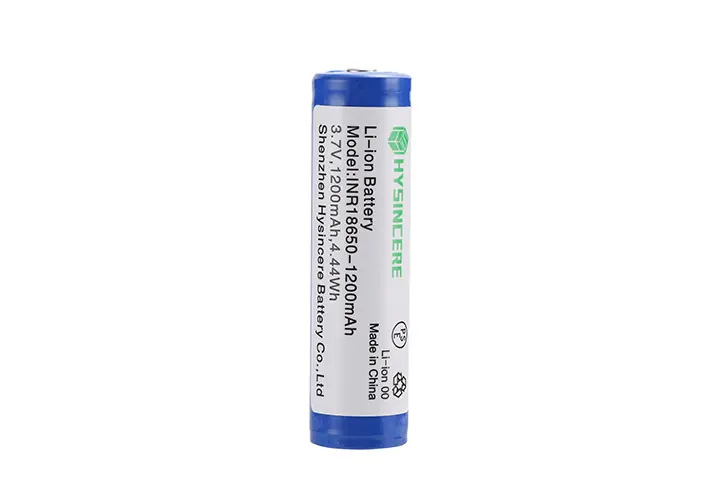
- Lithium-Ion (The “14500” Cell): The 14500 lithium-ion battery is in a similar size class to AA, but conventional cells have a nominal voltage of approximately 3.6–3.7 V. They require a device explicitly designed for them and a suitable charger. Protection boards and contact shapes can also change the dimensions.
3. Capacity and Performance Differences
With comparable chemistry and test conditions, the larger AA cell can store more energy than AAA. Usable capacity also depends on current, temperature, cutoff voltage and the specific model. Compare performance under the actual device load.
There is no fixed four- or five-fold runtime advantage for every alkaline cell over every zinc-carbon cell. Likewise, a higher cell voltage does not guarantee twice the power or a safe upgrade. Use only a battery type approved for the device.
Discuss Device Battery Requirements with Hysincere
Send Hysincere the device voltage, current, runtime target, available space, contacts and charging requirements. These details allow confirmed cell and battery-pack options to be assessed. Availability, suitability and required documentation for a particular AA or AAA option must be confirmed in the actual offer.
Discuss Your Cell Selection and Custom Battery Requirements
Share voltage, capacity, continuous and peak current, dimensions, cycle life, temperature, certification, and annual-volume requirements so Hysincere can evaluate suitable cells and battery-pack options.
What is the Difference Between AA (No. 5) and AAA (No. 7) Batteries FAQ
How do AA and AAA differ?
AA is larger than AAA. Compare the exact dimensions, chemistry, voltage and capacity at the intended load. A larger size alone does not establish compatibility or a fixed runtime advantage.
Can I replace a 1.5 V AA battery with a 14500 cell?
Not unless the device explicitly supports that cell. Conventional 14500 lithium-ion cells are approximately 3.6–3.7 V nominal, not 1.5 V. They need compatible electronics, contacts, protection and charging.
Can rechargeable NiMH batteries be used in every AA device?
No universal approval applies. NiMH cells are typically 1.2 V nominal, so check the device requirements, current demand and manufacturer’s instructions. Use a charger intended for that chemistry.
This article is intended for technical reference and preliminary project evaluation. Battery compatibility, charging limits, current capability, temperature range, BMS behavior, certifications, and installation requirements vary by model and application. Final selection and system configuration must follow the selected product datasheet, equipment-manufacturer requirements, and system-validation results.