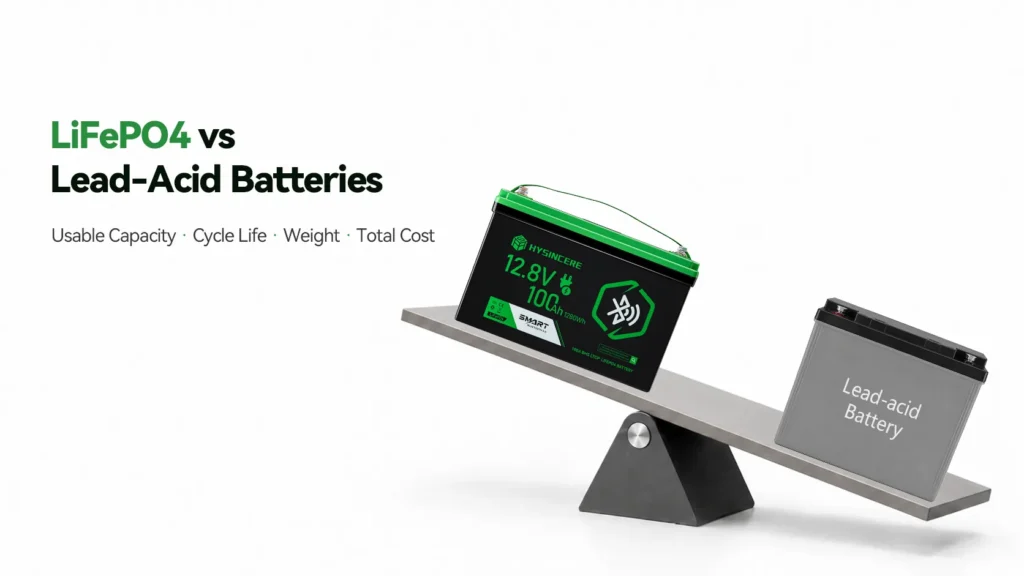
Many battery discussions start with the same line on a quotation sheet: 12V 100Ah.
It looks simple. A 12V 100Ah lead-acid battery and a 12.8V 100Ah LiFePO4 battery appear close enough to compare by price. In real systems, that comparison is often too shallow.
Once the battery is installed in an RV, marine system, solar storage setup, trolling motor, golf cart, backup power unit, or light electric equipment, the buyer does not feel the label on the battery. The buyer feels runtime, voltage stability, charging behavior, weight, maintenance, replacement frequency, and downtime.
That is why this article does not treat LiFePO4 as an automatic answer for every project. Lead-acid still has its place. The better question for a B2B buyer is: which battery chemistry gives this specific application the lowest practical cost, with fewer service problems over time?
The Short Answer
LiFePO4 is usually the stronger choice for deep-cycle, mobile, frequently used, weight-sensitive, and low-maintenance applications.
Lead-acid can still make sense when the system is used rarely, when the first purchase price is the main concern, or when the existing equipment is built around lead-acid charging and installation conditions.
So the useful question is not:
Which battery is cheaper to buy today?
The useful question is:
Which battery gives the lowest cost per usable cycle, with the least maintenance risk, in this application?
Main Differences Between LiFePO4 and Lead-Acid Batteries
| Factor | LiFePO4 Battery | Lead-Acid Battery | Why It Matters |
|---|---|---|---|
| Usable capacity | Usually allows a higher usable portion of rated capacity when the BMS and system are designed correctly | Often operated with shallower discharge to protect service life | Two 100Ah batteries may not deliver the same real runtime |
| Cycle life | Typically much stronger in deep-cycle use | More sensitive to depth of discharge, temperature, and state of charge | Affects replacement frequency and lifetime cost |
| Weight | Usually lighter for similar usable energy | Usually heavier and bulkier | Important for RV, marine, golf cart, and portable systems |
| Voltage behavior | Flatter voltage curve during discharge | Voltage drops more noticeably during discharge | Helps equipment run more consistently |
| Charging | Needs the correct LiFePO4 charging profile | Often needs full charging and float/absorption management | Affects solar recovery, turnaround time, and field use |
| Maintenance | Lower routine maintenance | Some lead-acid types require more attention; undercharging can shorten life | Affects service cost and customer satisfaction |
| Low-temperature charging | Requires BMS protection or self-heating design when charging in cold conditions | Some lead-acid systems can accept limited low-current charging in cold conditions | Critical for winter RV, marine, and outdoor use |
| Upfront cost | Usually higher | Usually lower | First cost is not the same as total cost |
| Total cost | Often stronger in high-cycle applications | Can become costly after replacement, labor, and downtime | Important for distributors and project buyers |
AGM, Flooded, and Gel Batteries Use Lead-Acid Chemistry
AGM (absorbed glass mat), flooded lead-acid (FLA), and gel lead-acid batteries all use lead-acid chemistry; none is a lithium battery. AGM holds the electrolyte in glass-fiber separators, flooded batteries use free liquid electrolyte, and gel batteries immobilize the electrolyte in a gel. These construction differences affect maintenance, venting, and charging requirements, so the three designs should not be treated as one operating profile.
When comparing any of them with LiFePO4, use the exact battery and charger datasheets. Check usable Wh, load current, charging voltage and profile, temperature, dimensions, terminals, and cycle duty instead of assuming the same Ah rating or the existing charger makes the systems interchangeable.
Why Amp-Hours Alone Can Mislead Buyers
Ah is only part of the story. Real usable energy also depends on voltage, discharge depth, current draw, temperature, BMS limits, and charging behavior.
A simple 12V-class example:
- A 12V 100Ah lead-acid battery has about 1,200Wh of nominal energy.
- A 12.8V 100Ah LiFePO4 battery has about 1,280Wh of nominal energy.
That is only the paper value. In actual use, lead-acid batteries are often kept away from repeated deep discharge because it can shorten service life. A well-designed LiFePO4 system can usually make more of its rated capacity available to the user.
Before comparing quotations, it is worth asking:
- How much usable energy will the system actually deliver?
- Will the battery hold stable voltage under the real load?
- Does the charger match the battery chemistry?
- What happens in cold weather?
- What will replacement labor and downtime cost later?
Cycle Life Changes the Cost Picture
Lead-acid has a clear advantage at the beginning: it is usually cheaper to buy. For low-cycle standby systems, that may be enough.
But in applications that cycle often, the calculation changes. RV rental fleets, marine power systems, solar storage, golf carts, cleaning machines, and mobile work equipment do not simply sit on standby. They are charged, discharged, moved, and serviced repeatedly.
A practical cost formula is:
Cost per usable cycle = battery purchase cost / expected usable cycles
In real projects, the buyer should also include:
- replacement labor
- downtime
- freight and installation
- warranty handling
- recycling or disposal handling
- customer complaints and field service
- charger or system changes
If you compare only the first invoice, lead-acid may look better. If you compare the whole service period, LiFePO4 often becomes more competitive in high-cycle applications.
Weight and Installation Space Are Not Small Details
Battery weight affects more than shipping. In RVs, boats, golf carts, and mobile equipment, it affects handling, installation, vehicle efficiency, structure, and user experience.
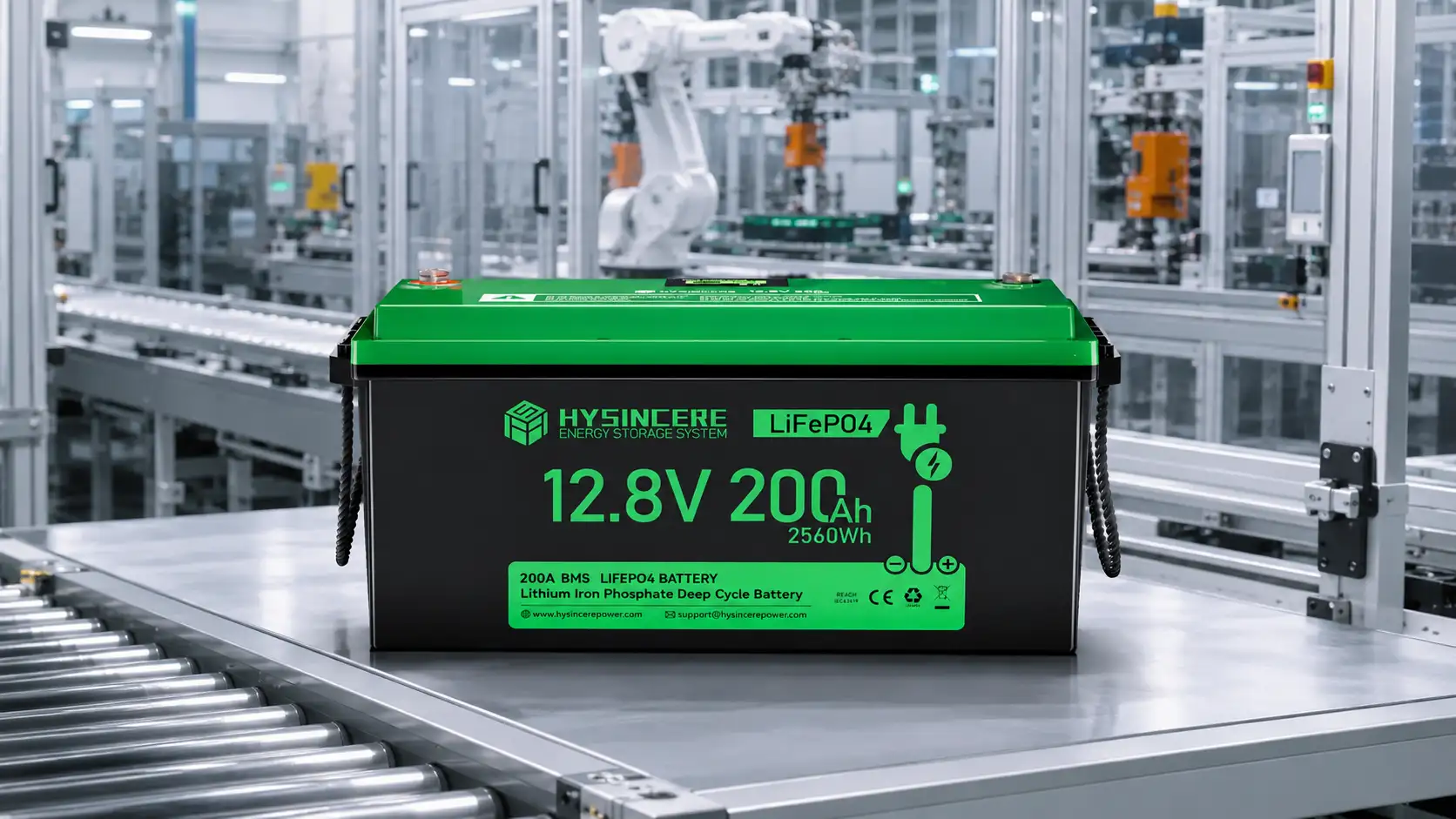
On the current Hysincere lead-acid replacement category page, the 12.8V 100Ah regular LiFePO4 model LF12100-HL-TM is listed at 1280Wh and 8.95kg. The same category also includes 150Ah, 200Ah, 300Ah, 314Ah, and 400Ah options, with regular, LCD display, Bluetooth, and self-heating configurations.
This does not mean every lead-acid battery should be compared against one single weight number. Lead-acid weight varies by type, brand, case design, and capacity. A better approach is to compare the customer’s actual battery bank against the replacement plan: total usable energy, total weight, physical size, terminal layout, and cable routing.
Charging Compatibility Must Be Checked
LiFePO4 should not be treated as a blind drop-in replacement. Many systems can be converted successfully, but only when the electrical conditions are right.
Before replacing lead-acid with LiFePO4, confirm:
- nominal system voltage
- maximum charging voltage
- charger or inverter-charger profile
- solar controller, alternator, or DC-DC charger behavior
- maximum continuous discharge current
- peak current demand
- low-temperature charging conditions
- terminal position, battery size, and mounting method
- communication requirements such as Bluetooth, CAN, or RS485
If these points are ignored, the battery may not charge fully, the BMS may disconnect under load, or the system may fail to deliver the expected runtime.
Cold-Weather Charging Needs Special Attention
Cold weather is one of the most common mistakes in lead-acid replacement projects.
LiFePO4 batteries can discharge in cold conditions within their specified range, but charging at low temperature must be controlled carefully. Many applications need low-temperature BMS protection or a self-heating battery structure. Hysincere’s current lead-acid replacement category includes self-heating models for winter RV use, outdoor equipment, and low-temperature regions.
If the customer’s system may charge below 0°C, clarify:
- Will the battery charge in freezing conditions?
- Is charging from solar, vehicle alternator, shore power, or an inverter-charger?
- Is self-heating required?
- How does the BMS handle low-temperature charging?
- What is the actual load current in cold operation?
These questions are better handled during selection than after the product is already in the field.
When Lead-Acid Still Makes Sense
Lead-acid is not obsolete in every project. It can still be reasonable when:
- the equipment is used rarely
- the battery is mainly for short-term standby
- the initial budget is very tight
- the existing charging system cannot be changed
- replacement labor is simple and inexpensive
- the project is not sensitive to weight or cycle life
- the user is already comfortable maintaining lead-acid batteries
A good supplier should not push lithium into every case. The right battery depends on the application, duty cycle, operating environment, and service expectations.
Applications Where LiFePO4 Often Fits Better
RV Power Systems
RV users usually care about usable energy, weight, charging speed, and maintenance. LiFePO4 is a strong fit for RV power systems with solar charging, refrigerators, water pumps, lighting, small inverter loads, and frequent off-grid use. Review the RV lithium battery application when matching runtime and charging conditions.
Marine and Trolling Motor Systems
Marine applications care about weight, runtime, stable discharge, and installation reliability. LiFePO4 can reduce battery-bank weight and improve usable capacity, but charger compatibility, peak current, terminal protection, and mounting conditions must be checked. The marine lithium battery application and trolling motor battery application provide the next level of application detail.
Solar Storage and Backup Power
Solar systems often cycle repeatedly. LiFePO4 is well suited for off-grid, hybrid, and backup storage applications where cycle life, predictable output, and low maintenance are important.
Golf Carts and Light Motive Power
These projects depend on voltage platform, continuous current, peak current, mechanical strength, communication, and BMS protection. Selection should begin with the vehicle system, not only the Ah rating. See the golf cart lithium battery application for the system factors that matter in motive use.
Cold-Weather Outdoor Equipment
Winter RV systems, outdoor equipment, mobile energy storage, and cold-region projects should confirm whether self-heating or low-temperature charging protection is required. Use the cold-weather lithium battery application to continue that review.
Questions to Ask Before Selecting a Battery
If you are evaluating a lead-acid replacement project, move beyond “How much is a 100Ah battery?” and ask:
- How much usable Wh will the battery deliver under my real load?
- What depth of discharge is recommended?
- What are the continuous and peak current limits?
- Can my current charger still be used?
- How is low-temperature charging protected?
- What BMS protections are included?
- Is Bluetooth, CAN, or RS485 communication required?
- Will the size, terminal position, and mounting method fit the original space?
- What certification or transport documents are required for the target market?
- For volume projects, how will warranty and technical support be handled?
Good answers to these questions lead to a real battery solution, not just a capacity-based quotation.
Where Hysincere Fits
Hysincere focuses on lithium battery solutions for energy storage and motive power applications, covering R&D, design, assembly, sales, and service support. Founded in 2013, Hysincere works with lithium battery packs, lead-acid replacement batteries, energy storage systems, and related application solutions.
For lead-acid replacement projects, Hysincere’s current website includes regular, LCD display, Bluetooth, and self-heating LiFePO4 configurations. These options can be matched to RV, marine, solar storage, backup power, and light electric equipment projects according to capacity, weight, monitoring needs, and low-temperature requirements.
If you are sourcing for a project, distributor channel, or OEM/ODM application, send the voltage, load current, runtime target, charging method, temperature range, installation space, and target market requirements. A practical selection starts from the system, not from the Ah label alone.
Use the right guide for the next decision
After comparing battery chemistries, use the guide that answers your next replacement or system-selection question:
- Lead-Acid to LiFePO4 Conversion Checklist — verify voltage, charger, BMS current, cold charging, wiring, installation and system compatibility.
- 12V 100Ah LiFePO4 Selection Guide — compare a specific 12V/100Ah use case for RV, marine and solar systems.
- LiFePO4 Charger Compatibility Guide — check AC charger, alternator, solar controller and inverter/charger compatibility.
- Regular vs LCD vs Bluetooth vs Self-Heating — choose the monitoring and low-temperature features needed for the project.
Technical references and scope
Battery performance varies by model, depth of discharge, temperature, load, and charging strategy. Use this article for project screening, then confirm the final choice against the battery, BMS, charger, and equipment specifications. References:
- Battery University: Charging Lithium Iron Phosphate
- Battery University: Charging Lead Acid
- Battery University: Charging at High and Low Temperatures
Evaluate Your Lead-Acid Replacement Project
Share the existing battery, system voltage, continuous and peak loads, charging equipment, temperature, installation space, and communication requirements. Hysincere can help evaluate the battery, BMS, charger, and overall system compatibility.
LiFePO4 vs Lead-Acid FAQ
Does a 100Ah LiFePO4 battery last the same as a 100Ah lead-acid battery?
Not necessarily. Ah is only the nominal capacity. Real runtime depends on voltage, usable discharge depth, load current, temperature, and system design. In many applications, LiFePO4 provides more usable capacity.
Can LiFePO4 directly replace lead-acid?
Sometimes, but it should not be assumed. Voltage, charger profile, current demand, low-temperature protection, BMS limits, size, terminals, and series/parallel rules must be checked.
Why does LiFePO4 cost more upfront?
LiFePO4 uses a different cell chemistry and requires BMS protection and pack design. The initial price is usually higher than lead-acid, but in high-cycle applications the lifetime cost can be lower.
Is lead-acid still useful?
Yes. Lead-acid can still work well for low-cycle standby systems, tight initial budgets, fixed legacy equipment, and users who already understand lead-acid maintenance.
What should I check for cold-weather use?
Check whether the battery will be charged below freezing, how the BMS handles low-temperature charging, and whether self-heating is required. Cold-weather charging should not be ignored in LiFePO4 projects.
What should be checked first in a replacement project?
Start with system voltage, usable Wh, continuous and peak current, charger compatibility, operating temperature, and installation space. These factors matter more than comparing Ah labels alone.
Are AGM batteries lithium?
No. AGM means absorbed glass mat and is a lead-acid battery design, not a lithium chemistry. It differs from flooded and gel lead-acid batteries in how the electrolyte is held, while LiFePO4 uses lithium iron phosphate chemistry and has different charging and protection limits.
This article is intended for technical reference and preliminary project evaluation. Battery compatibility, charging limits, current capability, temperature range, BMS behavior, certifications, and installation requirements vary by model and application. Final selection and system configuration must follow the selected product datasheet, equipment-manufacturer requirements, and system-validation results.