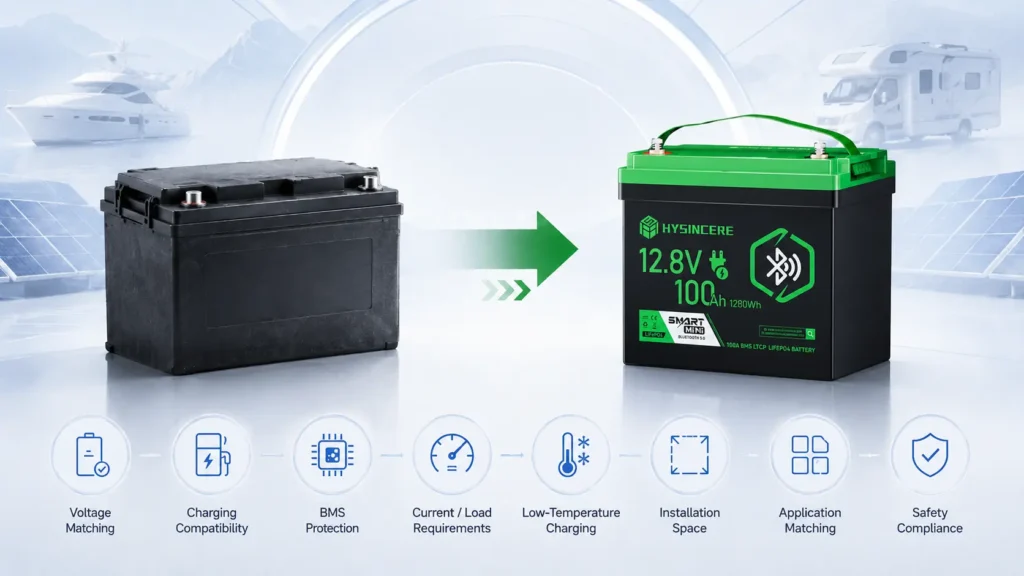
Converting a lead-acid system to LiFePO4 often involves more than replacing the battery. In an RV, boat, solar backup system, communications cabinet, or industrial DC installation, the battery is only one part of the power path. A mismatch in voltage limits, load current, charging equipment, low-temperature protection, cabling, or mounting can turn a “same-voltage replacement” into nuisance shutdowns, incomplete charging, equipment alarms, or field rework.
This guide is written for buyers, engineers, distributors, and product teams that need a defensible system review—not another generic list of lithium benefits.
The practical answer: the same “12V” label does not guarantee interchangeability
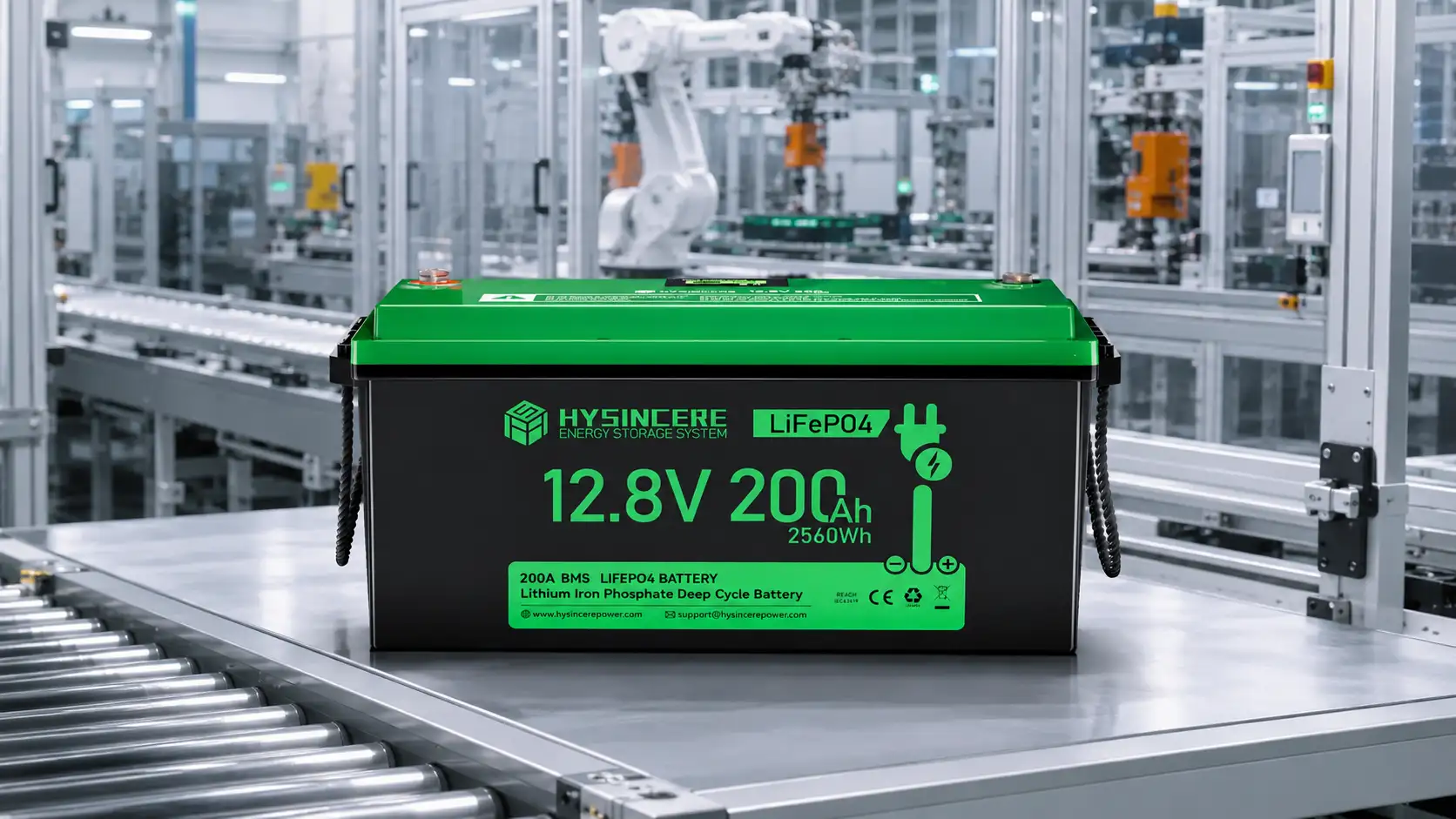
Many deep-cycle lead-acid applications can be evaluated for LiFePO4, but suitability depends on the operating envelope of the complete system, not only the 12V, 24V, or 36V label on the case. A common 12V LiFePO4 platform uses four cells in series and is rated at 12.8V. Hysincere currently lists 100Ah models with 1280Wh of rated energy. That platform can serve many nominal-12V loads, but charge limits, low-voltage settings, BMS current capability, and every charging source still require confirmation.
AGM is a lead-acid battery type. An AGM-to-LiFePO4 conversion uses the same system checks; the charger profile, current limits, and installation still require model-specific review.
Buyers already comparing 12V 100Ah options can start with the 12V 100Ah selection guide. For a chemistry-level comparison, see LiFePO4 vs. lead-acid capacity, life, weight, and cost.
Complete these 10 checks before converting from lead-acid to LiFePO4
- Define the duty before choosing capacity.
A battery used as an RV house bank, marine service bank, trolling-motor supply, UPS backup, or engine-starting source sees very different current, runtime, and failure consequences. Document the load type, daily operating hours, acceptable downtime, and whether the battery is the primary or standby source. - Confirm nominal voltage and the real operating window.
Do not match “12V lead-acid” to “12V lithium” by label alone. Check the equipment input range, charger output, inverter low-voltage shutdown, and alarm thresholds. The same applies at 24V and 36V. A native 25.6V or 38.4V pack is not automatically equivalent to several 12.8V batteries in series. - Compare energy in watt-hours, not amp-hours alone.
Amp-hours are convenient only when voltage and test conditions are comparable. Estimate the required runtime in Wh, then account for load profile, conversion losses, and engineering margin. - Calculate continuous current and surge current.
Inverters, pumps, motors, compressors, and winches can draw much more current at startup than during normal operation. Adequate cell energy does not prove that the BMS, terminals, fuse, contactor, and cables can carry the load. Confirm continuous discharge current, peak current, and the permitted peak duration. - List every charging source.
The AC charger is only one part of the system. RVs may also have an alternator, converter/charger, and solar controller. Boats may use shore power and engine alternators. Solar systems may rely on an inverter/charger. Each source must be compatible with the selected battery. - Review equalization, desulfation, and temperature-compensation functions.
Lead-acid charging programs may use voltage stages or pulses that LiFePO4 does not require and may not permit. A charger is not compatible simply because current flows. Use the target battery specification and the charger’s adjustable range as the decision basis. For a focused answer, see when an existing lead-acid charger can be considered for a LiFePO4 replacement. - Confirm low-temperature charging protection.
A battery may be able to discharge at a temperature where charging is restricted. Limits are model-specific. Cold-climate projects should verify low-temperature cutoff, self-heating logic, sensor location, and the energy source used for heating. Hysincere’s cold-weather application page shows available directions, but the selected model datasheet remains authoritative. - Check dimensions, terminals, restraint, and environment.
“It fits in the tray” is not enough. Confirm terminal orientation, lug clearance, service access, ventilation, vibration, salt exposure, water risk, and enclosure restraint. Mobile and marine installations need particular attention to movement and corrosion. Use the case, terminal, and installation-clearance measurement guide for the physical check; this conversion checklist records only the go/no-go result. - Verify series/parallel rules and protection architecture.
Only connect batteries in series or parallel when the exact model is approved for that configuration. Multi-battery systems also require matched units, similar state of charge, balanced cabling or busbars, branch protection, and a correctly sized main fuse. - Agree on documentation, acceptance, and support requirements.
A B2B project needs more than a successful sample. Confirm the datasheet, transport documentation, market-specific certifications, labels, communications protocol, packaging, warranty, and acceptance criteria before design freeze. Requirements vary by product, country, application, and shipping method.
A 12V example: why a 100Ah label may not answer the real question
Assume a mobile system must run a 1200W AC load through an inverter. Using 90% as an illustrative conversion efficiency:
The buyer therefore needs more than a “12V 100Ah” quotation. The review must establish whether:
- the BMS can carry roughly 104A continuously rather than for only a few seconds;
- startup surge exceeds the normal running current;
- cables, terminals, the disconnect, and the main fuse are designed for the current;
- the battery can still provide the required power at the target temperature and state of charge.
Runtime requires the same discipline. A 300W average load operating for four hours consumes about 1200Wh at the load. A battery rated at 1280Wh should not therefore be presented as a guaranteed four-hour solution when the system also has conversion losses, protection limits, temperature effects, and aging.
For a full Ah, Wh, current, and runtime estimate, use the LiFePO4 Battery Size & Runtime Calculator; the example above remains limited to the conversion decision.
When “drop-in replacement” is the wrong engineering approach
| Project condition | Why the risk is higher | Better approach |
|---|---|---|
| The battery also cranks an engine | Starting requires high short-duration current that a deep-cycle BMS may not support | Use a battery explicitly approved for starting, or separate starting and house functions |
| The old charger uses automatic equalization or desulfation | The voltage or pulse strategy may be outside the LiFePO4 specification | Disable incompatible functions if approved, or use a compatible charger |
| A large lithium bank is connected directly to an alternator | Low battery resistance can create high charging current and alternator heat | Evaluate a DC-DC charger or another approved current-limiting method |
| Charging must continue below freezing conditions | Charging limits depend on the cells and BMS strategy | Specify low-temperature cutoff or self-heating and verify the exact model data |
| The system is a critical UPS, fire, or communications backup | Compatibility, communications, fault behavior, and approvals are more demanding | Use an equipment-manufacturer-approved battery architecture and perform system validation |
| Different batteries will be mixed or added later without a plan | Age, resistance, and state-of-charge differences can create current imbalance | Use matched batteries under the manufacturer’s expansion rules and recheck protection |
Different applications have different review priorities
RVs: review the converter/charger, alternator-to-house-battery path, solar controller, inverter, battery monitor, and winter operating conditions. See Hysincere’s RV lithium battery applications.
If the original gauge estimates charge from voltage, review the LiFePO4 battery monitor guide before commissioning; LCD, Bluetooth, and shunt data serve different operating roles.
Marine and trolling motors: first separate starting, service, and trolling-motor duties. Then check the 12V/24V/36V platform, surge current, charging sources, corrosion control, and mechanical restraint. See the marine and trolling-motor application pages.
Solar and home backup: capacity is only one decision. Inverter communications, charge/discharge voltage, parallel architecture, protection, and critical-load priorities also matter. See home energy storage applications.
Prepare this operating brief before requesting a quotation
- Application and battery duty: primary power, cyclic storage, standby, or starting;
- Nominal system voltage, allowed input range, and existing battery model;
- Average load, maximum continuous load, startup surge, and required runtime;
- Brand/model, voltage range, and maximum current of every charging device;
- Minimum and maximum temperature, including whether charging occurs in the cold;
- Battery-bay dimensions, terminal orientation, cable size, vibration, and water exposure;
- Number of batteries, series/parallel plan, and future expansion expectations;
- Target market, shipping method, certification, labeling, and communication requirements;
- Expected annual volume, sample plan, and acceptance test.
Turn a Battery Swap into a Verifiable System Upgrade
Hysincere offers 12.8V, 25.6V, and 38.4V lead-acid replacement platforms and can discuss capacity, BMS, low-temperature protection, self-heating, displays, and communications for project requirements. A complete operating brief produces a more useful technical recommendation and quotation.
Lead-Acid to LiFePO4 Conversion FAQ
Can a 12V LiFePO4 battery directly replace a 12V lead-acid battery?
It can be evaluated in many deep-cycle applications, but the 12V label alone is not enough. Confirm the equipment voltage range, charger settings, continuous and peak current, temperature, dimensions, terminals, and BMS capability. Starting and critical-backup applications normally require additional system validation.
Must the existing charger always be replaced?
No. It may remain usable if its voltage and charging logic can be set within the selected battery’s limits and incompatible equalization or desulfation modes can be disabled. Compatibility should be confirmed from both manufacturers’ technical data, not merely from the fact that the battery accepts a charge.
Can one 100Ah lithium battery replace two 100Ah lead-acid batteries?
There is no reliable answer from Ah alone. Compare system voltage, measured load, required runtime, allowable discharge, conversion efficiency, and peak current. Convert both options to Wh and evaluate them under the intended duty cycle.
Can LiFePO4 batteries operate in cold weather?
Many models can discharge at low temperature, while charging limits are usually more restrictive. Check the exact datasheet and confirm low-temperature charge cutoff or self-heating where required. Do not apply one brand’s temperature rating to all LiFePO4 batteries.
Can 12V batteries be connected in series for 24V or 36V?
Only when the exact model is approved for series operation. Use matched batteries, align their initial state of charge, and follow the required protection and cabling rules. For volume projects, a native 25.6V or 38.4V pack can sometimes simplify consistency and integration.
Is voltage and capacity enough information for a quotation?
Usually not. Provide load power, peak current, runtime, charging equipment, temperature, dimensions, series/parallel configuration, certification needs, and expected volume. Voltage and capacity describe only part of the battery—not the complete project.
Can an AGM battery be replaced with LiFePO4?
It can be evaluated in many deep-cycle systems, but AGM is still a lead-acid battery type and the change is not only a battery swap. Check the charger profile, equipment voltage range, continuous and peak current, low-temperature charging, dimensions, terminals, and BMS limits for the exact LiFePO4 model.
This article supports preliminary project evaluation. It does not replace the formal documentation of the selected battery, charger, inverter, vehicle, vessel, or equipment manufacturer. Final configuration should follow model-specific specifications and system validation.