An unusually high internal-resistance reading needs investigation, but one number cannot establish whether a lithium battery is safe. Compare the exact cell model, measurement method, temperature and state of charge. Stop use and charging if there is damage, swelling, leakage or unusual heating.
Measure Resistance Under Comparable Conditions
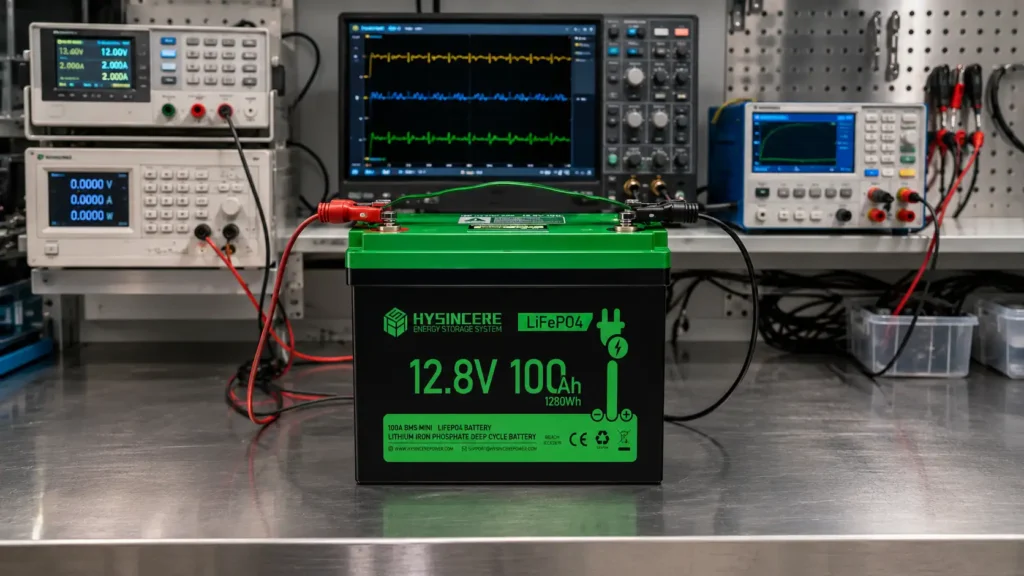
An AC impedance reading and a DC pulse-resistance result are not interchangeable. Leads, contacts and connections can also affect the result. Compare like-for-like measurements against the relevant specification; neither 30–80 mΩ for a 1 Ah cell nor a value below 15 mΩ is a universal acceptance limit.
Voltage Drop and Heat Under Load
A simple resistance model uses voltage drop ΔV = IR and resistive loss P = I²R. For an illustrative 5 A load and 0.05 Ω resistance, the calculated drop is 0.25 V and the loss is 1.25 W. These are electrical calculations, not a prediction of cell temperature or a product rating.
- Heat under load: Higher resistance can increase losses at a given current. Check the load duration and cooling as well as temperature; resistance alone does not define a thermal-runaway threshold.
- Earlier cutoff: Voltage sag may trigger the device or BMS before a low-current capacity test would suggest. Available energy at the intended load matters more than capacity measured under easier conditions.
Cell Differences in a Battery Pack
In series, every cell carries the pack current, and a weaker cell can reach its voltage limit sooner. In parallel, differences in resistance and connections can change current sharing. The temperature of a particular cell depends on its actual current and cooling; it does not follow that every higher-resistance cell is always the hottest.
Review Cell and Pack Requirements with Hysincere
For a custom battery pack, send Hysincere the cell model, measured result and method, temperature, charge level, load profile and operating symptoms. Those details help distinguish a measurement issue, connection loss, aging or an unsuitable cell choice. Do not bypass protection or mix replacement cells to hide a fault.
Discuss Your Battery Project Requirements
Share the application, voltage, capacity, load, charging method, dimensions, temperature, certification, and annual-volume requirements for an initial technical review by Hysincere.
A resistance reading alone cannot establish safe current or battery condition. Compare the exact model and test conditions. Stop use and charging if there is damage, leakage, swelling or unusual heating. Do not bypass protection, open cells or run improvised fault tests.