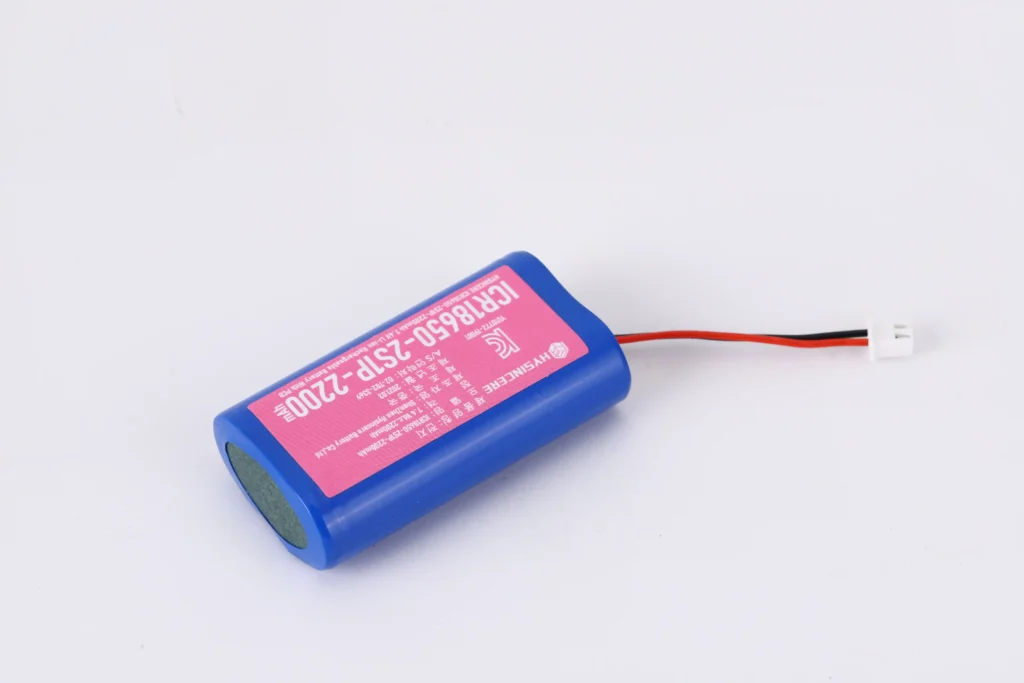
A protected 18650 cell has an added electronic protection board; an unprotected version normally does not. That difference affects dimensions, current limits and system design. It does not mean “safe in every device” versus “without any safety mechanisms.”
For an OEM project, identify what protects the individual cell, the assembled pack and the equipment. Compare those functions with the actual charger, load and installation before choosing either version.
What Is a Protected 18650 Battery?
A protected version combines a lithium-ion cell with an additional protection circuit, often called a PCB or PCM. The board can disconnect the current path under specified fault conditions. Functions, thresholds and response times depend on the design:
- Overcharge: A voltage protection threshold is not necessarily the normal charge-termination voltage. Verify both values against the selected cell; the board does not replace a suitable charger.
- Over-discharge: An undervoltage cutoff can limit further discharge. There is no universal 2.5 V threshold for every cell or protection board; follow the actual specifications.
- Short-circuit and overcurrent: Check the detection threshold, delay and switching capability. Protection must match the possible fault current and the application.
Check the complete dimensions: The board, contacts and wrapper can add length and diameter. Some protected versions are around 69–70 mm long, but use the actual drawing. An unprotected 18650 is not necessarily exactly 65.0 mm long either. Confirm fit, polarity and the device’s approved cell specification.
What Is an Unprotected 18650 Battery?
“Unprotected” usually means no added electronic single-cell protection board. A cell may still contain design-specific internal safety mechanisms, but these do not replace suitable pack or device protection. Loose industrial cells should not be treated as a generally approved consumer power source.
In a properly designed multi-cell pack, monitoring and fault interruption can be coordinated at pack level. The architecture depends on the cell, series/parallel arrangement, charger and load. Examples of projects requiring that assessment include:
- OEM tool packs with coordinated cell, charger and equipment protection.
- Electric drives and automated guided vehicles with suitable pack monitoring.
- Industrial power systems with defined fault detection and interruption.
- Portable equipment and lighting whose manufacturer approves the selected cell and protection arrangement.
Technical Comparison Matrix
| Feature | Protected 18650 Battery | Unprotected 18650 Battery |
|---|---|---|
| Circuit Protection | Model-specific functions; verify thresholds, delays and current limits. | Suitable electronic protection must be provided by the complete pack or device. |
| Physical Length | Often around 69–70 mm; confirm the offered variant. | 18650 size class; use the drawing’s maximum dimensions and tolerances. |
| Discharge Rate (Amps) | Limited by the cell, board, contacts and temperature. | Limited by the cell and complete pack/device design—not unrestricted. |
| Primary Use Case | Only in compatible holders and equipment approved for that version. | Qualified systems with a coordinated protection architecture. |
| Safety assessment | Not a plug-and-play safety guarantee. | Not permission to operate without protection or use loose cells. |
Choosing the Right Cell for Your Business
When to Use Protected 18650 Batteries
An added protection board can be useful when its dimensions, limits and cutoff behavior fit the device. It is one part of the protection design, not a substitute for system validation. Check each application separately:
- Medical equipment: Meet the device-specific safety and documentation requirements. A protection board alone does not establish approval or foolproof operation.
- Portable lighting: Use the approved cell and compatible charger. The board does not make an unsuitable or unverified charger acceptable.
- Measurement instruments: Check contact geometry, startup current, runtime and shutdown behavior in the actual instrument.
When to Use Unprotected 18650 Batteries
For an OEM pack, cell monitoring and protection can be designed together. Cells without individual boards are one possible component choice, not a mandatory choice for every product. Typical design checks include:
- Multi-cell packs: Coordinate voltage and temperature monitoring, current limits, fault interruption and any required balancing with the series/parallel arrangement.
- Electric drives: Match the pack, motor controller and charger, including startup peaks and regenerative charging where applicable.
- Tools: Verify protection across the pack, tool and charger. A function located in the tool alone may not cover charging, storage or a disconnected pack.
Discuss the Protection Design with Hysincere
Choose the architecture around the complete product. Specify who monitors voltage, temperature and fault current, how the current path is interrupted, and which charging system is used. Keep traceable cell documentation and test the proposed configuration.
Hysincere develops and manufactures battery packs. Send the equipment type, cell count, voltage window, energy requirement, continuous and peak current, installation space and required test documents. The team can assess a pack and protection arrangement against those conditions; availability and approval depend on the specific configuration.
Discuss Your Cell Selection and Custom Battery Requirements
Share voltage, capacity, continuous and peak current, dimensions, cycle life, temperature, certification, and annual-volume requirements so Hysincere can evaluate suitable cells and battery-pack options.
Protected and Unprotected 18650 Questions
Is a protected 18650 safe in any device?
No. Dimensions, contacts, current limits, protection thresholds and charging requirements must fit the device. An added board does not prevent every internal failure or make an incompatible charger acceptable.
Does an unprotected cell have no safety mechanisms?
Unprotected normally means no added electronic single-cell protection board. Design-specific internal mechanisms may exist, but they do not replace suitable pack and equipment protection.
Can protected and unprotected versions be interchanged?
Not automatically. The board and contacts can change size, current limits and cutoff behavior. Confirm the device-approved specification, charger and complete installation dimensions before substitution.
This article is intended for technical reference and preliminary project evaluation. Battery compatibility, charging limits, current capability, temperature range, BMS behavior, certifications, and installation requirements vary by model and application. Final selection and system configuration must follow the selected product datasheet, equipment-manufacturer requirements, and system-validation results.