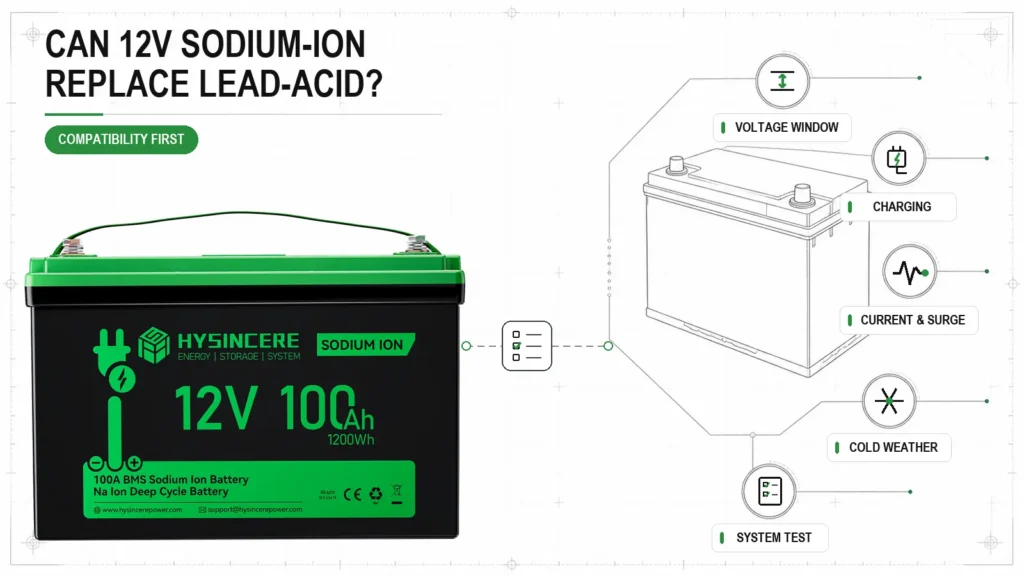
Yes, a 12V sodium-ion battery can replace a lead-acid battery in some systems—but “12V” does not mean universal drop-in compatibility. The replacement is suitable only when the battery, charger, alternator, solar controller, inverter or UPS, loads, protection devices and operating temperature all work inside one verified system envelope.
For buyers and engineers, the right question is not simply “Will it fit?” It is: Can every charging source and every load operate safely between the selected battery’s permitted charge, discharge, current and temperature limits?
Hysincere’s sodium-ion batteries designed for lead-acid replacement provide product options for this type of project. The following checks should still be completed for the exact model and installation.
The short answer: replace only when five conditions are true
A proposed 12V sodium-ion replacement should pass all five gates:
- The battery’s voltage window fits the charger, equipment input range, alarms and shutdown settings.
- Every charging source can use an approved profile without incompatible equalization, desulfation or temperature-compensation behavior.
- The maximum continuous load and startup surge stay within the battery and the rest of the DC power path.
- Charging and discharging temperatures are assessed separately for the exact model.
- The installation, protection, controls and commissioning tests are suitable for the real application.
If one gate is unknown, the answer is not yet confirmed. A trial installation should not be used to replace missing specifications.
Start with the real voltage window, not the 12V label
“12V” is a nominal system class. It does not define the full charge curve, the highest charging voltage, the lowest permitted discharge voltage or the state-of-charge behavior seen by an existing gauge.
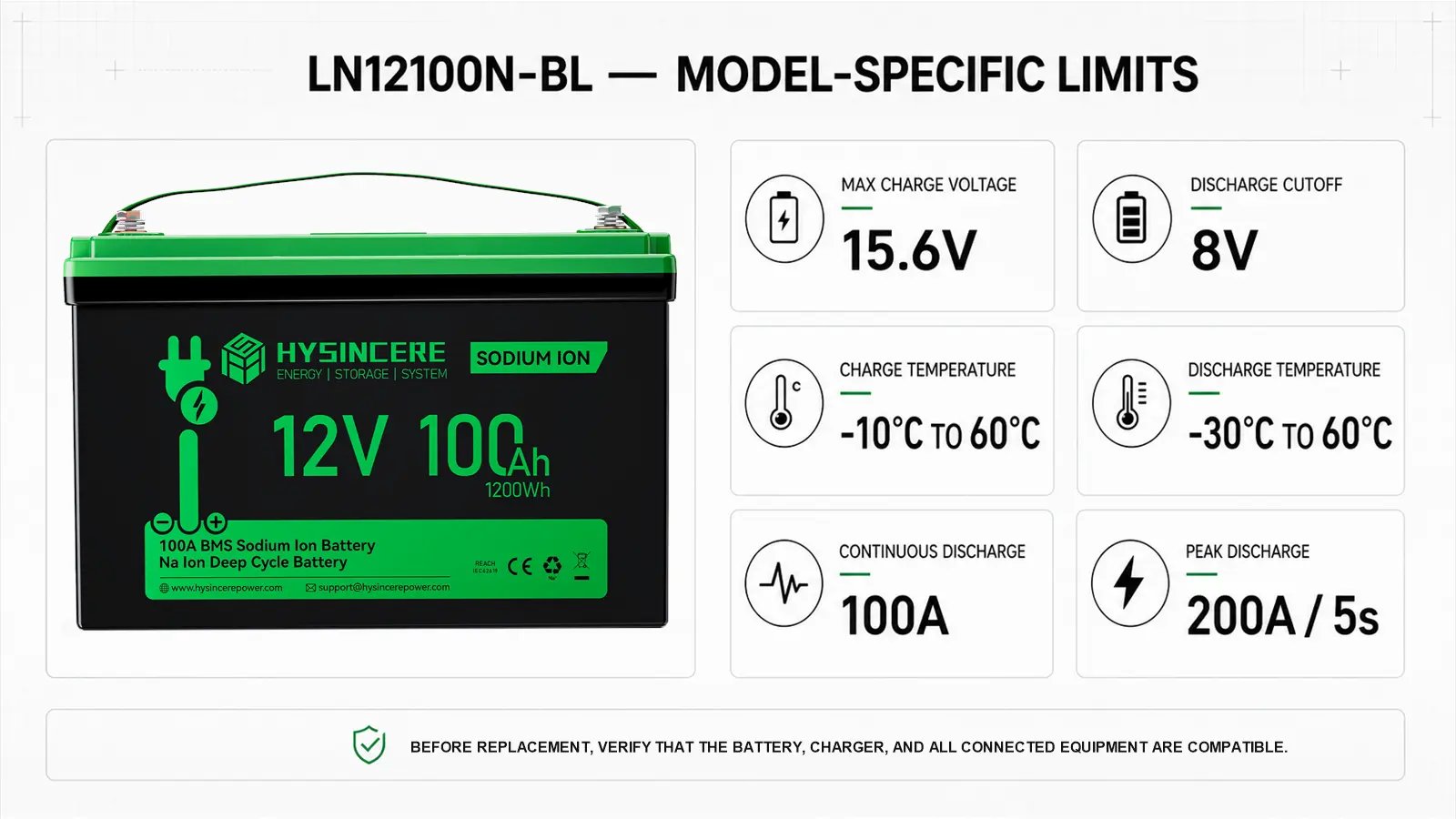
For the Hysincere LN12100N-BL, the currently verified model data includes:
| LN12100N-BL field | Verified model value | How to use it in a compatibility review |
|---|---|---|
| Nominal voltage | 12V | Match the nominal system class, then check the actual limits below. |
| Nominal capacity | 100Ah | Use with the load profile and required runtime; capacity alone does not prove power compatibility. |
| Rated energy | 1200Wh | Compare with required load energy, conversion losses and engineering margin. |
| Maximum charge voltage | 15.6V | Confirm that no charging source or control mode exceeds the model limit. |
| Discharge cutoff | 8V | Compare with equipment alarms and shutdown logic. Do not treat a protection boundary as the preferred operating setpoint. |
These are model-specific boundary data, not universal sodium-ion values. In particular, 15.6V is the maximum charge-voltage boundary listed for this model, not a recommended everyday charger setpoint. The project still needs a manufacturer-approved operating profile and suitable engineering margin; it should not routinely depend on the battery reaching a protection limit.
Compare the battery data with the following equipment fields:
| System item | Data to obtain | Possible mismatch |
|---|---|---|
| AC charger | Highest output voltage, stage logic, current and restart behavior | Overvoltage, repeated restart, incomplete charge or incompatible maintenance mode |
| Inverter or DC load | Allowed DC input range, alarm and low-voltage shutdown | Early shutdown, nuisance alarm or reliance on battery protection |
| UPS | Charger profile, transfer logic, battery test and DC cutoff | Charger conflict, failed battery test or unexpected runtime behavior |
| Battery monitor | How state of charge is estimated and whether chemistry settings are available | An inaccurate percentage even when the battery is operating normally |
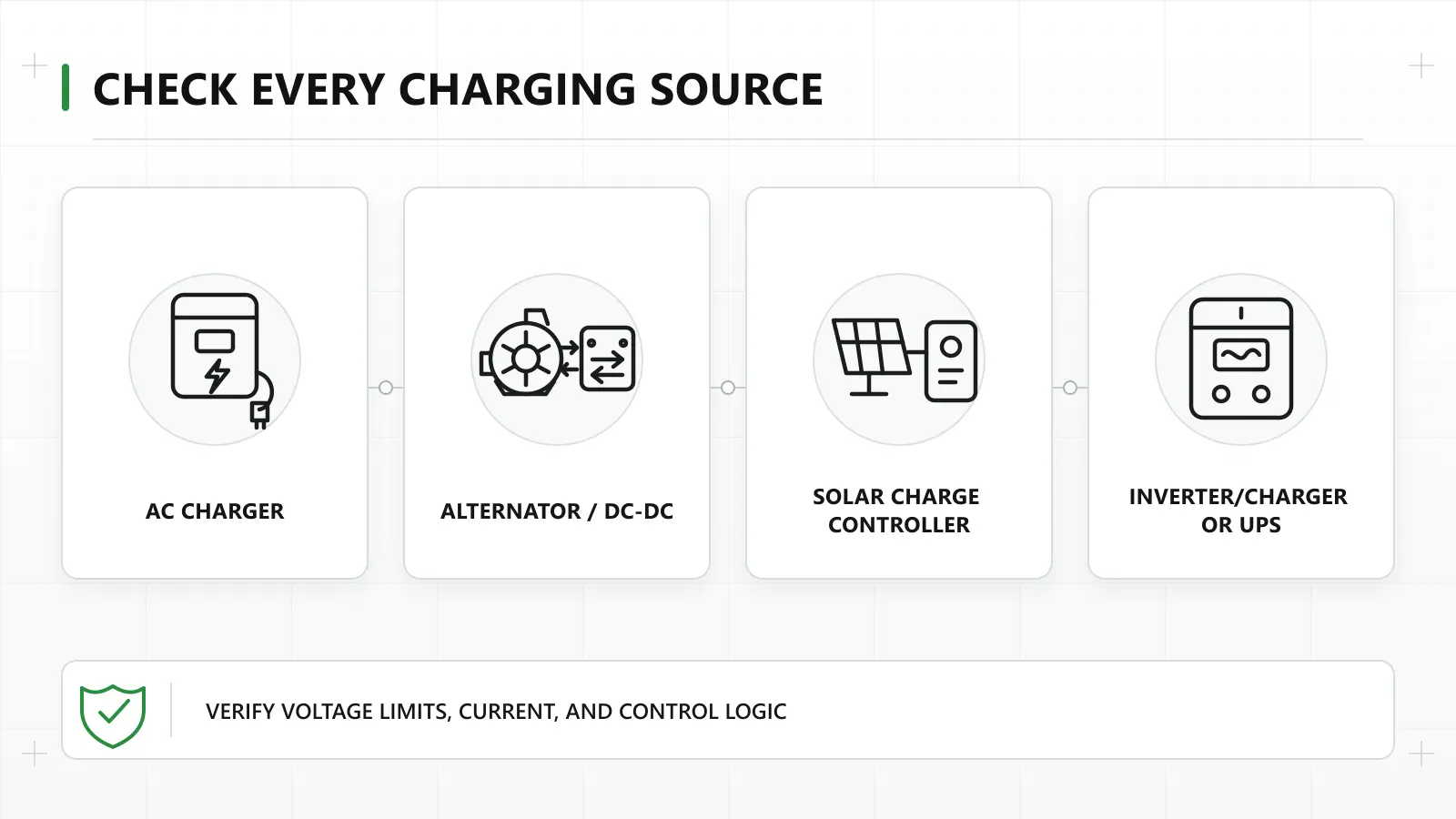
Check every charging source, not only the wall charger
A vehicle, boat, solar installation or backup system can have several charging paths. Each one must be reviewed independently and then tested as part of the complete system.
AC charger
Obtain the charger manual or measured profile and check:
- the bulk or absorption setpoint against the selected battery specification;
- whether float or standby charging is required, optional or unsuitable for the approved profile;
- whether equalization, reconditioning, desulfation or high-voltage pulse modes can be disabled;
- whether lead-acid temperature compensation changes voltage in a way that conflicts with the selected battery;
- the maximum charging current and the behavior after the battery or charger enters protection.
Current flowing into the battery does not by itself prove charger compatibility.
Alternator
Do not assume that an alternator connection suitable for lead-acid is automatically suitable for sodium-ion. Record the alternator or DC-DC charger model, regulated voltage, current limit, cable length and expected charging time. The review should also consider current control and alternator temperature under prolonged charging. If the original system cannot regulate the required profile, an approved DC-DC charging stage or another engineered interface may be needed.
Solar charge controller
Confirm that the controller offers a suitable user-defined or manufacturer-approved profile. Review its high-voltage setpoint, float behavior, equalization function, temperature compensation, low-temperature logic and load-output cutoff. A controller preset named “lead-acid” is not evidence of compatibility.
Inverter/charger or UPS
These devices must be reviewed twice: once as a charger and once as a load. Confirm the charging algorithm, DC input range, low-voltage alarm, shutdown threshold, restart voltage, battery-test logic and maximum continuous and surge demand. Some UPS units expose few battery settings; in that case, compatibility must be established from the equipment manufacturer’s specifications and system testing rather than assumed from the 12V label.
Match continuous current and surge duration to the real load
Energy and current answer different questions. A 1200Wh battery may contain enough energy for a duty cycle yet still be unsuitable for a load whose current or startup surge exceeds the battery-management and power-path limits.
For the LN12100N-BL, the verified discharge limits used in this draft are:
- maximum continuous discharge current: 100A;
- peak discharge current: 200A for 5 seconds.
These values apply to this model only. A load that requires 200A for longer than five seconds is not covered by the five-second peak rating. The same review must include terminals, cables, connectors, disconnects, contactors and fuses; a battery rating does not validate the rest of the circuit.
Use the lowest expected operating voltage and a realistic efficiency when checking an inverter load, because current rises as battery voltage falls. For motors, pumps and compressors, obtain measured startup current and duration whenever possible instead of relying only on the nameplate wattage.
Separate cold-weather charging from cold-weather discharging
“Works in cold weather” is too broad to support a replacement decision. A battery can be permitted to discharge at a temperature where charging is restricted, and operation within a stated range does not guarantee the same allowable charge rate, capacity, power or runtime across that entire range.
The verified temperature ranges for the LN12100N-BL are:
| Function | Verified model range | Project implication |
|---|---|---|
| Charging | −10°C to +60°C | The charger and system controls must prevent charging outside the model-specific permitted range. |
| Discharging | −30°C to +60°C | The load may operate over a wider low-temperature range than charging, but required current and runtime still need validation. |
Do not generalize these limits to every sodium-ion battery. For a cold-climate project, also define:
- the coldest battery temperature, not only the outdoor air temperature;
- whether charging can begin while the battery is cold;
- where the temperature sensor is located and which controller acts on it;
- how the system behaves after a temperature-related stop;
- the required power and runtime at the minimum design temperature.
Review installation, protection and bank architecture
Electrical compatibility is necessary but not sufficient. Before replacing the battery, check the available space, restraint, terminal orientation, lug clearance, service access, cable size, branch protection, main fuse, disconnect and environmental exposure.
Current LN12100N-BL product data lists a maximum configuration of 4S4P. Treat that as a model-specific upper boundary to verify against the current datasheet and written project approval—not as automatic permission to build any 4S4P bank. The design must confirm matched batteries, charging architecture, current sharing, equal-length paths where required, branch and main protection, isolation, monitoring, fault behavior and the resulting system voltage and current.
Do not assume that batteries of different chemistries, models, ages or states of charge can share one bank. The system owner should also define how faults are isolated and how a failed unit is serviced without exposing personnel or equipment to uncontrolled DC current.
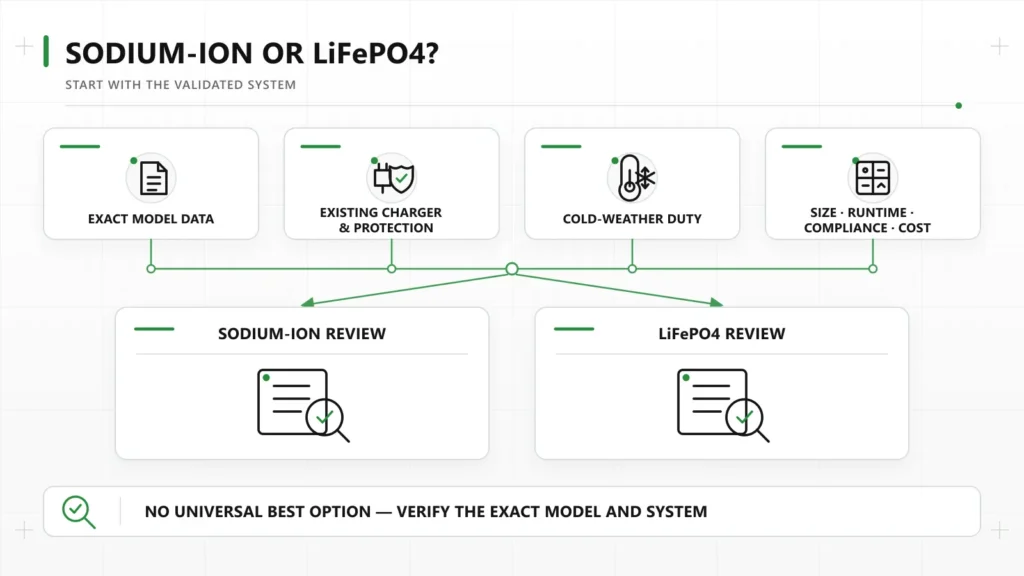
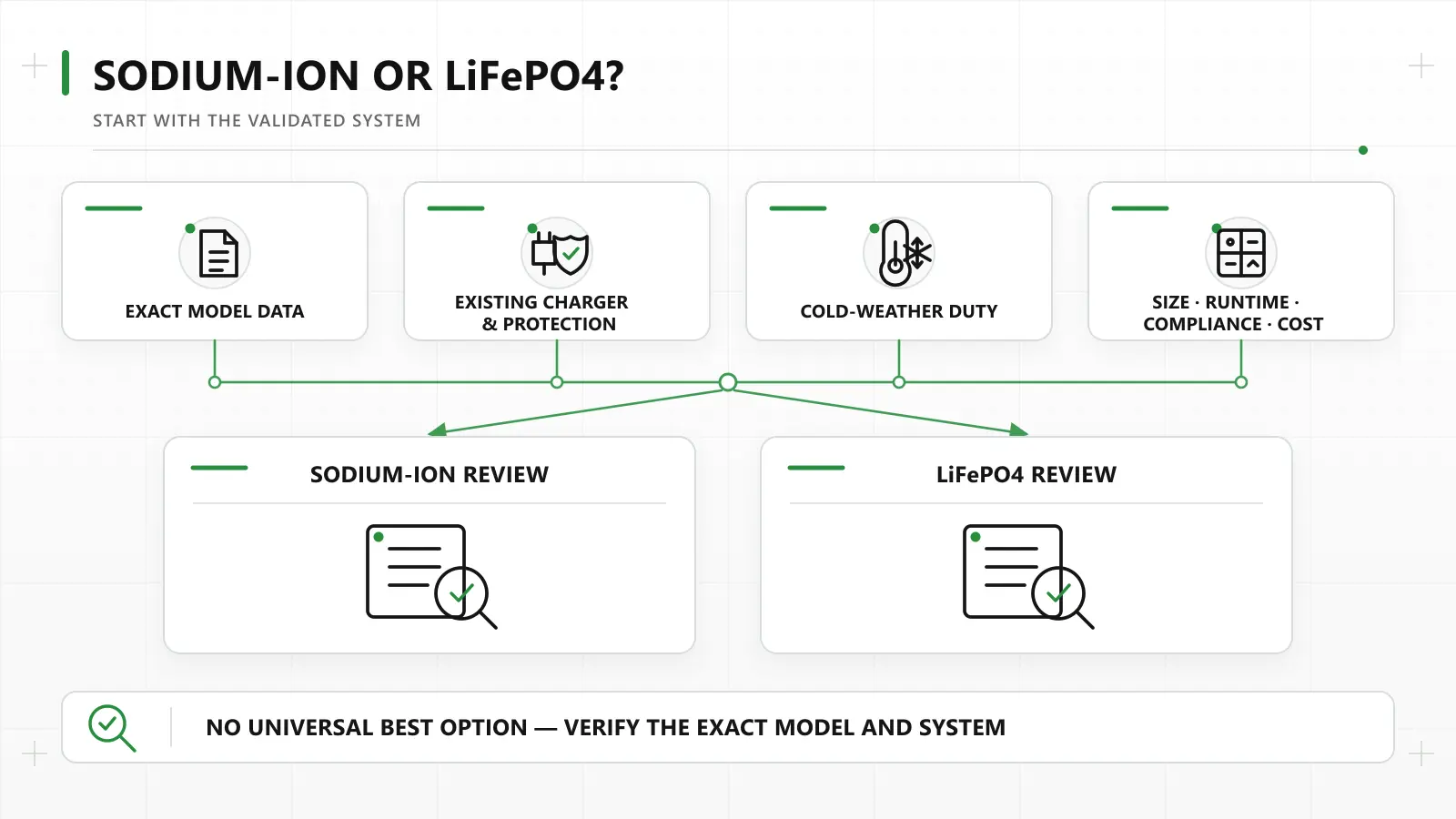
Sodium-ion or LiFePO4: choose the validated system, not the chemistry slogan
This article does not repeat the broad technology comparison owned by Hysincere’s Lithium vs. Sodium Batteries guide. For a 12V replacement project, use the shorter decision logic below:
| Project situation | Sodium-ion review direction | LiFePO4 review direction |
|---|---|---|
| A specific sodium-ion model has verified voltage, current and temperature limits that match the duty | Keep sodium-ion on the shortlist and complete charger and system testing. | Compare an exact LiFePO4 model on the same duty; do not rely on generic chemistry claims. |
| The site already has a validated LiFePO4 charger, protection design and approved equipment list | Quantify every change needed before introducing a different chemistry. | An already validated LiFePO4 architecture may reduce integration work. |
| Low-temperature operation is the main requirement | Compare the exact model’s separate charge and discharge ranges and required output at temperature. | Compare the exact model’s charging restriction, protection and any approved heating strategy. |
| Weight, size, runtime, certifications or lifecycle cost are decisive | Compare current datasheets, compliance evidence, samples and commercial terms for the exact products. This article does not assign a generic winner. | |
Sodium-Ion or LiFePO4: Project Review Direction
Compare exact products and the validated system rather than relying on generic chemistry claims.
Sodium-Ion Review Direction
Keep the exact model on the shortlist only after its limits match the real duty.
Complete charger and system testing for the exact model. For low-temperature projects, compare separate charge and discharge ranges and required output at temperature.
| Project situation | Review direction |
|---|---|
| A specific sodium-ion model has verified voltage, current and temperature limits that match the duty | Keep sodium-ion on the shortlist and complete charger and system testing. |
| Low-temperature operation is the main requirement | Compare the exact model’s separate charge and discharge ranges and required output at temperature. |
| Weight, size, runtime, certifications or lifecycle cost are decisive | Compare current datasheets, compliance evidence, samples and commercial terms for the exact product. |
LiFePO4 Review Direction
An already validated LiFePO4 architecture may reduce integration work.
Compare an exact LiFePO4 model on the same duty. Confirm charger settings, protection design, approved equipment and any low-temperature charging or heating strategy.
| Project situation | Review direction |
|---|---|
| The site already has a validated LiFePO4 charger, protection design and approved equipment list | An already validated LiFePO4 architecture may reduce integration work. |
| Low-temperature operation is the main requirement | Compare the exact model’s charging restriction, protection and any approved heating strategy. |
| Weight, size, runtime, certifications or lifecycle cost are decisive | Compare current datasheets, compliance evidence, samples and commercial terms for the exact product. |
Buyers who prefer an established LiFePO4 replacement path can review Hysincere’s 12V LiFePO4 battery range. The final choice should follow verified product data and system validation in both cases.
When you should not make a direct replacement
Do not treat the project as a direct swap when any of the following applies:
- the charger’s maximum voltage or charging stages cannot be matched to the battery specification;
- equalization, desulfation or incompatible temperature compensation cannot be disabled;
- the equipment input range, alarm or cutoff conflicts with the battery’s verified voltage window;
- continuous current exceeds the model limit, or the startup surge exceeds the permitted current or duration;
- charging can occur below the selected model’s minimum charging temperature or above its maximum;
- the UPS, inverter/charger, alternator or solar controller has undocumented battery logic;
- the battery also serves an engine-starting or other high-consequence duty without explicit approval for that use;
- different battery chemistries or unmatched units would remain in one bank;
- required dimensions, terminals, protection, certification or communications have not been confirmed.
In these cases, change the charger or control architecture, select another battery, separate the duties, or obtain an equipment-manufacturer-approved solution before deployment.
Commission the complete system before fleet deployment
For a B2B project, validate a representative system before purchasing or converting a fleet:
- Record the existing lead-acid battery, every charging source and every load.
- Confirm the selected sodium-ion model specification and approved operating profile.
- Measure charger voltage and current through startup, normal charging, full charge, standby and restart.
- Test maximum continuous load and the worst expected startup surge.
- Verify alarms, low-voltage shutdown, restart and battery-monitor behavior.
- Test temperature controls at the lowest and highest relevant charging and discharging conditions.
- Inspect cable temperature, voltage drop, terminal security and fuse coordination.
- Record the results and define acceptance limits before scaling to production.
Lead-Acid Replacement Product Selector
Filter published catalog products from their Crocoblock taxonomy data. Final compatibility still requires model-specific validation.
What to send for a B2B compatibility review
Prepare the following information with your inquiry:
- current lead-acid battery model, nominal voltage and bank configuration;
- application and battery duty: cyclic, standby, motive, house load or another defined function;
- AC charger, alternator or DC-DC charger, solar controller, inverter/charger and UPS models;
- measured or specified charge voltages, current limits, alarms and shutdown thresholds;
- average load, maximum continuous load, startup current, surge duration and required runtime;
- minimum and maximum battery temperature, including whether charging occurs in the cold;
- installation space, terminal arrangement, cable size, fuse and disconnect details;
- number of batteries, proposed series or parallel architecture and future expansion plan;
- destination market, required documentation, approval tests and expected volume.
Conclusion
A 12V sodium-ion battery can replace lead-acid when the whole system is compatible. The nominal voltage is only the starting point. Voltage boundaries, charger behavior, alternator and solar charging, inverter or UPS settings, continuous current, surge duration, temperature limits, protection and commissioning must all agree.
The LN12100N-BL example shows why model-specific data matters: 12V, 100Ah and 1200Wh identify the product class, while the 15.6V maximum charge voltage, 8V discharge cutoff, 100A continuous discharge limit, 200A/5s peak limit and separate charge/discharge temperature ranges define critical parts of the engineering review. None of those values should be generalized to every sodium-ion battery.
Need a 12V Replacement Compatibility Review?
Share your battery, charger, load, surge, temperature and installation data. Hysincere can help evaluate an appropriate model and the system checks required before sampling.
12V Sodium-Ion Lead-Acid Replacement FAQ
Practical answers for voltage, charging, cold-weather and load compatibility checks.
Is a 12V sodium-ion battery a universal drop-in replacement for lead-acid?
No. Nominal voltage alone does not prove compatibility. Check the actual voltage window, every charging source, load current and surge, temperature limits, protection, installation and equipment logic for the exact model.
Can I use an existing lead-acid charger with a sodium-ion battery?
Only if its complete charging profile is approved for the selected battery. Verify maximum voltage, current, float or standby behavior, equalization, desulfation, temperature compensation and restart logic. Current flow alone is not proof of compatibility.
Can a sodium-ion battery charge and discharge at the same low temperature?
Not necessarily. The limits are separate and model-specific. For LN12100N-BL, the verified charging range is −10°C to +60°C and the discharge range is −30°C to +60°C. These limits do not apply to every sodium-ion battery.
Can LN12100N-BL run an inverter or UPS?
It can be considered only after the inverter or UPS voltage window, charger, continuous current, startup surge and cutoff behavior are checked. LN12100N-BL is rated at 100A continuous discharge and 200A peak for five seconds; the connected system must remain within the full set of limits.
Does 100Ah tell me how long the replacement battery will run?
No. Runtime depends on watt-hours, the real load profile, conversion losses, protection limits, temperature and operating margin. Use measured load data instead of comparing amp-hours alone.
Should I choose sodium-ion or LiFePO4 for a 12V lead-acid replacement?
Compare exact models against the same duty. Sodium-ion may be considered when a validated model fits the voltage, current and temperature requirements. LiFePO4 may reduce integration work where the charging and protection architecture is already validated. Neither chemistry is a universal winner.
Product limits and compatibility are model- and system-specific. Confirm the current datasheet, charger and equipment specifications, applicable standards and a representative system test before replacing batteries or deploying a fleet.