Can a 24V 100Ah LiFePO4 battery last a full day on a trolling motor? It can cover a planned trip if the motor’s actual current draw and running time stay within the energy budget you set. It cannot be promised from the 100Ah label alone. Wind, current, boat load and the time spent holding position can change the answer before the day is over.
The six-hour trip below shows how to make that decision. Its current readings are illustrative, not a test of a Hysincere battery or a particular motor.
Set a budget for the trip
Start with the hours the motor will actually draw power. Include travel between fishing spots, position holding and the return. Time at anchor with every load disconnected has a different draw from a stationary boat whose motor is correcting its position.
For this example, assume a fully charged 100Ah battery can deliver its rated capacity under the stated conditions. Set aside 20Ah as a planning reserve, leaving 80Ah for the planned trip. That 20% reserve is an example, not a battery discharge limit or a manufacturer’s runtime guarantee. Choose a reserve for the real waterway, weather and return plan. Known return travel belongs in the planned use; do not count the same capacity both as return energy and as an extra reserve.
For each period, multiply the average current measured at the battery in amps by the hours that current is drawn. Add the periods together. A speed setting or thrust rating alone does not provide a reliable average current. Our 12V, 24V and 36V trolling motor sizing guide covers the wider voltage and capacity choice.
A six-hour trip: 75Ah used
Suppose the boat is on the water for six hours, with five hours of motor operation. These currents are chosen only to show the calculation; they are not fixed values for any motor setting.
| Illustrative period | Time | Average battery current | Estimated use |
|---|---|---|---|
| Slow movement between nearby spots | 2 h | 10 A | 20 Ah |
| Position adjustments and holding | 2 h | 15 A | 30 Ah |
| Higher-load travel | 1 h | 25 A | 25 Ah |
| Motor off; no other load on this battery | 1 h | 0 A | 0 Ah |
| Total | 6 h | — | 75 Ah |
The trip uses 75Ah of the 80Ah planning allowance. On these assumptions, 100Ah could cover it, but only 5Ah remains before the chosen reserve is touched. The full battery would have 25Ah left in this example, of which 20Ah is already reserved. That is a narrow margin, not a promise of comfortable all-day runtime.
The zero-current hour assumes the motor, its controller and every other device connected to this battery stop drawing power. Add standby loads, a fish finder or electronics powered through a converter if they remain on. Replace all example currents with measurements from the actual boat before making a customer claim.
What if the afternoon is windier?
Keep the same itinerary, but suppose the two hours spent holding position now average 25A instead of 15A. That change adds (25A − 15A) × 2 h = 20Ah. The day’s estimated use rises from 75Ah to 95Ah. It exceeds the 80Ah planning allowance and leaves only 5Ah of the assumed 100Ah capacity.
A calm-water result therefore cannot stand for every trip. Shorten higher-load periods, change the route or evaluate more capacity on the motor’s approved voltage platform if this heavier use is expected. See the trolling motor battery application page for the wider equipment and installation checks.
Can the battery recharge before the next trip?
For a boat used on consecutive days, capacity is only half the schedule. The 75Ah example would take at least 3.75 hours at a constant 20A, or 7.5 hours at a constant 10A, to replace that amount on a simple Ah ÷ A calculation. These are ideal lower-bound figures, not promises of a full charge. Current may taper near the end, and temperature, battery limits and actual charger output can extend the time.
Check the exact battery’s permitted charging current and temperature, the charger’s LiFePO4 settings and every connection before using those figures. A charger marked “24V” is not automatically suitable. For repeat-use projects, test the same boat and charger through a trip, the overnight charging window and the next departure.
Check electrical fit before choosing 100Ah
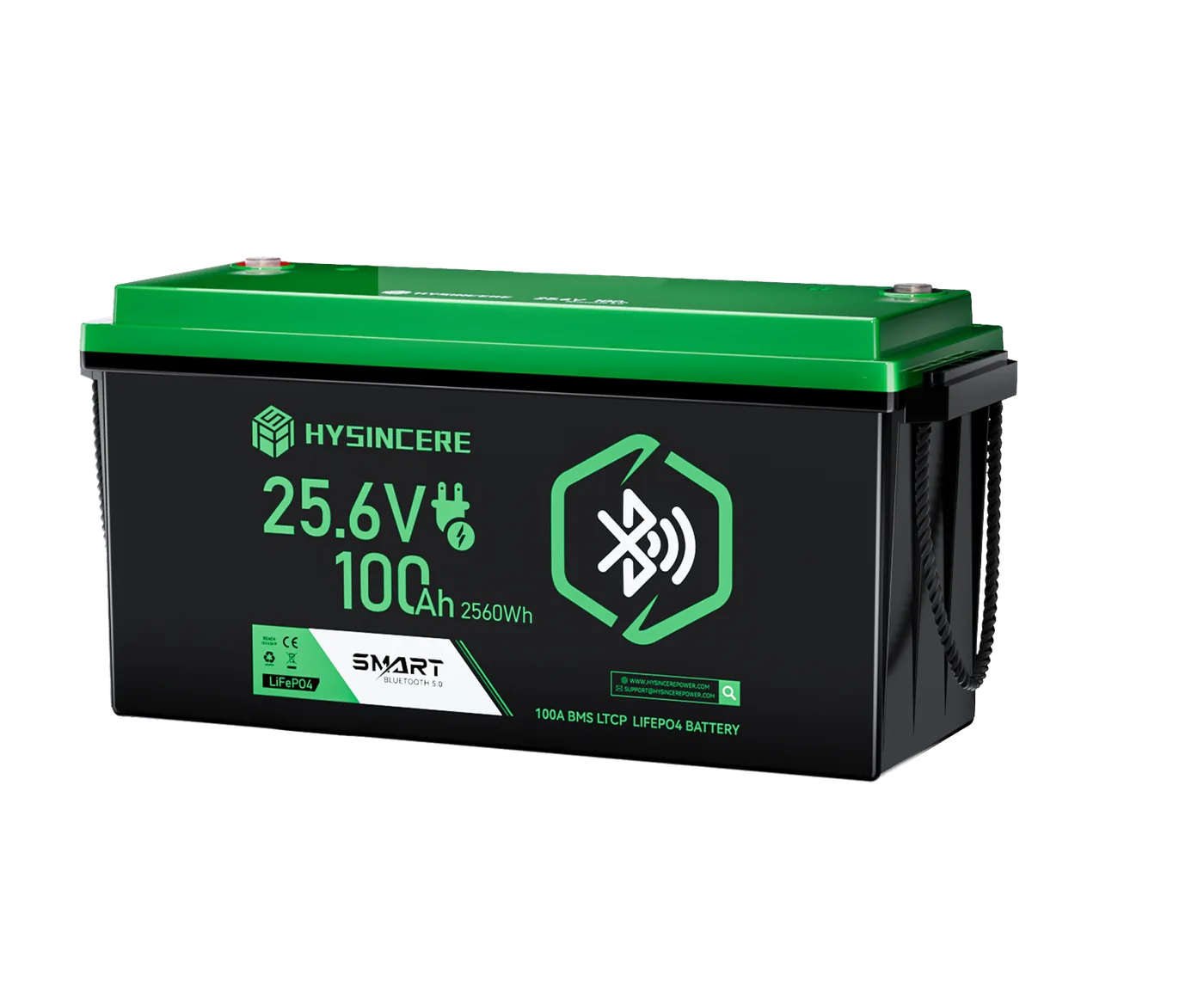
The published Hysincere LF24100N-B is a 25.6V, 100Ah Bluetooth LiFePO4 battery with 2,560Wh of rated energy. Its product data lists 100A maximum continuous discharge and 29.2V maximum charging voltage. Those figures help screen a candidate; they do not approve it for every 24V trolling motor.
Confirm the motor manufacturer’s allowed voltage range, continuous and short peak current, cable and circuit protection requirements, battery-space dimensions and charger. Check the motor’s permitted conditions across the battery’s operating voltage range, including charging conditions. Do not connect a 12V-only fish finder directly to a 24V supply; use an approved separate supply or suitable converter and include its draw in the budget. If the existing setup uses two 12V batteries, our single-24V versus two-12V comparison explains the configuration tradeoffs.
Record one real day before bulk supply
For a boat builder, equipment supplier or distributor, a useful sample record identifies the motor model, boat load, water and weather conditions, battery and charger versions, and time spent in each operating mode. Log battery current during travel and position holding, the start and end state of charge, any protection event and the actual overnight recharge time. Repeat on a day with the higher load the product is expected to face.
Then decide whether this exact configuration covers the required trip and recharge window. If the motor, load or charger changes, review the result again. To discuss a 24V battery for a boat or motor project, send Hysincere the motor model and current limits, planned duty cycle, battery-space measurements, charger details, destination market and expected order quantity.
Planning a 24V trolling motor setup?
Send the motor model, current limits, typical trip, battery space and charger details. We can review a suitable sample direction for your project.
Common questions
Is 100Ah enough for a full day with a 24V trolling motor?
It depends on battery-side current and operating time. In the illustrative six-hour trip, 75Ah is used, leaving only 5Ah within an 80Ah planning allowance. Heavier position holding raises that example to 95Ah. Measure the actual setup before promising runtime.
Does a six-hour fishing trip mean six hours of motor draw?
No. Count each period when the motor draws current, including position holding and return travel. Add any other loads connected to the same battery. An hour with every load off contributes no use in the example.
Can a charger labelled 24V recharge this battery?
The 24V label alone is insufficient. Confirm the selected battery's permitted charging voltage, current and temperature, and check the charger's LiFePO4 profile and wiring.
Can 12V marine electronics share a 24V trolling battery?
Only through an approved separate supply or suitable converter if the electronics are rated for 12V. Include their draw and conversion losses in the day's energy budget.
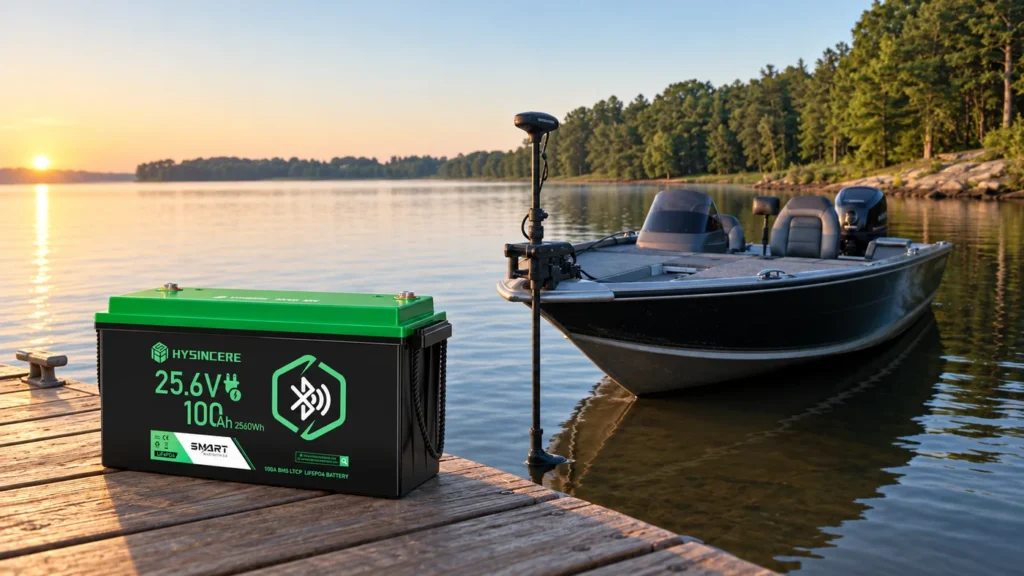
The six-hour current and charging examples are illustrations, not measured battery or motor results. The boat image shows an application context, not a documented customer installation. Confirm the battery, motor and charger together before use.