For a 24V system, a single 24V LiFePO4 battery is often the simpler option to install and manage. Two 12V batteries can also work, provided the manufacturer approves that exact model for series use and the complete bank meets the equipment requirements.
The difference is not automatically more energy or more power. It is how the batteries fit, how they are protected and charged, and what happens when one part needs attention. Start by comparing equal capacity, then look at the practical trade-offs.
Compare the same amount of energy
The familiar 12V and 24V labels describe system classes. Typical LiFePO4 nominal voltages are 12.8V and 25.6V. That distinction matters when checking the equipment’s operating voltage range.
Consider two possible 100Ah arrangements:
| Arrangement | Nominal voltage | Bank capacity | Nominal energy |
|---|---|---|---|
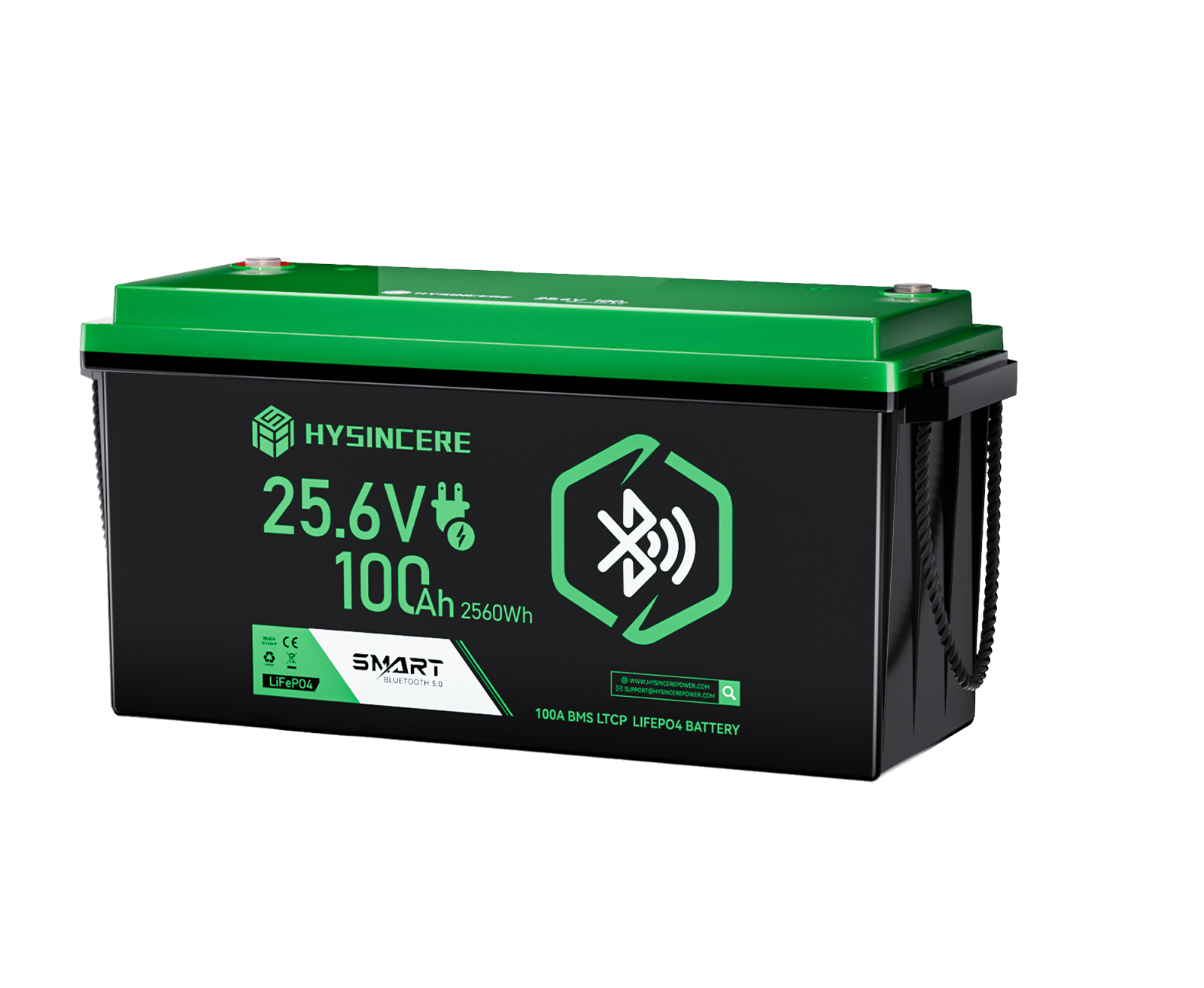
| One 25.6V 100Ah battery | 25.6V | 100Ah | 2,560Wh |
| Two approved 12.8V 100Ah batteries in series | 25.6V | 100Ah | 2,560Wh |
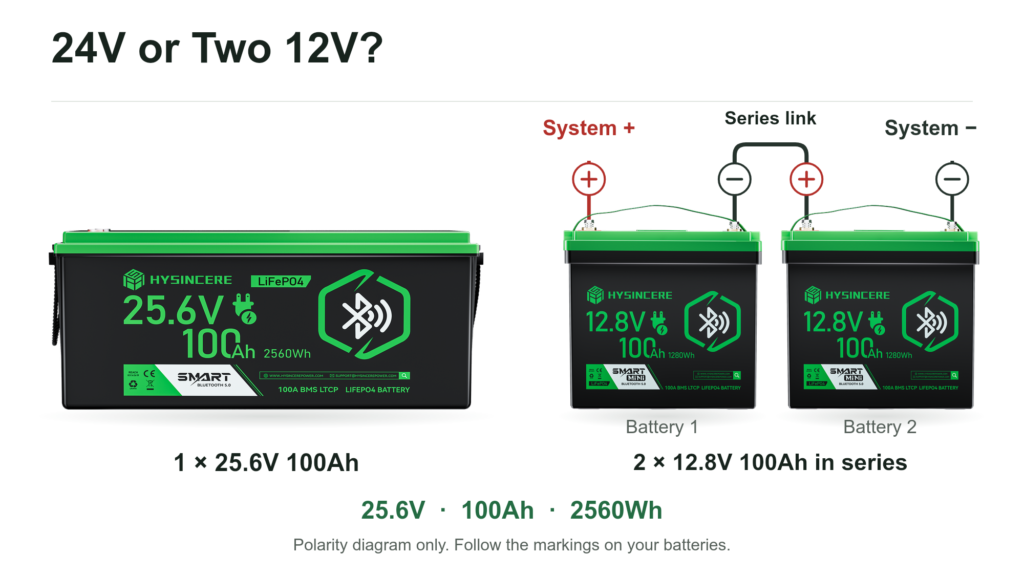
Connecting batteries in series adds their voltages, not their amp-hour ratings. Two 12.8V 100Ah batteries therefore make a nominal 25.6V 100Ah bank, not 200Ah.
The product images show the LF24100N-B (25.6V, 100Ah) and two LF12100N-B batteries (12.8V, 100Ah each). Both models are LiFePO4 batteries with a listed continuous discharge limit of 100A. The diagram connects Battery 1 negative to Battery 2 positive; the two free terminals provide the system output. Check the markings on the actual batteries and confirm the proposed configuration for the supplied model revision.
These are nameplate calculations, not a runtime test. Usable energy still depends on the operating limits, temperature, battery condition and losses in the system. For a load-based calculation, use our inverter battery sizing guide.
Check current limits before choosing the layout
A pair of batteries does not automatically provide twice the current. In a series bank, the same load current passes through both batteries. Each battery, its BMS and every connection must support that current.
As an illustration, two batteries each approved for 100A continuous discharge in the intended series configuration do not become a 200A bank. The bank remains limited by the weakest applicable component or system limit. A single 24V battery also has its own current rating; it is not necessarily higher.
For a motor, pump or inverter, check continuous current and startup current separately. A peak rating needs a duration to be useful. A battery that can supply a brief surge may still be unsuitable for a longer motor start.
Two self-contained 12V packs usually have separate protection electronics. If one reaches a limit, it may interrupt the whole series bank. A purpose-built 24V pack can manage its internal cell string as one pack, but the actual protection architecture must still be checked. Some systems use an external BMS.
Ask for written confirmation of series compatibility for the exact model and revision. A Bluetooth feature, identical case or matching Ah label does not establish that permission.
Plan how the whole bank will be charged
A series-connected pair is a 24V-class bank. Its charging system must suit the complete bank and the battery manufacturer’s instructions. An existing 12V charger cannot simply be treated as a charger for the assembled bank.
Pack matching also matters. A battery with a lower state of charge can reach a discharge limit before its partner. During charging, the fuller battery may reach its upper limit first. An internal cell balancer should not be assumed to balance two separate battery packs.
Follow the selected manufacturer’s procedure for matching and preparing batteries. Confirm whether a multi-bank charger or any additional monitoring equipment is approved for the proposed setup; do not add an equalizer simply because it is sold for 24V systems.
For an AGM or flooded-battery replacement, check the existing charger’s full profile as well as its voltage label. Our LiFePO4 charging compatibility guide explains the settings that need review.
Look at the battery space and service access
One 24V battery removes the external series link between two cases. This can make the installation easier to inspect, although it does not remove the need for correctly rated protection, cables and mounting.
Two smaller cases may fit a divided compartment more easily. They can also be easier to handle individually. The trade-off is another battery position, more exposed connections and access to both units when checking their condition.
Measure the space around the terminals, not only the case. Include cable bends, covers, hold-downs and room to lift the battery out. The battery measurement guide covers these clearances.
If the equipment also needs 12V power, do not assume it can be taken from one battery in a 24V string. That creates unequal loading. Ask the system designer for an approved way to supply the 12V loads, such as an appropriately specified DC-DC converter.
Which arrangement makes sense for your project?
Consider one 24V battery when a suitable model fits the equipment, meets the current requirement and simplifies installation or maintenance. It is a useful starting point for a new 24V installation where there is no need to retain separate 12V battery positions.
Consider two 12V batteries when the installation benefits from separate cases and the manufacturer explicitly supports the intended series bank. Include the cost of connections, mounting, charging and service in the comparison, rather than comparing battery prices alone.
If replacing one battery in an existing pair becomes necessary, check the manufacturer’s replacement policy. Adding a new unit beside an aged unit can leave the bank mismatched; do not assume that the same model name is enough.
For a single-pack option, compare the published capacities and features in our 24V LiFePO4 battery range. If a two-pack layout suits the installation better, the 12V battery range can provide candidates for a model-specific series review. Listing a battery there does not, by itself, mean it is approved for series use.
What to confirm before ordering
Send the equipment model, DC voltage range, continuous and startup load, charger details, available space and required runtime. For a replacement, add the labels of the existing batteries and a photo of their installation.
Those details let the supplier compare workable configurations. For a trolling motor, begin with its specified voltage and current requirements; the trolling motor battery sizing guide can help you prepare them. Changing from two cases to one should solve an installation or service problem while still meeting the same electrical requirements.
Choosing a battery for a 24V system?
Compare the 24V range, or send the equipment, load, charger and available dimensions so we can review the configuration.
Frequently Asked Questions
Do two 12V 100Ah batteries in series make 24V 200Ah?
No. With two matched 12.8V 100Ah LiFePO4 batteries, the series bank is nominally 25.6V 100Ah, or 2,560Wh. Series adds voltage; it does not add Ah.
Can any two 12V LiFePO4 batteries be connected in series?
No. Confirm that the exact battery model and revision are approved for the intended series arrangement. Follow the manufacturer’s matching, charging and protection requirements.
Is one 24V battery always more powerful than two 12V batteries?
No. Compare continuous and peak current, including peak duration. In a series pair, both batteries carry the same current; their current ratings do not add together.
Can I reuse my existing charger?
Only after its full charging profile and bank-voltage rating have been checked against the new configuration. A matching 24V label alone does not establish compatibility.
Should I replace both batteries if one in the pair fails?
Ask the manufacturer about the specific pair. Differences in age, condition and usable capacity may make a single replacement unsuitable; do not assume a new battery will match the remaining one.