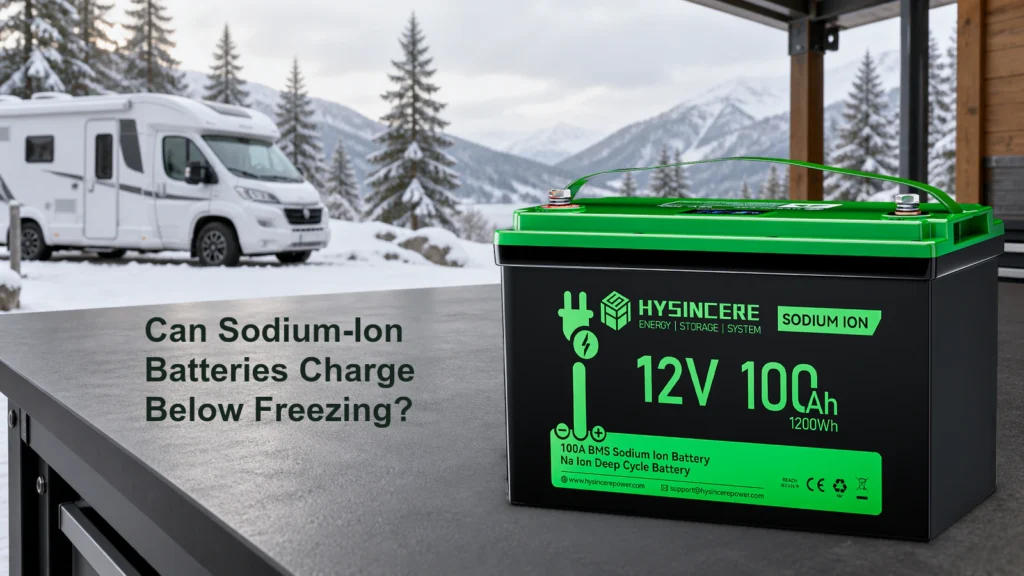
Yes, some sodium-ion batteries can charge below 0°C, but this capability must be confirmed for the exact battery model. A low-temperature discharge rating does not establish a charging limit. Before connecting a charger, check the permitted charging temperature, current and voltage in the battery documentation.
For an RV or outdoor solar system, this matters most after a cold night. The battery may still power the lights and refrigerator, while charging has to wait. To plan winter use, you need to know when charging can start and how much energy the battery can recover before the next night.
Check the exact model’s charging limits
The Hysincere LN12100N-BL lists charging from −10°C to +60°C and discharging from −30°C to +60°C. These are this model’s stated temperature ranges, not general limits for sodium-ion batteries. Confirm the permitted charging current and conditions for the complete pack separately. Check the LN12100N-BL model specifications
When buying a complete battery, ask for the battery pack’s specification too. Its battery management system (BMS) monitors conditions and controls charging. The cells, temperature sensors and BMS settings all need to support the intended use.
Why charging and discharging need separate checks
Discharging supplies energy to equipment; charging puts energy back into the battery. The manufacturer may permit these processes over different temperature ranges and at different currents.
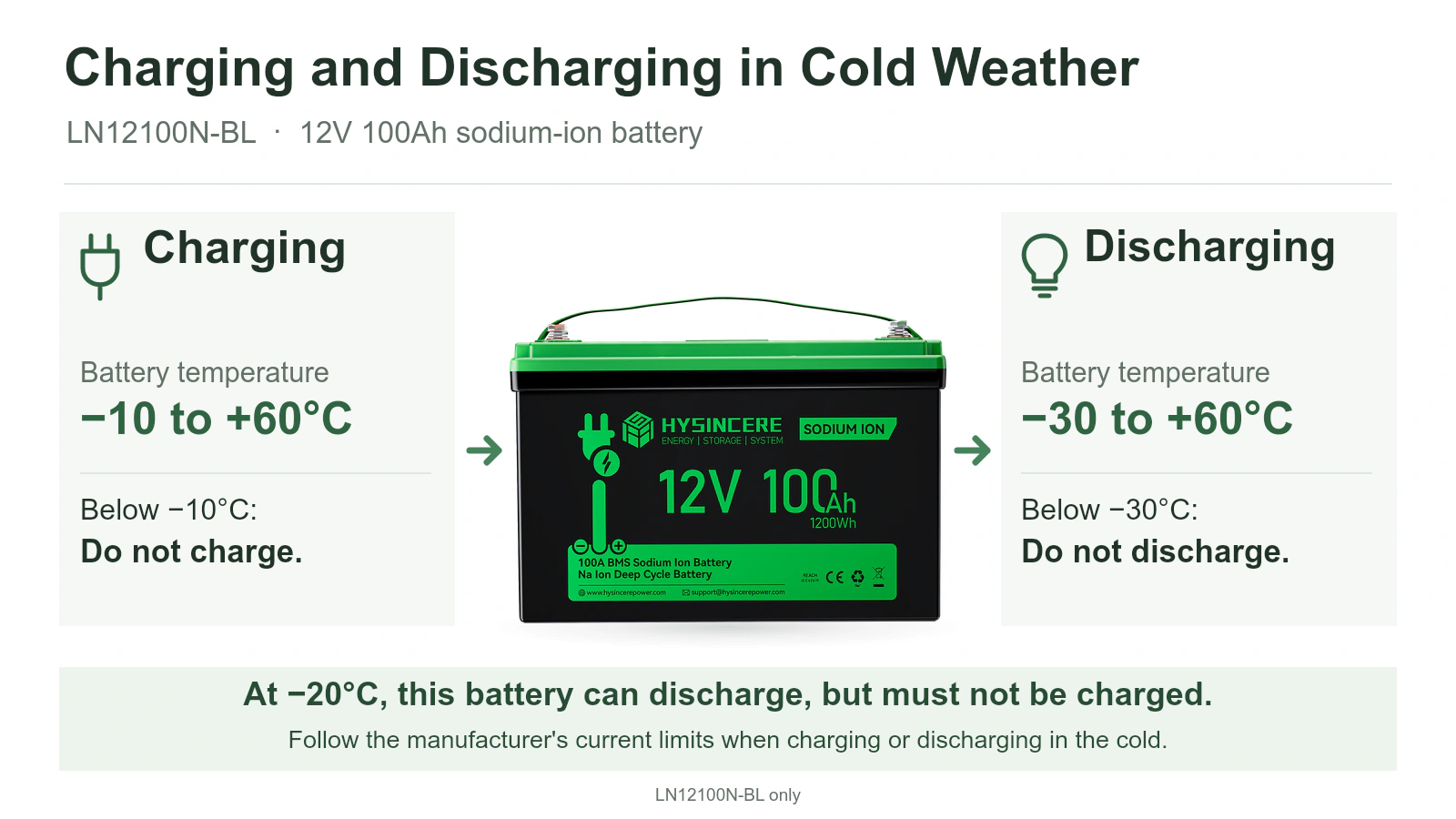
Also check how a low-temperature test was performed. A battery charged at room temperature and then discharged in a cold chamber demonstrates cold discharge performance. It does not demonstrate that the battery accepted that charge while cold.
Ask the supplier whether the charging test started with a cold battery. The report should show its temperature, charging current, starting charge level and when charging ended. Check whether a heater was running. That helps you distinguish a battery that charges while cold from one that warms up before charging.
What to check before charging below 0°C
Use the following questions when reviewing a battery specification or discussing a sample with the supplier.
- Charging temperature: Confirm the battery’s permitted range and whether it refers to ambient air or a battery sensor reading.
- Charging current: Ask how much current is allowed at your lowest charging temperature. The room-temperature maximum may not apply.
- Charging voltage: Check the approved voltage profile, including when charging ends and any standby settings.
- Temperature protection: Confirm how the BMS stops or limits charging, and when charging can resume.
- Heating: Find out whether preheating is required, how it is powered and how long it takes in the expected conditions.
If the datasheet only says “operating temperature,” request separate charging and discharging limits. If it gives a minimum charging temperature without a corresponding current limit, ask for the missing information before setting the charger.
Do not disable a low-temperature cutoff to make charging start. A protection event should be investigated using the battery and charger documentation.
What this means for an RV or solar installation
Imagine an RV battery that has cooled to −10°C overnight. At sunrise, its solar controller becomes ready to charge. A model approved for those conditions may begin charging at the specified current. Another may need to warm up first. If the BMS blocks charging, check its temperature reading and the manufacturer’s limits before treating it as a fault.
The correct outcome depends on the selected battery. A −10°C discharge rating cannot tell you which outcome to expect, and a sunny morning does not prove the cells have warmed sufficiently.
Then check how much charge the system can recover during the available daylight. A lower charging current or time spent heating leaves less opportunity to replenish the battery. For a winter campsite with only a few useful hours of sunlight, that can matter as much as the minimum charging temperature.
For cold-weather battery applications, the useful assessment covers the complete pack and the actual charging sources. An RV may have solar, a mains charger and a DC-DC charger; each needs a compatible operating profile.
Check Your Winter Charging Requirements
Share your lowest battery temperature, available charging time, daily energy demand and charging-equipment details with Hysincere.
Frequently Asked Questions
Does a sodium-ion battery always need a heater?
No. Heating requirements depend on the battery's approved charging conditions and the installation temperature. A model approved to charge at the project's minimum temperature may operate without preheating under its specified current limits. Confirm this for the complete pack.
Can I keep my existing battery charger?
Possibly, if its voltage profile, current settings and temperature controls meet the sodium-ion battery's requirements. A “12V” label or a lithium charging mode does not establish compatibility. Give the supplier the exact charger model and settings to review.