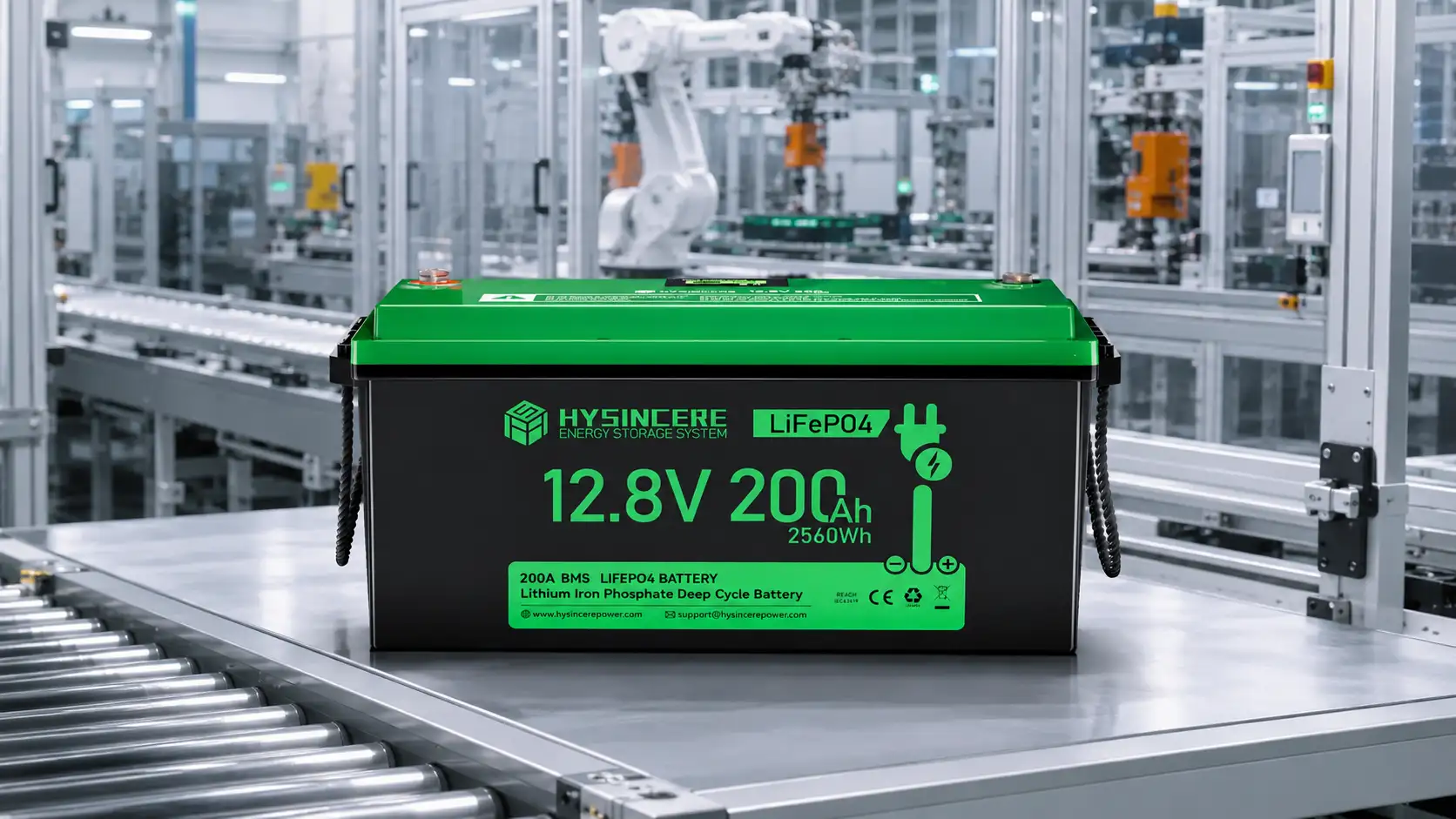
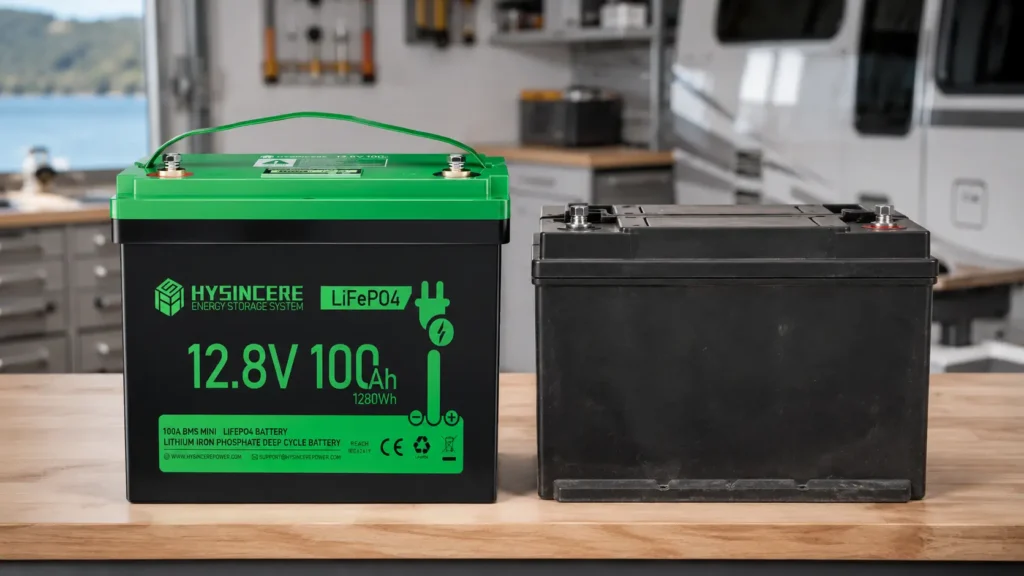
A 12V 100Ah LiFePO4 battery may suit RV house loads, a boat’s service bank or a small solar system when its usable energy covers the daily demand and it can recharge in time. At a nominal 12.8V, it stores 1280Wh before discharge limits and system losses are considered.
To decide whether one battery is enough, check daily energy use, continuous and peak current, charging sources, temperature limits and installation space. Capacity alone does not confirm suitability for a large inverter or engine starting. The checks below help you compare a specific model with your equipment.
The short answer
A 12V 100Ah LiFePO4 battery can be a sensible starting point for light-to-moderate 12V house loads, weekend RV use, a boat’s service bank, onboard electronics, or a small solar buffer that can be recharged regularly. It is not automatically the right choice for multi-day autonomy, large inverter loads, engine starting, 24V or 48V systems, or installations that charge below the battery’s permitted temperature.
Before selecting a model, confirm six things:
- the system voltage and battery-bank architecture;
- daily energy use in watt-hours, not only amp-hours;
- continuous and peak discharge current;
- every charging source and its settings;
- charging and discharging temperature limits;
- dimensions, terminals, mounting, environmental protection, and required documents.
The Hysincere lead-acid replacement battery range includes several product families, but the exact model still has to be matched to the application. A capacity label alone is not a technical approval.
Start with energy, not the 100Ah label
“12V” is a system class, not always the battery’s exact nominal voltage. A four-cell LiFePO4 battery is commonly rated at 12.8V. Hysincere’s live product category, for example, lists the Bluetooth model LF12100-S-T50 at 12.8V, 100Ah, 1280Wh, and 11kg.
The nominal energy calculation is straightforward:
Nominal energy (Wh) = nominal voltage (V) x rated capacity (Ah)
For a 12.8V 100Ah battery:
12.8V x 100Ah = 1280Wh, or 1.28kWh
That 1280Wh is nominal energy. It is not a promise that every connected load will receive 1280Wh. The usable amount depends on the exact battery’s permitted discharge limit, BMS cutoff, temperature, load, cable losses, inverter efficiency, and the reserve the system designer chooses to keep.
For an AC load powered through an inverter, use:
Estimated runtime = rated Wh x allowed discharge fraction x system efficiency / average load W
The table below is an illustration only. It assumes a 1280Wh battery, a 90% allowed discharge fraction, and 90% conversion efficiency, leaving about 1037Wh at the AC load. These assumptions are not specifications for every Hysincere model.
| Average AC load | Illustrative runtime | What can change the result |
|---|---|---|
| 60W | about 17.3 hours | device duty cycle, standby draw, inverter efficiency at low load |
| 120W | about 8.6 hours | compressor cycling, temperature, cable loss |
| 500W | about 2.1 hours | sustained current, inverter loss, BMS limit |
| 1000W | about 1.0 hour | high current, voltage sag, heat, reserve setting |
For direct 12V DC loads, do not apply inverter efficiency, but do include wiring and device losses. For cycling equipment such as refrigerators and pumps, calculate with measured daily watt-hours or equivalent run time, not the appliance’s maximum label wattage multiplied by 24 hours.
Six checks before approving a 12V 100Ah battery
1. Confirm the voltage platform
The battery, charger, inverter, DC loads, alternator charging equipment, and solar controller must operate on the same intended voltage platform. A 12.8V LiFePO4 battery may be sold for a 12V-class system, but its charging profile and voltage limits are not the same as every lead-acid battery.
If the equipment requires 24V, 36V, 48V, or 51.2V, start with that platform. Do not build a different voltage bank until the battery manufacturer confirms that the exact model supports the proposed series arrangement.
2. Build a daily energy budget
List every load, its actual operating wattage, and its daily run time. Add expected standby consumption, inverter loss, and a reserve. Then multiply the daily requirement by the number of days the system must operate without meaningful charging.
If daily use is close to the battery’s planned usable energy, a single 100Ah battery leaves little margin for weather, aging, longer run time, or a missed charging cycle. A system that “works on paper” with no reserve usually becomes a service problem later.
3. Check continuous current and surge current
Energy determines how long a load can run. Current determines whether the battery can run it at all. The battery’s continuous discharge rating, short-duration peak rating, BMS logic, terminals, cables, fuse, and inverter must all support the load.
For a rough inverter-side current check:
Battery current (A) is approximately inverter power (W) / battery voltage (V) / inverter efficiency
At 12.8V and an assumed 90% inverter efficiency, a 1000W AC load draws roughly 87A from the battery; a 2000W load draws roughly 174A before considering startup surge. This is why a battery can have enough watt-hours for an appliance but still trip its BMS when the appliance starts. Use the exact inverter and battery manuals for final design.
4. Map every charging path
An RV or boat may charge from shore power, an alternator through suitable charging equipment, solar, or a generator-connected charger. A stationary solar system may use an MPPT controller or inverter/charger. Each source must have settings and current limits compatible with the exact battery.
“12V charger” is not enough information. Confirm the charging profile, maximum charge voltage, charge current, low-temperature behavior, and whether equalization or other lead-acid-specific functions must be disabled. Also check how charging sources interact when more than one is active.
5. Design for the real temperature range
Discharging in cold conditions and charging in cold conditions are different questions. The permitted limits vary by cell, BMS, pack design, and model. If the battery can be charged in winter storage, an exposed RV compartment, or a cold marine locker, verify the model’s allowed charging temperature and whether the BMS blocks charging or the pack provides a self-heating function.
Do not treat “low-temperature protection” and “self-heating” as interchangeable. Protection can stop a charge; self-heating may prepare a battery for charging under defined conditions. The exact operating logic belongs in the model datasheet or manual. Hysincere’s cold-weather battery application page is the relevant internal reference for projects where temperature is a primary selection factor.
6. Verify the mechanical and documentation fit
Check the battery tray, compartment opening, hold-down method, terminal orientation, cable bend radius, service access, and total installed weight. For marine use, also review moisture exposure, vibration, corrosion risk, enclosure requirements, and local electrical rules.
For B2B procurement, request the exact drawing, specification sheet, test conditions, user manual, shipping documents, and the certifications required by the destination market. A company-level certification list does not prove that every certificate applies to every model.
RV selection: treat 100Ah as a house-battery decision
In an RV, a 12V 100Ah LiFePO4 battery is normally evaluated as a house battery for lighting, pumps, electronics, a compressor refrigerator, ventilation, and inverter-fed appliances. It should not be confused with the vehicle’s engine-starting battery unless the exact model is approved for starting duty.
One 100Ah battery can work well when the loads are controlled and the bank is recharged every day. It may be too small when the system must run a microwave, induction cooker, electric heater, air conditioner, or several appliances together, especially when there is no reliable charging window.
A practical RV review should answer:
- How many watt-hours does the vehicle use in a normal day and in a worst-case day?
- How long must it operate without shore power, alternator charging, or useful solar input?
- What is the inverter’s continuous rating and startup surge?
- Can the existing converter/charger be set for the selected LiFePO4 battery?
- Is alternator charging controlled by a compatible DC-DC charger or another approved method?
- Will the battery be charged in an unheated compartment?
The Hysincere RV lithium battery application page provides the commercial application path, but the quotation should still be based on the vehicle’s load list and charging architecture. “Weekend RV” and “full-time off-grid RV” are not the same battery requirement.
Marine selection: separate starting, service, and propulsion duties
“Marine battery” can describe three very different jobs:
| Battery duty | Typical job | Selection priority |
|---|---|---|
| Starting battery | crank an inboard or outboard engine | approved cranking current, engine compatibility, reserve and protection |
| Service or house bank | navigation electronics, lighting, pumps, refrigeration, communications | daily energy, continuous current, recharge time, environmental fit |
| Trolling-motor battery | supply a propulsion motor | motor voltage, current draw, required run time, cable and protection design |
A deep-cycle 12V 100Ah LiFePO4 battery is not automatically an engine-starting battery. If starting duty is required, ask for a model specifically rated and approved for the engine and installation. For trolling motors, first confirm whether the motor requires 12V, 24V, or 36V; capacity alone cannot correct a voltage mismatch.
For service-bank use, calculate the combined daily demand from electronics, pumps, lighting, refrigeration, and other hotel loads. Then check the alternator, shore charger, and any solar controller as one charging system. Secure mounting, correctly sized marine cable, fusing, terminal protection, and access for inspection are part of the battery choice, not installation details to solve later.
Use the Hysincere marine lithium battery page for onboard service-power requirements and the trolling-motor lithium battery page when propulsion-motor voltage and runtime are the primary questions.
Solar selection: size storage and solar recovery together
A 12V 100Ah battery is an energy-storage component, not a complete solar system. A small off-grid installation needs at least a battery, solar array, compatible charge controller, DC protection, cabling, monitoring, and, when AC loads are present, an inverter.
Start with daily load energy. If the system removes 800Wh from the battery on a typical day, the solar array must return more than 800Wh because charging, wiring, controller, and conversion losses exist. Available production also changes with location, season, panel angle, shading, temperature, and weather. The PVWatts Calculator from the National Lab of the Rockies can provide a location-based production estimate, but final off-grid design still needs local conditions and a reserve policy.
A single 12V 100Ah battery can suit a small cabin, communications load, portable work system, or light backup use when daily consumption and recovery are modest. It is usually not the correct architecture for whole-home storage or sustained high-power loads. Those projects should be evaluated on a higher-voltage platform and can continue to the Hysincere home energy storage application page.
When to choose a larger bank or a higher voltage
The table below is a decision screen, not a replacement for engineering approval.
| Project condition | 12V 100Ah decision |
|---|---|
| Light or moderate 12V loads with dependable daily charging | reasonable candidate; verify the exact BMS and charging limits |
| Daily energy is close to the planned usable capacity | increase reserve, add capacity, or reduce loads |
| Two or more days of autonomy without meaningful charging | calculate a larger bank from daily Wh x autonomy days |
| High-power inverter on a 12V system | check current carefully; a higher-voltage system may be more practical |
| Engine starting or dual-purpose marine use | select only a model approved for starting duty |
| 24V, 36V, 48V, or 51.2V equipment | use the correct voltage platform or an approved bank design |
| Regular charging in cold conditions | require verified low-temperature charge protection or an appropriate heating strategy |
| Whole-home or commercial stationary storage | evaluate a purpose-built stationary storage system, not a small drop-in battery |
Series and parallel expansion require model approval
Parallel connection can increase capacity while keeping nominal voltage; series connection can increase bank voltage. Neither should be assumed from the battery’s chemistry or case size. The exact model must permit the planned configuration, and the maximum number of batteries may be limited.
For an approved multi-battery bank, use matched batteries with the same model, capacity, condition, and similar state of charge. Design equal-current paths, suitable busbars, individual or bank protection as required, correctly rated DC disconnects, and cables sized for current and voltage drop. Do not mix new and heavily aged batteries, different capacities, different chemistries, or products with incompatible BMS behavior.
Higher power on a 12V bank means higher current. Before adding many batteries in parallel to support a large inverter, compare that architecture with a purpose-built 24V or 48V system. The goal is not merely to make the voltage add up; it is to create a bank that shares current predictably and can be protected and serviced safely.
12V 100Ah buyer specification checklist
Send the supplier a complete operating brief instead of asking only for a 100Ah price.
| Item to confirm | Information to provide or request | Why it matters |
|---|---|---|
| Application and battery duty | RV house, marine service, trolling motor, solar buffer, backup, or starting | prevents a deep-cycle model from being used for the wrong job |
| Nominal system voltage | 12V-class or required bank voltage | confirms compatibility with loads, charger, and inverter |
| Daily and worst-case energy | Wh per day and autonomy days | determines required usable capacity and reserve |
| Continuous and peak load | watts, amps, duration, and motor/compressor surge | determines BMS, cell, terminal, cable, and fuse requirements |
| Charging sources | shore, AC charger, alternator/DC-DC, solar controller, generator | identifies charging-profile and interaction risks |
| Temperature | minimum/maximum storage, charge, and discharge conditions | determines protection or heating requirements |
| Installation | compartment dimensions, orientation, mounting, ventilation, moisture and vibration | confirms physical and environmental fit |
| Expansion plan | single battery, parallel, series, or series-parallel | confirms whether the exact model supports the bank design |
| Monitoring and communication | local display, Bluetooth, CAN, RS485, or no communication | aligns the battery with service and system-integration needs |
| Required documents | drawing, datasheet, manual, test report, shipping and market documents | prevents assumptions during approval and import |
| Commercial scope | quantity, destination market, label, packaging, and project schedule | allows an accurate B2B quotation and delivery review |
How Hysincere fits this selection process
Hysincere’s current lead-acid replacement category is organized into regular, smart LCD, Bluetooth, and self-heating series. At the time of verification, the live category lists the Bluetooth model LF12100-S-T50 at 12.8V, 100Ah, 1280Wh, and 11kg. These values describe that listed model; they do not automatically establish its cranking rating, temperature limits, series/parallel capability, IP rating, or suitability for every RV, marine, or solar system.
Hysincere was founded in 2013 and focuses on R&D, design, assembly, sales, and service for energy-storage and motive battery packs. For a project review, we recommend sending the system voltage, load table, inverter rating, charging sources, target runtime, temperature range, compartment drawing, destination market, and expected quantity. This gives the engineering and commercial teams enough information to discuss a suitable configuration instead of quoting from capacity alone.
Technical references and scope
Runtime and system-fit examples in this guide are screening calculations, not model guarantees. Final approval must use the exact battery, BMS, charger, inverter, cable, fuse, installation, and local requirements.
- National Lab of the Rockies: PVWatts Calculator
- U.S. Coast Guard: Boatbuilder’s Handbook – Electrical Systems
Comparing chemistries before choosing capacity? See our LiFePO4 vs lead-acid battery comparison for usable capacity, cycle life, weight, charging behavior and total cost.
Discuss Your Energy Storage Battery Requirements
Provide system voltage, target capacity, inverter or charging equipment, parallel scale, communication protocol, installation environment, and target market so Hysincere can evaluate a suitable battery solution.
How to Choose a 12V 100Ah LiFePO4 Battery for RV, Marine, and Solar Systems FAQ
Is one 12V 100Ah LiFePO4 battery enough for an RV?
It can be enough for controlled house loads and regular recharging, but the answer depends on daily Wh, inverter loads, autonomy days, and charging availability. Calculate the vehicle's normal and worst-case energy use before choosing one battery.
How long will a 12V 100Ah battery run a refrigerator?
Use the refrigerator's measured daily energy or average duty-cycle power, not only its maximum wattage. Divide the battery's planned usable Wh by the refrigerator's average load after including wiring and conversion losses. Ambient temperature, door openings, thermostat setting, and compressor cycling can change the result substantially.
Can a 12V 100Ah battery run a 2000W inverter?
Capacity alone cannot answer this. At 12.8V and an assumed 90% inverter efficiency, a 2000W AC load requires roughly 174A before startup surge. The exact battery, BMS, cables, fuse, terminals, and inverter must all support the required continuous and peak current.
Can I use a deep-cycle 100Ah LiFePO4 battery to start a boat engine?
Only when the exact model is specifically rated and approved for engine-starting duty. A service-bank or deep-cycle rating does not automatically include the cranking current and protection behavior an engine requires.
Can a 12V 100Ah battery be charged from solar panels?
Yes, when the panels feed a compatible solar charge controller and the controller is configured for the exact battery. Do not connect a solar array directly to the battery. Confirm array voltage, controller current, charge settings, temperature logic, and required protection.
Can I connect several 12V 100Ah batteries in parallel or series?
Only if the exact battery model permits the proposed configuration. Follow the manufacturer's limit, use matched batteries, bring them to a similar state of charge before connection, and design balanced cables, busbars, fusing, and disconnects.
What changes when the battery is used in cold weather?
Available power, charging acceptance, and BMS behavior may change. Check the exact model's permitted charge and discharge temperatures, low-temperature cutoff, sensor location, and any self-heating logic. Do not assume that discharge capability means charging is also allowed at the same temperature.
Why is a “12V” LiFePO4 battery often rated at 12.8V?
“12V” describes the system class. A typical four-cell LiFePO4 pack uses a 12.8V nominal rating. Use the exact nominal, charge, and cutoff voltages from the model datasheet when calculating energy and configuring equipment.
This article is intended for technical reference and preliminary project evaluation. Battery compatibility, charging limits, current capability, temperature range, BMS behavior, certifications, and installation requirements vary by model and application. Final selection and system configuration must follow the selected product datasheet, equipment-manufacturer requirements, and system-validation results.