Four lithium battery industry trends stand out in the latest data: demand keeps growing fast, LiFePO4 (LFP) has become the leading chemistry, pack prices fell to a record low in 2025, and sodium-ion is starting to scale. For a battery buyer, each trend matters only when it changes a real decision: which chemistry fits the equipment, who can actually supply it, and what the price includes.
| Trend | What the data shows | What it means for buyers |
|---|---|---|
| Demand growth | EV battery demand reached about 1.2TWh in 2025, up almost 30% (IEA) | Large-format cells are plentiful, but popular models still need confirmed allocation and lead times |
| LFP leads | LFP was over 55% of EV batteries and over 90% of new stationary storage in 2025 (IEA) | LFP is now the mainstream choice for storage, RV, marine and lead-acid replacement packs |
| Falling prices | Average pack price $108/kWh, down 8%; stationary storage packs $70/kWh; LFP $81/kWh vs NMC $128/kWh (BNEF) | Survey averages reflect very large volumes; small custom orders, BMS, enclosure and certification add cost |
| Sodium-ion scaling | Sodium-ion cell capacity is just over 1% of lithium-ion capacity (IEA) | An option for some storage and lead-acid replacement uses; check voltage window and chargers |
Sources: IEA, Global EV Outlook 2026; BloombergNEF, battery price survey, December 2025. Figures are global averages and change every year; they are not quotes for any specific product.
Read any forecast through four practical checks:
- Technology and applications: separate laboratory results from a cell or pack you can actually buy. Compare usable energy, current, temperature limits and evidence for your application.
- Production and delivery: announced factory capacity isn’t confirmed output. Ask for the exact model, production status, qualified annual volume and delivery schedule.
- Demand by application: EV, stationary storage and equipment batteries serve different loads and buyers. Growth in one segment doesn’t describe every battery business.
- Comparable prices: compare quotes with the same energy, current limits, enclosure, BMS, documentation, delivery terms and warranty. A cell price is not a pack price, and a pack price is not an installed-system price.
What Energy Storage Demand Means for a Battery Project
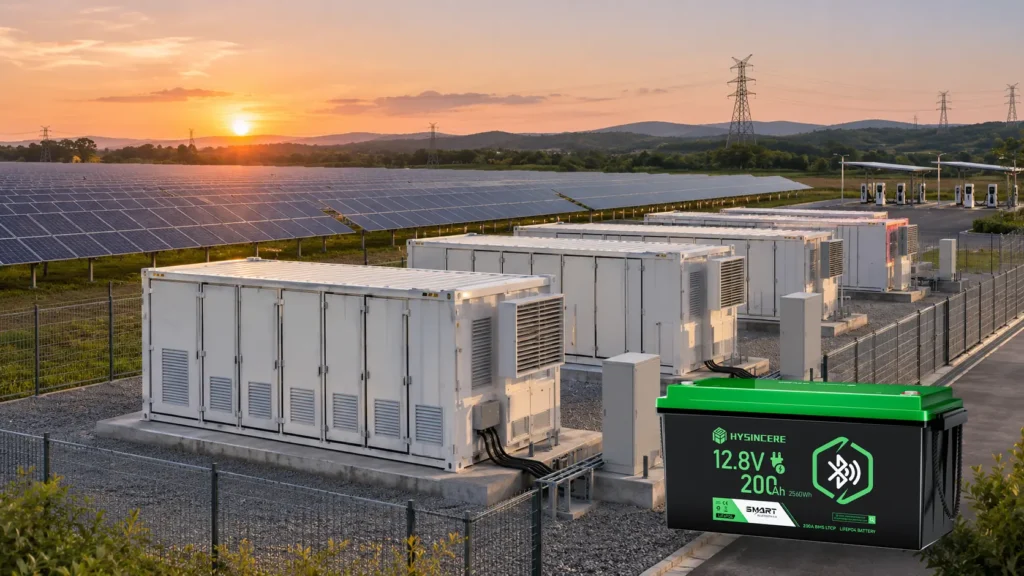
Stationary storage is the fastest-moving part of the market, and it is almost entirely LFP. The reasons are practical: LFP avoids nickel and cobalt, costs less per kWh, and its thermal stability and long cycle life suit batteries that sit in homes, cabinets and containers for many years.
The growth doesn’t size your project, though. A battery moves energy from when it’s charged to when the load needs it, and the application sets the design. Backup power needs a defined load and duration; solar storage also needs a charging window; equipment batteries have to fit the machine and its duty cycle. Specify power (kW) and energy (kWh) separately.
For example, a constant 2kW load running for four hours uses 8kWh at the load. Assuming 90% conversion efficiency and a 90% usable-energy allowance:
That’s a planning example, not a runtime claim for any product. Charging power, peak load, temperature and aging all need to fit too. Our LiFePO4 battery capacity calculator runs the same steps with your own numbers.
What to Check Across the Supply Chain
Falling average prices and more factory capacity make it tempting to compare suppliers on price alone. The details below decide whether a quote is comparable and whether the batteries you receive match the samples you approved.
- Exact configuration: cell model, series/parallel arrangement, BMS limits, charger or inverter interface and enclosure. Changing one of these can affect performance, installation or test documentation.
- Change control: who approves a substitution before production, and how much notice you get.
- Traceability: how cell batches are traced, how incoming material is checked and how finished-pack tests are recorded.
- Repeat orders: agreed specification revision, sample approval, delivery schedule and packing standard.
- Total cost: purchase price, usable lifetime energy, replacement work and maintenance on the same basis.
Keep market forecasts separate from purchasing commitments. Record each forecast’s date, region, chemistry and application, then compare it with current quotes for your configuration. Headline growth doesn’t establish your project’s return. For what drives the price of a custom pack, see our guide to custom battery pack cost, and for longer-term cost levers, how scale and recycling reduce battery costs.
Prepare a Battery-Pack Project with Hysincere
Hysincere designs and assembles LiFePO4 and sodium-ion battery packs from selected purchased cells; we don’t manufacture cells. Send us the application, voltage, energy, continuous and peak load, charging method, available space, temperature range and planned quantity. We’ll assess the pack, BMS and integration against a defined specification.
Product documentation and a confirmed quotation are the basis for procurement, not an industry growth forecast. If you’re comparing chemistries, our LiFePO4 vs ternary lithium battery comparison is a good next step.
Discuss Your Battery Project Requirements
Share the application, voltage, capacity, load, charging method, dimensions, temperature, certification, and annual-volume requirements for an initial technical review by Hysincere.
Lithium battery industry trends: FAQ
What are the main lithium battery industry trends?
Four stand out in 2025 data: fast demand growth (EV battery demand of about 1.2TWh, per the IEA), LFP becoming the leading chemistry, record-low average pack prices ($108/kWh, per BloombergNEF), and the early scale-up of sodium-ion.
Why is LiFePO4 (LFP) gaining market share?
LFP avoids nickel and cobalt and costs less per kWh: BloombergNEF put LFP packs at $81/kWh versus $128/kWh for NMC in 2025. Its thermal stability and long cycle life also suit storage, which is why the IEA reports LFP in over 90% of new stationary installations.
Are battery prices still falling?
On average, yes. BloombergNEF reported an 8% fall in 2025, with stationary storage packs at $70/kWh. These are high-volume survey averages; a small custom order with its own BMS, enclosure and certification will cost more per kWh.
Will sodium-ion batteries replace lithium-ion?
Not soon. The IEA puts sodium-ion cell capacity at just over 1% of lithium-ion capacity. It is expected to suit uses such as stationary storage and some lead-acid replacements, where its voltage range and charger needs must be checked.
This article is intended for technical reference and preliminary project evaluation. Battery compatibility, charging limits, current capability, temperature range, BMS behavior, certifications, and installation requirements vary by model and application. Final selection and system configuration must follow the selected product datasheet, equipment-manufacturer requirements, and system-validation results.