
The main lithium-ion cathode materials are lithium cobalt oxide (LCO), nickel manganese cobalt (NMC), nickel cobalt aluminum (NCA), lithium manganese oxide (LMO) and lithium iron phosphate (LFP). The cathode sets most of a cell’s voltage and a large share of its energy density, thermal stability and cost. That’s why “lithium-ion” covers cells as different as a 3.7V phone battery and a 3.2V LiFePO4 storage cell.
The cathode still doesn’t decide everything. Anode, electrolyte, separator, cell design and manufacturing matter too, so finished cells should be compared on their own data. Below are the five families, what each is good at, and how to read cathode claims on a datasheet.
| Cathode | Formula | Nominal cell voltage | Practical capacity (material) | Thermal stability | Typical uses |
|---|---|---|---|---|---|
| LCO | LiCoO2 | 3.6–3.7V | about 140–180mAh/g | Lower | Phones, laptops, small electronics |
| NMC | LiNixMnyCozO2 | 3.6–3.7V | about 150–200mAh/g, rising with nickel | Medium; drops as nickel rises | EVs, power tools, e-bikes |
| NCA | LiNiCoAlO2 | 3.6V | about 180–200mAh/g | Medium to lower | High-energy cylindrical cells, EVs |
| LMO | LiMn2O4 | 3.7V | about 100–120mAh/g | Good | Power tools, often blended with NMC |
| LFP | LiFePO4 | 3.2V | about 150–165mAh/g | Very good | Energy storage, RVs, boats, many EVs |
Approximate values for orientation. Practical capacity depends on the charge voltage and test conditions; it is a material figure, not the capacity of a finished cell or pack.
Lithium Cobalt Oxide: LCO
LiCoO2 was the cathode of the first commercial lithium-ion cells in 1991 and is still common in phones, laptops and small lithium-polymer batteries. Its layered structure packs a lot of energy into a small volume and gives a stable 3.6–3.7V nominal voltage.
The trade-offs are cobalt cost and supply, and lower thermal stability. Only about half of LCO’s theoretical lithium can be used safely, because charging it too far damages the structure, which is why the usual charge limit is 4.2V per cell or a little higher for specially designed cells. Cycle life is moderate and depends heavily on charge voltage, current and temperature.
Other Cathode Material Families
Nickel-based: NMC and NCA
Replacing much of the cobalt with nickel raises capacity and lowers cobalt use. NMC mixes nickel, manganese and cobalt in different ratios; a higher nickel share stores more energy but makes the material more reactive when hot or overcharged. NCA uses aluminum for stability and is found in high-energy cylindrical cells. Both need careful thermal and charge management at pack level. For a direct comparison with LFP, see LiFePO4 vs ternary lithium batteries.
Lithium Manganese Oxide: LiMn2O4
LMO has a three-dimensional spinel structure that lets ions move quickly, so it handles high current well and is thermally robust. Its capacity is lower, and manganese can dissolve into the electrolyte at high temperature, which shortens life. That’s why LMO is often blended with NMC rather than used alone.
Lithium Iron Phosphate: LiFePO4
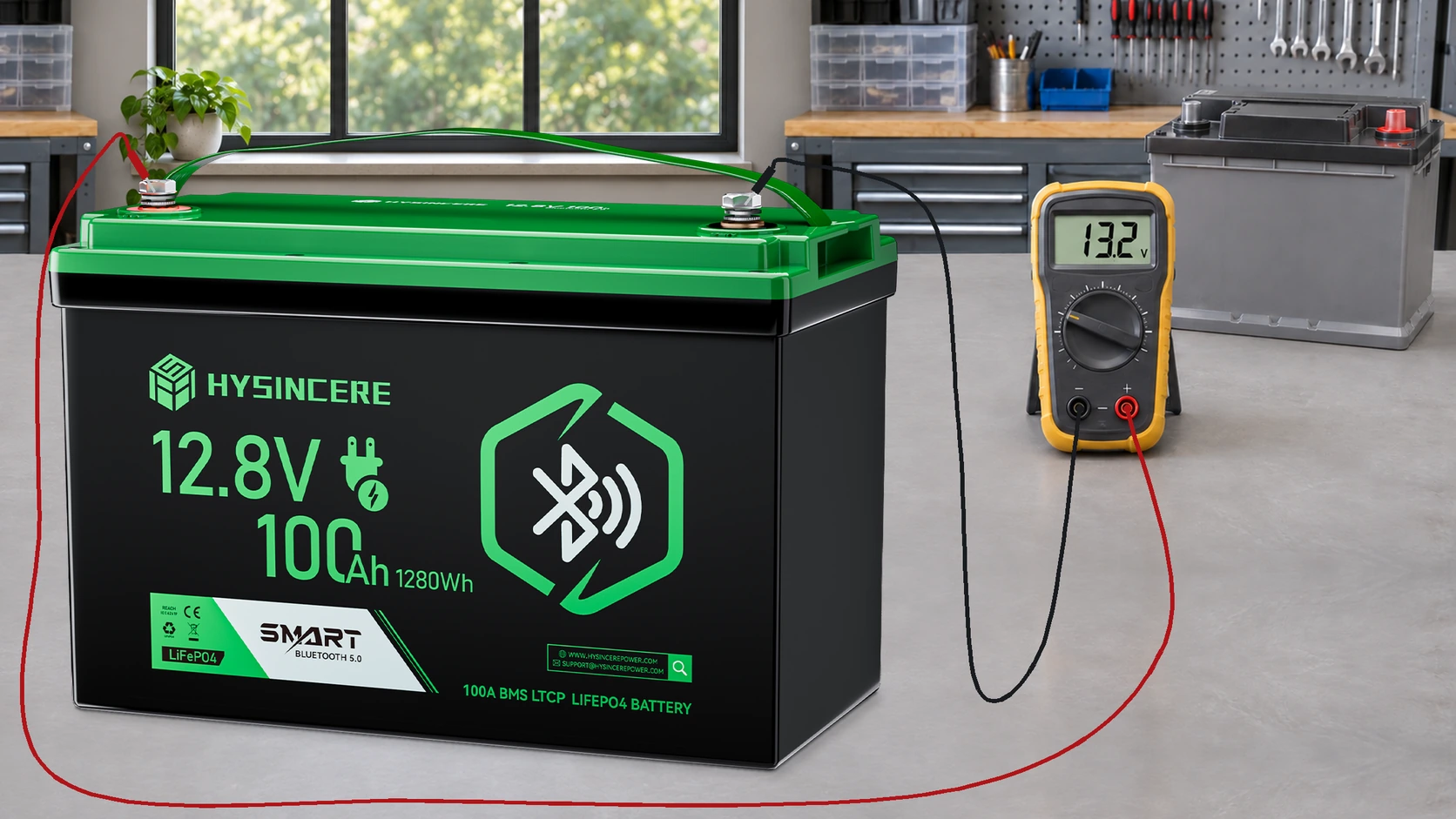
LFP’s olivine structure holds oxygen tightly, which gives it very good thermal stability and long cycle life without cobalt or nickel. Its lower voltage (3.2V) and lower density mean less energy per kilogram than NMC, and its conductivity is poor, so commercial LFP uses nanosized particles and carbon coating. Four LFP cells in series give 12.8V, a natural match for 12V lead-acid systems. A newer variant, LMFP, adds manganese to raise the voltage.
How to read cathode claims on a datasheet
- mAh/g is not pack capacity. It refers to the cathode material alone. A cell adds anode, electrolyte, separator, foils and casing; a pack adds BMS, wiring and housing.
- Chemistry is not a cycle-life guarantee. Compare cycle ratings at the same depth of discharge, current, temperature and end-of-life capacity.
- Charge limits follow the chemistry. A 3.7V lithium-ion cell typically charges to 4.2V; an LFP cell to about 3.6–3.65V. Using the wrong charger profile is a real risk.
- Safe chemistry still needs protection. LFP is thermally stable, but packs still need a BMS, fusing and a sound enclosure.
The cathode is only half the electrode pair; see also soft and hard carbon anodes and lithium battery separators.
Select a Cell Chemistry with Hysincere
Hysincere designs and assembles battery packs from selected purchased cells: LiFePO4 for 12V and higher-voltage systems, 3.7V lithium-ion cylindrical and lithium-polymer cells for compact devices, and sodium-ion where low-temperature charging matters. Send us the voltage range, energy and load profile, charging method, temperature range and available space, and we’ll recommend a chemistry and specific cells based on their datasheets and system tests. Start a custom battery pack.
Discuss Your Battery Project Requirements
Share the application, voltage, capacity, load, charging method, dimensions, temperature, certification, and annual-volume requirements for an initial technical review by Hysincere.
Lithium-ion cathode materials FAQ
What are the main lithium-ion cathode materials?
LCO (LiCoO2), NMC (nickel manganese cobalt), NCA (nickel cobalt aluminum), LMO (LiMn2O4) and LFP (LiFePO4). They differ in voltage, energy density, thermal stability and cost.
Which cathode material is the safest?
LFP has the best thermal stability of the common families because its phosphate structure holds oxygen tightly. A finished pack still needs a BMS, fusing and a suitable enclosure.
Why do LFP cells have a lower voltage?
The iron-phosphate chemistry gives a nominal 3.2V per cell, compared with about 3.6–3.7V for cobalt-, nickel- or manganese-based cathodes. Four LFP cells in series make 12.8V.
Is mAh/g the capacity of a battery?
No. It is the specific capacity of the cathode material in a test. A cell and pack include many other components, so their Wh/kg is much lower.
Does the cathode decide cycle life?
It has a big influence, but anode, electrolyte, cell design, depth of discharge, current and temperature also matter. Compare cycle ratings tested under the same conditions.
This article is intended for technical reference and preliminary project evaluation. Battery compatibility, charging limits, current capability, temperature range, BMS behavior, certifications, and installation requirements vary by model and application. Final selection and system configuration must follow the selected product datasheet, equipment-manufacturer requirements, and system-validation results.