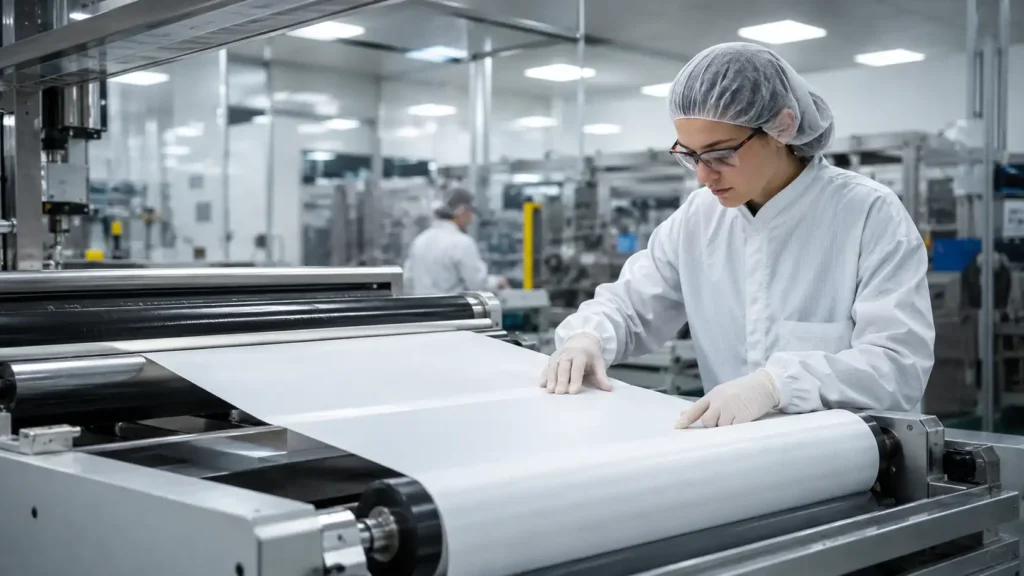
A lithium battery separator is a thin, porous polymer film between the cathode and the anode. It stops the electrodes from touching, which would cause an internal short circuit, while letting lithium ions pass through electrolyte held in its pores. Most separators are made of polyethylene (PE), polypropylene (PP) or a PP/PE/PP trilayer, often with a ceramic coating. In typical lithium-ion cells they are only about 10–25µm thick.
The separator affects safety, internal resistance and cycle life, but it is one part of the cell design. This guide explains what it does, how dry and wet processes differ, and what a battery buyer can actually check.
What a Battery Separator Does
A separator has three jobs that pull in different directions:
- Insulate. It must block electrons completely and stay intact when the electrodes swell and shrink during cycling, or when a burr or particle presses on it.
- Conduct ions. It must be porous enough that ions move freely. A thicker or denser film improves insulation but raises internal resistance and lowers rate capability.
- Behave predictably when hot. Polymer films shrink when heated. If a separator shrinks at its edges, the electrodes can touch. PE melts at roughly 130–135°C and closes its pores, which slows or stops current; this is called shutdown. PP melts at about 160–165°C, so a PP/PE/PP trilayer can shut down in the PE layer while the PP layers still hold their shape.
| Property | Typical range | What it affects |
|---|---|---|
| Thickness | about 10–25µm | Thinner allows more energy in the cell, but needs more strength |
| Porosity | about 40–50% | Ion flow and electrolyte uptake; too high weakens the film |
| Air permeability (Gurley) | seconds per 100mL of air | Indirect measure of ion pathways; lower usually means lower resistance |
| Puncture strength | measured in gf or N | Resistance to particles, burrs and dendrites |
| Thermal shrinkage | % after heating at a set temperature and time | Whether the electrodes stay apart when the cell gets hot |
| Shutdown and meltdown temperature | PE about 130–135°C; PP about 160–165°C | When pores close, and when the film loses integrity |
| Wettability | contact angle or uptake test | How quickly and evenly the electrolyte fills the pores |
Ranges are indicative for common lithium-ion cells; each separator grade is specified by its own supplier data and test methods.
None of these numbers alone proves a cell is safe. A separator that passes its material tests can still fail if the cell has contamination, misaligned electrodes or poor manufacturing control, so finished cells need their own testing. More on cell construction in how lithium secondary batteries are built.
Dry and Wet Separator Processes
Most separators are made by one of two process families. Coatings and multilayer builds are then added on top.
| Dry process | Wet process | |
|---|---|---|
| How pores are made | Polymer film is extruded, annealed and stretched, which opens slit-shaped pores | Polymer is mixed with an oil, formed into film, stretched, then the oil is extracted with a solvent |
| Usual material | PP, or PP/PE/PP trilayer | PE, often ceramic-coated |
| Pore structure | Elongated, oriented pores | Smaller, more uniform, interconnected pores |
| Thickness | Usually thicker | Can be made thinner |
| Strength | Strong along the stretching direction, weaker across it | More balanced strength in both directions |
| Cost and process | No solvent, generally lower cost | Solvent recovery adds cost |
Neither process is “safer” by name. Ceramic coatings, usually alumina or boehmite, reduce thermal shrinkage and improve wetting, and they are now common on both types. Dry-process PP separators are widely used in cost-sensitive LiFePO4 cells, while thin coated wet-process PE is common where energy density matters most. What decides suitability is the measured data of the specific grade and how the finished cell performs.
Material Qualification and Supply Continuity
For a battery-pack buyer, the separator sits inside a purchased cell, so you usually won’t see it on a pack datasheet. What you can control is the cell:
- Ask which cell model is used and get its datasheet: capacity, internal resistance, voltage limits, current ratings and temperature range.
- Check that transport and safety documents, such as the UN 38.3 test summary, cover that cell and pack.
- Agree in writing that the cell model can’t change without notice. A different cell means a different separator, electrode and electrolyte, so the pack may need retesting.
- Review how cells are sorted and matched before assembly, not only what chemistry they are.
Hysincere doesn’t make cells or separators. We select cells by capacity, current, temperature, size, certification and availability, and customers can name a cell brand and model for us to evaluate. Once confirmed, the cell goes into the bill of materials, and any later change is explained and approved by the customer first. Before assembly, cells are sorted and matched by appearance, size, voltage, internal resistance and capacity, with a rest period to check self-discharge when needed. See also types of lithium battery cells and lithium-ion battery hazards.
Review Cell and Pack Requirements with Hysincere
If you’re planning a custom pack, send Hysincere the voltage, capacity, load profile, charging method, temperature range and target certifications. We’ll propose suitable cells, explain the trade-offs, and agree the test plan with you. Start a custom battery pack.
Discuss Your Battery Project Requirements
Share the application, voltage, capacity, load, charging method, dimensions, temperature, certification, and annual-volume requirements for an initial technical review by Hysincere.
Lithium battery separator FAQ
What is a lithium battery separator made of?
Usually a porous polyolefin film: polyethylene (PE), polypropylene (PP) or a PP/PE/PP trilayer. Many are coated with ceramic particles such as alumina or boehmite to reduce shrinkage when hot.
What is separator shutdown?
When a PE separator reaches roughly 130–135°C, it melts and closes its pores, which slows or stops ion flow. It is a protective feature, not a guarantee against thermal runaway.
Is a dry-process separator safer than a wet-process one?
Not by default. Each has trade-offs in pore structure, thickness and strength, and coatings change their behavior. Safety depends on the specific grade and on testing the finished cell.
How thick is a lithium-ion battery separator?
Typically about 10–25µm. Thinner films leave more room for active material but need higher strength and tighter manufacturing control.
Does changing the separator require retesting?
Yes. A separator change means a different cell, so performance and safety tests should be repeated. For pack buyers, this is why the cell model should be fixed in the bill of materials.
This article is intended for technical reference and preliminary project evaluation. Battery compatibility, charging limits, current capability, temperature range, BMS behavior, certifications, and installation requirements vary by model and application. Final selection and system configuration must follow the selected product datasheet, equipment-manufacturer requirements, and system-validation results.