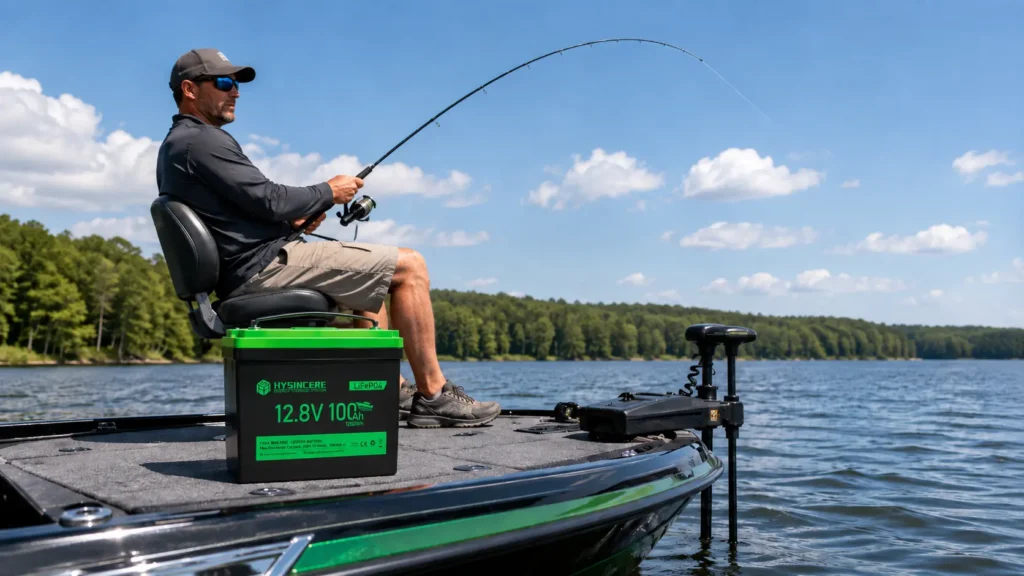
Start with the trolling motor, not the battery catalogue. Match the motor’s rated system voltage first, obtain its maximum current draw, estimate the current it will actually average during a normal trip, and then choose enough battery capacity for the required runtime and reserve.
For a 12V, 24V, or 36V trolling motor, the corresponding Hysincere LiFePO4 platform may be 12.8V, 25.6V, or 38.4V. That nominal match is only the starting point. The motor’s permitted voltage range, battery BMS current, cable and breaker design, charger, compartment, and operating temperature all need to be checked before a model is approved.
Start with the motor voltage
A larger amp-hour rating cannot correct a voltage mismatch. A 12V motor requires a 12V-class supply; a 24V motor requires a 24V-class supply; and a 36V motor requires a 36V-class supply. Read the motor nameplate and current manual rather than choosing voltage from boat size or thrust alone.
LiFePO4 nominal voltage is written differently from the familiar lead-acid label. A four-cell LiFePO4 battery is commonly described as 12.8V, an eight-cell battery as 25.6V, and a twelve-cell battery as 38.4V. These are the LiFePO4 platforms normally evaluated for 12V-, 24V-, and 36V-class loads. Approval still depends on the motor manufacturer’s allowed input-voltage range, including the battery’s voltage when fully charged.
Do not connect a 24V or 36V battery system to a motor rated only for 12V. Capacity and BMS protection do not make an over-voltage connection acceptable.
Hysincere’s current published LiFePO4 lead-acid replacement range includes the 12.8V 100Ah LF12100-HL-TM for trolling-motor projects. Published higher-voltage options include the 25.6V 100Ah LF24100N-B, the 25.6V 67Ah self-heating LF2467N-BJ, the 38.4V 52Ah LF3852N-B, and the 38.4V 67Ah self-heating LF3867N-BJ. Final model selection must use the current published product record and project requirements.
Choose the 12V, 24V, or 36V battery platform
| Motor requirement | LiFePO4 platform to evaluate | Hysincere product direction | What must be confirmed |
|---|---|---|---|
| 12V trolling motor | 12.8V battery | LF12100-HL-TM, 100Ah, 1280Wh | Motor voltage window, maximum current, target runtime, BMS, charger, cable, breaker, and fit |
| 24V trolling motor | 25.6V battery or an approved series bank | LF24100N-B, 100Ah and 2560Wh; LF2467N-BJ self-heating model, 67Ah and 1715Wh | Full-charge voltage, battery configuration, BMS current, charger voltage, protection, and installation space |
| 36V trolling motor | 38.4V battery or an approved series bank | LF3852N-B, 52Ah and 1996.8Wh; LF3867N-BJ self-heating model, 67Ah and 2572Wh | Motor voltage tolerance, required energy, current margin, charger, cabling, breaker, and environmental limits |
This is a voltage-platform table, not a universal motor recommendation. Motor current, fishing conditions, speed profile, desired reserve, and onboard charging can make two apparently similar boats require different capacities.
Calculate runtime from average current, not thrust alone
The motor’s maximum amp draw is needed for BMS, cable, and protection checks, but it is usually too conservative for estimating an entire day on the water. A trolling motor rarely runs continuously at maximum setting. Wind, current, boat weight, hull resistance, propeller condition, vegetation, steering corrections, and the selected speed all change the average current.
When the battery and motor are on the same voltage platform, a practical planning formula is:
Estimated runtime (hours) = battery capacity (Ah) × planning factor ÷ measured or estimated average current (A)
The planning factor is not a battery specification. It is a project allowance for reserve, operating uncertainty, temperature, cable loss, battery ageing, and the need to return without fully using the planned energy. The buyer should set it from the real operating risk. The following example uses 0.80 only to demonstrate the method.
| Illustrative average current | Calculation for a 100Ah battery | Estimated planning runtime |
|---|---|---|
| 20A | 100Ah × 0.80 ÷ 20A | 4.0 hours |
| 30A | 100Ah × 0.80 ÷ 30A | 2.7 hours |
| 40A | 100Ah × 0.80 ÷ 40A | 2.0 hours |
| 50A | 100Ah × 0.80 ÷ 50A | 1.6 hours |
These figures are calculation examples, not LF12100-HL-TM runtime claims. A useful field test is to record current during low-speed positioning, normal travel, holding against wind or current, and maximum power. Weight those readings by the expected time at each condition. That operating average produces a more defensible capacity estimate than copying the highest current from a motor chart.
For comparing different voltage platforms or adding other loads, use watt-hours:
Rated energy (Wh) = nominal voltage (V) × capacity (Ah)
Estimated runtime (hours) = rated energy (Wh) × planning factor ÷ average input power (W)
Keep the fish finder, GPS, pumps, lighting, and house loads separate unless the electrical design intentionally places them on the same protected bank. Hysincere’s marine battery application page covers service or house power, while this article is limited to trolling-motor duty.
Check maximum current against the BMS and the whole circuit
Capacity answers “how long”; current capability answers “can the system support the load without a protection trip or excessive voltage drop.” Ask for the motor’s maximum amp draw at the selected voltage and distinguish it from normal average current. Then compare it with the exact battery’s continuous-discharge rating, peak-discharge rating, peak duration, and BMS protection logic.
A sensible review includes:
- maximum motor current at the rated system voltage;
- expected sustained current in the most demanding normal condition;
- short transients when starting, changing speed, or clearing the propeller;
- any other loads connected to the same battery circuit;
- the exact battery model’s continuous and peak current limits and time conditions;
- connector, switch, plug, cable, fuse, and breaker ratings; and
- voltage measured at the motor under load.
Do not treat the circuit-breaker size as the motor’s actual current draw. The breaker protects a circuit under defined conditions; it is not a substitute for the motor data. Likewise, a brief BMS peak figure does not establish a safe continuous load.
Marine duty boundary: a deep-cycle trolling-motor battery is not automatically an engine-starting battery. Cranking, house, and trolling-motor duties require separate approval criteria. The broader lead-acid to LiFePO4 conversion checklist explains the system checks that apply beyond the motor circuit.
Purpose-built battery or series-connected bank?
A 24V or 36V motor may use a purpose-built battery at the required voltage or an approved series bank of lower-voltage batteries. With matched batteries, series connection adds voltage while amp-hour capacity stays the same; parallel connection adds amp-hour capacity while voltage stays the same. Match the bank to the motor’s rated voltage. A 24V or 36V bank is not suitable for a 12V motor.
A purpose-built 25.6V or 38.4V battery can reduce the number of inter-battery jumpers and individual battery connections. A series bank may fit an existing layout or service approach. Neither option is automatically correct. Compare available space, weight distribution, service access, charging method, redundancy plan, model availability, and total installed cost.
Never assume a LiFePO4 battery may be connected in series or parallel. Use only the quantity and configuration permitted by the exact current manual or written supplier approval. Do not mix different models, capacities, ages, states of charge, or BMS versions in one bank.
Verify cable, breaker, charger, and installation
Trolling motors are high-current DC loads, so cable length matters. Choose conductor size using the motor’s maximum current, the full positive-and-negative circuit length, allowable voltage drop, insulation rating, installation method and local marine requirements. Long or undersized cables can lower the voltage at the motor and overheat. Check the motor manual for its cable and breaker requirements, then verify that the protection also suits the cable, battery and complete circuit.
Before purchase, confirm:
- the motor manufacturer’s required DC-rated fuse or circuit breaker;
- cable size for maximum current and total circuit length;
- marine-rated terminals, crimps, connectors, disconnects, and corrosion protection;
- a secure, dry or appropriately protected battery compartment with service access;
- a charger compatible with LiFePO4 and the complete bank voltage;
- the charger’s maximum current and behavior after a BMS disconnect;
- the battery’s permitted charging and discharging temperatures; and
- whether separate chargers or DC converters are required for onboard electronics.
An existing lead-acid charger should not be approved from its front label alone. Record the make and model, then review its voltage stages, equalization or desulfation behavior, temperature compensation, output current, and lithium setting against the selected battery documentation. Hysincere’s lead-acid charger compatibility guide provides the detailed review method.
A practical selection workflow
- Identify the duty. Confirm this is a trolling-motor bank, not an engine-starting or general house bank.
- Record the motor data. Capture make, model, rated voltage, maximum amp draw, recommended breaker, and cable guidance from the current manual.
- Define the trip profile. Estimate hours at low, medium, and high power, along with wind, current, boat load, and required return reserve.
- Calculate energy. Use measured or defensible average current to estimate Ah and Wh, then apply a documented planning allowance.
- Approve the current path. Check battery BMS, cable, terminals, connectors, switch, fuse, breaker, and voltage drop as one circuit.
- Choose the bank architecture. Compare a purpose-built 12.8V, 25.6V, or 38.4V battery with only those series or parallel configurations explicitly approved for the exact model.
- Review charging and environment. Confirm charger, bank voltage, temperature limits, compartment, mounting, moisture, vibration, and service access.
- Validate before release. Use the current battery datasheet, drawing, manual, motor manual, protection schedule, and installation plan.
What to send for an accurate trolling-motor battery quotation
A complete inquiry lets the supplier size the battery around the boat rather than guessing from a voltage and Ah label. Send:
- trolling motor manufacturer, model, rated voltage, maximum amp draw, and recommended breaker;
- boat type, loaded weight if known, water conditions, and typical operating profile;
- required runtime and minimum return reserve;
- existing battery chemistry, voltage, capacity, quantity, and wiring diagram;
- available battery-compartment dimensions, mounting, terminal direction, and cable length;
- charger make, model, bank voltage, charging current, and available lithium settings;
- minimum and maximum charging and operating temperatures;
- other devices connected to the bank and their current or power;
- destination market, required documents, quantity, branding, and delivery schedule.
The right trolling-motor battery is the one that matches the motor voltage, supports the real current path, provides the planned runtime with reserve, and can be charged and installed correctly. Once those four questions are answered, comparing 12.8V, 25.6V, and 38.4V Hysincere options becomes a specification decision rather than a guess based on boat size.
Size the Battery From Your Trolling Motor Data
Send Hysincere the motor make and model, rated voltage, maximum amp draw, required runtime, boat and water conditions, existing battery and wiring, charger model, cable length, battery-compartment dimensions, temperature range, destination market, and quantity. We will review the 12.8V, 25.6V, or 38.4V battery direction against the complete project.
Trolling Motor Battery Sizing FAQ
Can I run a 24V trolling motor from one 12.8V battery?
No. A 24V motor needs a compatible 24V-class supply. Evaluate a purpose-built 25.6V battery or an approved series bank, then confirm the motor's permitted voltage range and the exact battery configuration.
How many amp-hours do I need for a trolling motor?
Divide the required operating amp-hours by the planning factor you have set for reserve and uncertainty. A practical starting calculation is capacity in Ah = average motor current in A × required runtime in hours ÷ planning factor. Use measured or defensible average current, not only the maximum amp draw.
Is maximum amp draw the same as average current?
No. Maximum amp draw is important for BMS, cable, connector, fuse, and breaker checks. Average current reflects the mix of speeds and conditions over the trip and is normally the better basis for estimating runtime.
Can any LiFePO4 batteries be wired in series for 24V or 36V?
No. Series and parallel permission is model-specific. Use only the battery quantity, configuration, and charging method allowed by the current manual or written supplier approval. Do not mix different models, capacities, ages, states of charge, or BMS versions.
Can the trolling motor share a battery with the engine starter or fish finder?
Do not assume it can. Engine starting, trolling-motor propulsion, and house electronics have different current, protection, voltage-quality, and reliability requirements. Confirm the motor and electronics manufacturers' wiring rules and design separate protected circuits or banks where required.
Can I keep my existing lead-acid charger?
Only after the exact charger is reviewed. Check its charging voltages, equalization or desulfation behavior, temperature compensation, maximum current, bank voltage, and lithium setting against the selected battery documentation.
Runtime calculations in this article are planning examples based on stated assumptions, not product performance guarantees. Actual current and runtime depend on the motor, speed setting, boat load, hull and propeller condition, wind, water current, temperature, wiring, reserve policy, and battery condition. Product availability, voltage range, BMS limits, series or parallel permission, charging limits, dimensions, terminals, environmental ratings, and documents vary by exact model and revision. Final approval must use the current Hysincere datasheet, motor and charger manuals, installation design, and applicable marine rules.