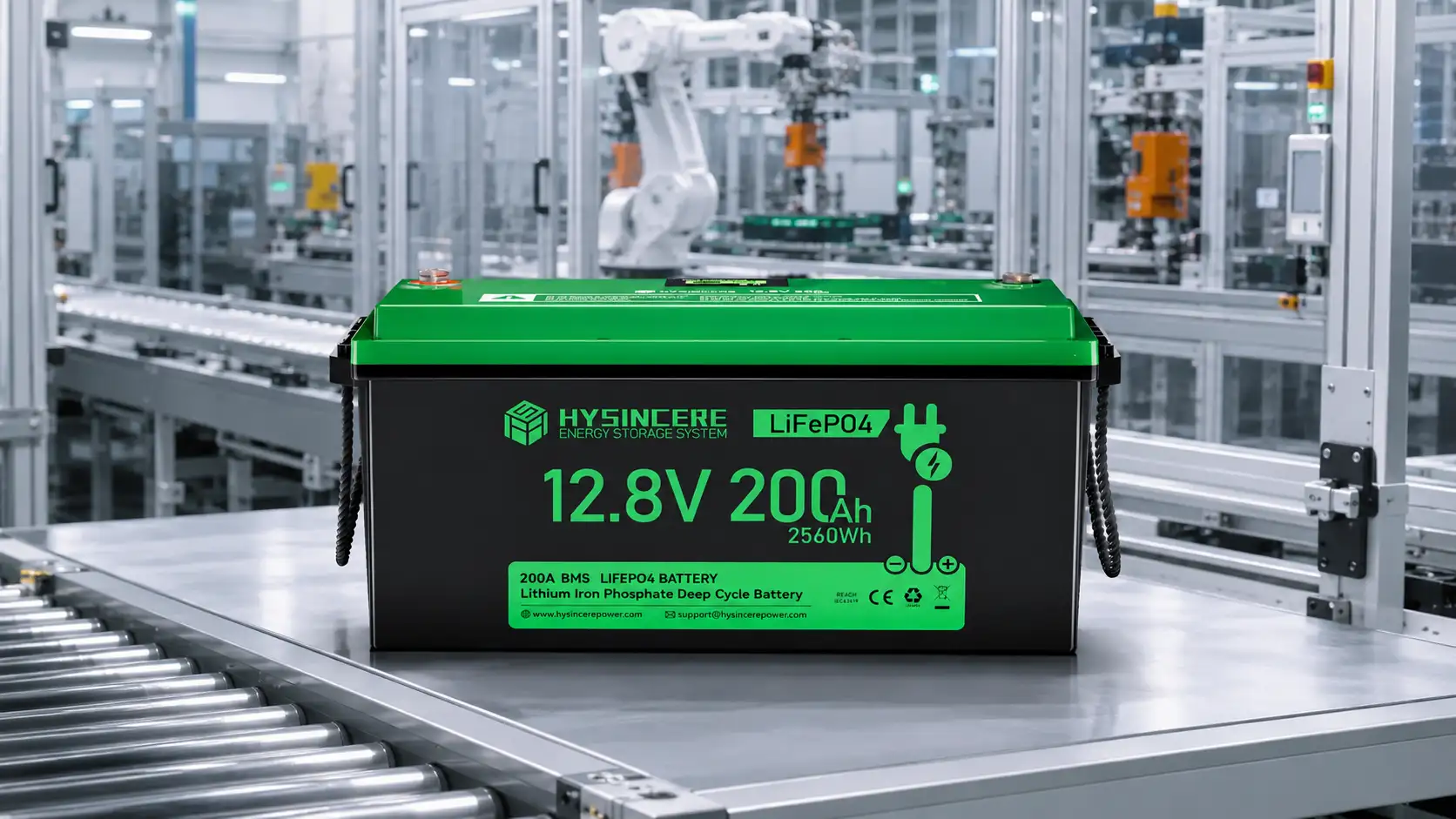

LiFePO4 batteries can last for thousands of charge-discharge cycles. For example, the Hysincere LF24100N-B specification lists 4,000 cycles with at least 60% capacity remaining, at 100% depth of discharge (DoD) and 0.5C charging and discharging.
How long it lasts in years varies with temperature, charging and daily use. For your equipment, what matters is how long it can keep providing the runtime the job requires.
Cycle life and service life are different
Cycle life describes performance under a defined charge-discharge test. A rating should state how much of the battery’s capacity is used each cycle and how much capacity remains at the end of the test.
Calendar aging is the change that occurs as time passes, including while a battery is stored or lightly used. Research on LiFePO4 cell degradation treats temperature and state of charge as relevant aging conditions. Cycling and calendar aging can happen together.
Service life is how long the complete battery remains suitable for the job. It also depends on the condition of its BMS, connections and enclosure, not only the cells.
A battery at 80% of its original capacity has not necessarily stopped working. It may still suit a lower-energy task. In equipment that needs almost all the original capacity to finish a shift, however, replacement may be necessary earlier.
How to read a LiFePO4 cycle-life rating
Two cycle counts are only useful for comparison when you know the test conditions. Check the depth of discharge (DoD), charge and discharge rates, temperature, voltage limits and remaining-capacity threshold. DoD is the share of capacity used during a discharge; the C-rate describes how quickly the battery is charged or discharged relative to its capacity.
The Hysincere LF24100N-B 25.6V 100Ah battery shown in this article provides a specific example. Page 7 of its specification lists the following cycle-life rating:
| Item | Listed value |
|---|---|
| Cycle life | 4,000 cycles |
| Depth of discharge | 100% DoD |
| Charge rate | 0.5C |
| Discharge rate | 0.5C |
| Remaining capacity after 4,000 cycles | At least 60% |
Reaching the listed cycle count does not mean the battery suddenly stops working. When comparing batteries, read the remaining-capacity threshold alongside the cycle count; a 60% threshold and an 80% threshold describe different endpoints.
These are the specification’s stated values, not an individual test report. Before a purchase decision, request the cycle-test report for the supplied model and revision. Check the test temperature and voltage limits, and whether the report covers cells or a complete battery pack. A cell report alone does not establish the service life of the whole pack.
Why dividing cycles by 365 is not a lifespan forecast
Suppose a battery has a hypothetical rating of 3,000 cycles and a system performs one cycle each day under the same cycling conditions. Dividing 3,000 by 365 gives about 8.2 years. That is a cycle-count calculation, not a forecast: it leaves out calendar aging, changing temperature and differences between the test and actual duty.
Nor does connecting a charger automatically count as one full cycle. For an energy-throughput estimate, two discharges of 50% each add up to one equivalent full discharge. That accounting method does not mean they cause exactly the same aging as one deep discharge, and a BMS may display cycle count differently.
For a practical assessment, record how much energy the equipment uses per day and how many days it runs each year. Keep the actual charging and discharge pattern alongside that total. A standby battery and a battery used for two shifts a day should not receive the same lifespan forecast.
Operating conditions that affect battery life
Temperature during use and storage
A battery near a heat source or left in a hot enclosure experiences different conditions from a laboratory sample. Review the installation temperature over a full operating season, not only the room temperature on the day of a test.
Cold conditions need a separate charging check. Follow the model’s allowed charging temperature and heating controls; the fact that a battery can discharge in the cold does not establish permission to charge it there. Our cold-weather LiFePO4 guide explains that distinction.
Daily energy demand and current
If the battery only just covers the required runtime when new, ordinary capacity loss can soon become a service problem. The load’s continuous and startup current must also remain within the battery’s limits. Extra Ah cannot correct an underspecified current rating.
Charging and long idle periods
Use the charging profile and storage instructions for the selected model. A universal “always stop at 80%” rule can conflict with the manufacturer’s balancing or operating requirements. For lead-acid replacement projects, check the charger’s compatibility with LiFePO4 before keeping its old settings.
During storage, small connected loads can continue drawing power. Follow the supplier’s instructions for isolation, inspection and recharging rather than assuming that a battery can be put away indefinitely.
Size the battery for the runtime you need later
Here is a simple way to make aging part of the purchasing decision. Assume a system needs 1,000Wh from the battery for its duty period, and the design needs to keep meeting that requirement at 80% remaining capacity.
That is the initial nominal energy required under the simplified assumption that all of the remaining capacity is available. If the system uses only 80% of that remaining energy as its operating window, the calculation becomes:
This is an illustrative capacity allowance, not a product recommendation. Conversion losses, temperature, current limits and the actual permitted operating window still need to be included. The example shows why a battery sized only for the first day of operation may not deliver the desired service life.

If you are comparing a replacement with an existing AGM or flooded battery, our LiFePO4 versus lead-acid comparison explains why nameplate Ah alone is not a like-for-like comparison.
What to ask before paying for a longer-life battery
Ask the supplier for a cycle rating tied to the exact model and test conditions. Then compare it with the duty you actually need: daily energy use, peak load, temperature, charging opportunities and the minimum acceptable runtime as the battery ages.
Keep warranty terms separate from cycle-life data. A test result describes performance under stated conditions; a warranty describes the supplier’s coverage. Neither should be substituted for the other.
For a fleet or bulk purchase, include installation labor, planned downtime and replacement access in the cost comparison. Avoid calculating a fixed lifetime saving from an unverified cycle claim.
You can compare available capacities and configurations in the Hysincere lead-acid replacement battery range. Bring the expected duty and required runtime to the discussion so the model-specific lifespan evidence can be assessed against your project. The OEM and bulk buying guide covers the other checks before sample approval.
Planning a lead-acid replacement?
Compare the available battery range, then share the daily energy use, operating temperature and runtime you need as the battery ages.
Frequently Asked Questions
Can a LiFePO4 battery last ten years?
It may, depending on the model and conditions, but ten years is not a universal lifespan. Compare the manufacturer’s evidence with the expected duty, temperature, charging and required remaining capacity.
Does 5,000 cycles mean 5,000 days?
No. The rating describes a test at specified conditions. Daily use may involve several partial discharges, more than one cycle or long idle periods, while calendar aging continues.
Is 80% remaining capacity the same as 80% state of charge?
No. Remaining capacity describes how much an aged battery can hold compared with its original capacity. State of charge describes how full it currently is. An aged battery can be fully charged while holding less energy than when it was new.
Should every LiFePO4 battery be charged only to 80%?
No universal limit suits every battery system. Follow the selected manufacturer’s charging and balancing instructions, and plan storage separately from normal operation.
Does a shorter runtime prove that the battery needs replacing?
Not by itself. Changes in load, temperature, charging, connections or protection settings can reduce runtime. Compare performance under similar conditions and have the cause checked before deciding.