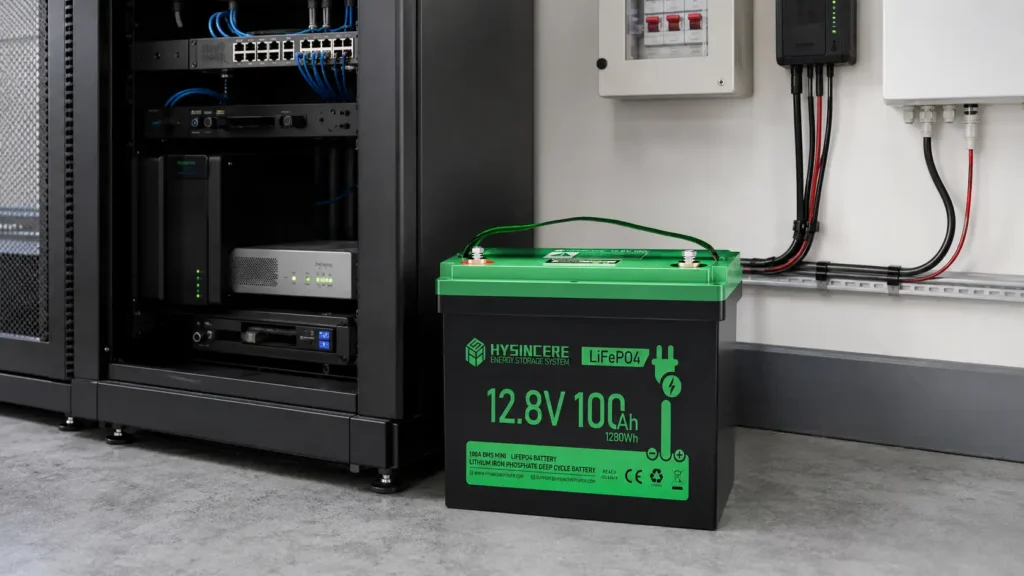
A LiFePO4 battery should not be treated as a universal drop-in replacement for the 12V 7Ah sealed lead-acid battery inside a UPS. The case may fit and the nominal voltage may look close, but a UPS battery is part of a tested charging, inverter, alarm, runtime, and fault-protection system.
For a consumer or certified commercial UPS, the safest service route is normally the replacement battery type approved by the UPS manufacturer. LiFePO4 can be a strong choice in a purpose-designed UPS or an engineered conversion program, but that work requires more than changing two terminals.
The short answer: only when the UPS architecture approves it
Small valve-regulated lead-acid batteries—often marked SLA, VRLA, AGM, 12V 7Ah, or a related rating—have been used in UPS products for decades. The charger may keep them on standby float for months, the inverter may draw high current during an outage, and the UPS firmware may estimate runtime from a lead-acid voltage curve and internal resistance.
A LiFePO4 pack changes each of those conditions. It typically includes a BMS that can open the charge or discharge path, its discharge voltage is flatter, and its allowable charge and discharge current depends on the exact pack. The correct question is therefore not “Can lithium make the UPS run?” but “Will the complete UPS remain predictable during charge, transfer, overload, low battery, shutdown, recharge, and fault recovery?”
A 12V 7Ah label describes only part of the battery
The “7Ah” rating is normally stated under defined test conditions and does not directly describe performance at a much higher UPS discharge rate. Two batteries with the same nominal Ah can have different high-rate capacity, internal resistance, voltage sag, terminals, temperature limits, and protection behavior.
The same caution applies to voltage. A 12V SLA and a 12.8V LiFePO4 battery belong to the same broad voltage class, but their charging and discharge curves differ. Review the dedicated 12V lead-acid versus 12.8V LiFePO4 voltage guide before using nominal voltage as evidence of compatibility.
Eight checks before considering a 12V 7Ah SLA-to-LiFePO4 conversion
| Check | Why it matters in a UPS | Evidence needed |
|---|---|---|
| UPS manufacturer approval | The UPS may be certified, warranted, and programmed around a defined replacement battery | UPS manual, approved battery list, service bulletin, or written engineering approval |
| Standby charging profile | A VRLA float strategy is not automatically a suitable LiFePO4 maintenance strategy | Measured and documented charge voltage, current, temperature behavior, and long-term standby logic |
| Discharge current | A small UPS can draw many times the Ah rating in amperes during an outage | Maximum continuous battery current, overload current, duration, and BMS limits |
| BMS cutoff and recovery | A hard BMS disconnect can make the UPS lose power abruptly or fail to restart charging | Charge/discharge protection thresholds, delay, release, wake-up, and charger interaction |
| Runtime estimation | Lead-acid-oriented firmware may misread a flat lithium voltage curve | Low-battery alarm, shutdown timing, calibration method, and actual full-load runtime test |
| Mechanical and terminal fit | Similar case size does not guarantee correct terminal type, spacing, restraint, or wire clearance | Dimensioned drawing, terminal specification, polarity, connector rating, and enclosure review |
| Temperature | UPS enclosures can be warm; unheated sites can be cold enough to restrict lithium charging | Cell/battery temperature range, sensor position, BMS rules, and enclosure thermal test |
| Compliance and responsibility | Changing chemistry may affect product certification, warranty, insurance, and site procedures | Target-market standards, change-control approval, labels, maintenance plan, and responsible engineer |
The BMS is not just an extra fuse
A fuse responds to excessive current. A BMS can also stop charge or discharge because of cell voltage, pack current, temperature, or an internal fault. That protection is valuable, but it introduces a switching event the original UPS may never have been designed to coordinate.
For example, if the BMS disconnects the battery at low state of charge, the UPS charger may require a visible battery voltage before it restarts. The pack and charger can then wait for each other. An engineered solution must define how the battery wakes, how charging resumes, and what happens after mains power returns unattended.
Long-term float behavior deserves a real endurance test
UPS batteries spend most of their life connected to a charger rather than supporting an outage. A conversion test that runs the UPS for ten minutes but ignores weeks or months of standby misses the dominant operating condition. Verify steady-state voltage, charge current, cell balance behavior, BMS status, enclosure temperature, and recovery after repeated short power interruptions.
The general guide on lead-acid charger and LiFePO4 compatibility explains why equalization, repair pulses, float, and temperature compensation must be reviewed rather than assumed.
Example: a 300W load can demand far more than 7A
It is easy to see “7Ah” and imagine a battery current near 7A. UPS loads do not work that way. Assume a UPS is delivering a 300W AC load from a 12V-class battery and use 85% conversion efficiency only as an illustrative planning value:
The battery path may therefore carry roughly 29A before allowing for surge, cable loss, aging, and low battery voltage. At a higher load or lower voltage, current rises. This is why a LiFePO4 pack with adequate energy can still fail in a UPS if its BMS continuous-current limit, peak limit, or terminal system is too small.
Runtime also cannot be calculated reliably from nominal Wh alone. A lead-acid battery may deliver less than its low-rate rated capacity at a high UPS discharge rate, while the UPS may stop at its programmed voltage. A LiFePO4 pack may hold voltage longer but then reach a BMS or UPS cutoff. The only defensible result comes from testing at the intended load and temperature with agreed end-of-discharge criteria.
Two responsible paths—and why they should not be mixed
Path 1: service an existing UPS with its approved replacement battery
For an installed UPS that was designed and approved for VRLA, use the manufacturer-specified replacement battery or cartridge and follow the service interval. This preserves the original charge logic, runtime assumptions, certification basis, and warranty position as far as the equipment maker specifies.
Path 2: develop or select a UPS designed for lithium
For OEM products, fleet programs, industrial equipment, or a new UPS platform, LiFePO4 can be evaluated at the architecture level. The charger, inverter, BMS, communications, enclosure, thermal design, firmware, alarm behavior, certification, and service process are then developed and validated together.
This is different from buying a physically similar 12.8V battery and treating it as an approved replacement. A project may use cells and a BMS selected specifically for short high-rate discharge, long standby, expected temperature, fault response, and communication with the UPS controller.
Minimum validation plan for an engineered LiFePO4 UPS project
- Document the baseline.
Record the existing SLA model, UPS model, load range, charge behavior, alarm timing, runtime, enclosure temperature, and field duty. - Review the electrical architecture.
Confirm charger limits, battery current, inverter cutoff, fusing, wire and connector ratings, isolation, grounding, and BMS coordination. - Test standby operation.
Observe charging and thermal behavior over a representative period, including repeated short transfers and return to mains. - Test at real loads.
Run normal, maximum, and permitted overload conditions. Record battery current, terminal voltage, temperature, alarm points, shutdown, and actual runtime. - Test fault and recovery cases.
Verify low battery, BMS charge/discharge protection, charger restart, loss and return of mains, disconnected battery, sensor fault, and unattended recovery. - Complete compliance change control.
Determine which product and market approvals require review or retesting, then update labels, manuals, service parts, acceptance criteria, and traceability.
Information to prepare for a B2B UPS battery project
- UPS manufacturer, model, rated VA/W, DC bus voltage, and service documentation;
- Existing SLA battery model, quantity, series/parallel layout, terminal, and enclosure dimensions;
- Measured charge voltage/current and long-term standby behavior;
- Normal load, maximum load, overload profile, transfer time, and required runtime;
- Battery current during start, full load, low battery, and recharge;
- Ambient and internal enclosure temperature range;
- Alarm, low-battery shutdown, restart, monitoring, and communications requirements;
- Target country, equipment standards, certification status, warranty responsibility, and change-control owner;
- Sample quantity, annual volume, validation plan, and acceptance criteria.
Hysincere provides lead-acid replacement battery platforms and can discuss custom requirements, but a UPS inquiry should always begin with the actual equipment architecture. A catalogue voltage and capacity are not enough to declare a model compatible.
Start with the UPS model and load—not with a battery case size
For an OEM or industrial UPS project, send Hysincere the UPS architecture, present SLA configuration, charge data, load profile, temperature, runtime target, compliance requirements, and validation plan. The first technical outcome may be an approved battery concept, a request for additional testing, or a conclusion that the existing UPS should retain its specified SLA battery.
12V 7Ah SLA-to-LiFePO4 UPS FAQ
Can I replace a 12V 7Ah UPS battery with a 12.8V 7Ah LiFePO4 battery?
Do not assume so from size, voltage, and Ah alone. Confirm UPS manufacturer approval, charge profile, high-rate current, BMS cutoff/recovery, runtime calibration, terminals, temperature, certification, and warranty. For an existing certified UPS, the approved replacement battery is normally the appropriate service choice.
Why can a 7Ah battery need a BMS rated above 7A?
Amp-hours describe capacity under defined test conditions; they are not the UPS discharge current. A few hundred watts from a 12V battery can require tens of amperes. The BMS, cells, terminals, connector, wiring, and fuse must support the actual continuous and peak current.
Will the UPS correctly display lithium runtime?
Not necessarily. Firmware designed around lead-acid voltage and resistance can overestimate or underestimate remaining time on LiFePO4. An engineered project should validate low-battery alarms, shutdown timing, calibration, and runtime at the intended load and temperature.
Is a LiFePO4 UPS battery safer because it has a BMS?
A suitable BMS adds important cell-voltage, current, and temperature protection, but it does not by itself make an unapproved conversion safe. The charger, inverter, enclosure, fault response, wiring, compliance, and service process must also be designed for the battery.
When does LiFePO4 make sense for UPS applications?
It makes sense when the UPS or conversion program is designed and validated around lithium requirements—especially where weight, service planning, monitoring, or lifecycle goals justify the engineering work. Critical systems should use an equipment-approved lithium architecture rather than an informal battery substitution.
This article is not a service instruction for opening or modifying a UPS. Follow the UPS manufacturer’s approved replacement procedure and applicable electrical, fire, product-safety, workplace, and local code requirements.