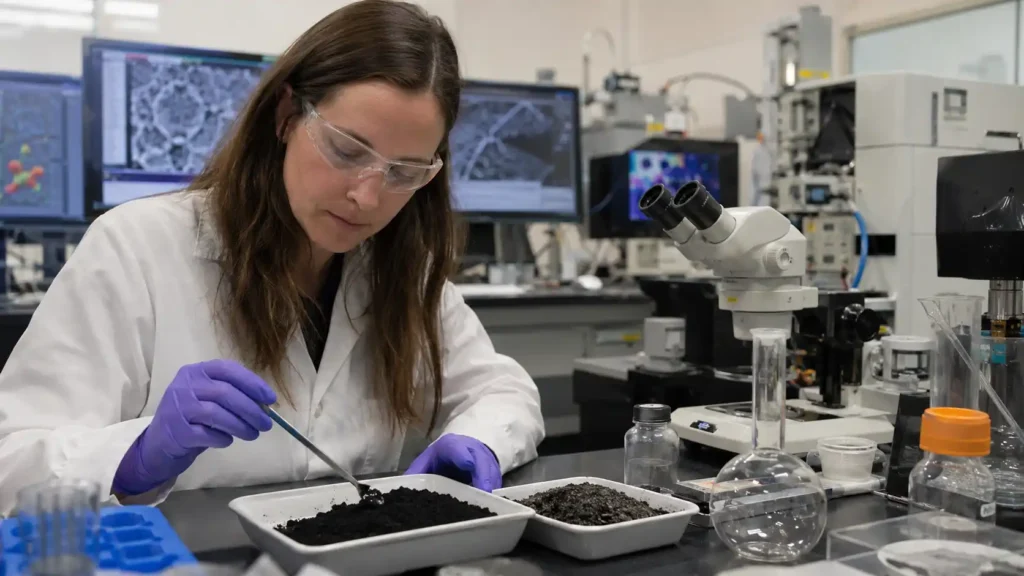
Soft carbon vs hard carbon anode: the key difference is what happens when you heat them. Soft carbon can be turned into graphite at very high temperatures; hard carbon can’t, and keeps a disordered structure with small pores. That structural difference changes how each one stores lithium or sodium, how much charge is lost in the first cycle, and where each material makes sense.
Neither name is a performance rating. What matters for a battery project is how the complete cell performs, so this guide explains the materials and then what to check at cell and pack level.
Soft Carbon: The Easily Graphitized Carbon
Soft carbon is graphitizable carbon. Its small graphene-like layers are roughly parallel, so heat treatment at very high temperatures, typically around 2,500–3,000°C, lets them line up into graphite. Below that, it’s used as an anode material in its own right, usually carbonized at much lower temperatures.
Common precursors are petroleum coke, needle coke and pitch. These are also the raw materials for synthetic graphite. Natural graphite, by contrast, is mined; heating coke doesn’t produce it.
As an anode, soft carbon is often discussed for its good rate capability and low-temperature behavior, because its less-ordered structure gives lithium more paths in and out. The trade-offs are a lower capacity than graphite and an irreversible loss in the first cycle, when part of the lithium is consumed forming the protective SEI layer. How large these effects are depends on the precursor, processing and electrolyte.
Hard Carbon: The Difficult-to-Graphitize Carbon
Hard carbon is non-graphitizable. Its layers are randomly oriented and cross-linked, with closed micropores between them, so even very high temperatures don’t turn it into graphite. It’s typically made from resins, sugars, biomass or other organic precursors, but the precursor and carbonization process have to be specified. Not every polymer-derived carbon qualifies, and carbon black is not a substitute for a qualified hard-carbon anode material.
Hard carbon stores ions in several ways: between widely spaced layers, on defect sites and inside its micropores. That gives a sloping voltage curve followed by a low-voltage plateau. It’s also why hard carbon is the main anode material in most sodium-ion cells: sodium ions are too large to sit comfortably in graphite, but fit into hard carbon’s wider spacing and pores.
| Property | Soft carbon | Hard carbon | Graphite (reference) |
|---|---|---|---|
| Graphitizes with heat? | Yes, at very high temperature | No | Already graphitic |
| Typical precursors | Petroleum coke, needle coke, pitch | Resins, sugars, biomass, polymers | Mined (natural) or made from coke (synthetic) |
| Structure | Small, roughly parallel layers | Random layers with closed micropores | Ordered layers, 0.335nm spacing |
| Voltage profile | Sloping | Sloping, then a low-voltage plateau | Mostly flat plateau |
| Often chosen for | Rate and low-temperature behavior | Sodium-ion cells; rate and cycling stability | High energy density in lithium-ion; mature supply |
| Main challenges | Lower capacity; first-cycle loss | Larger first-cycle loss; lower density; precursor cost and consistency | Slower at high rates and low temperature; poor host for sodium |
General material characteristics. Actual capacity, efficiency and lifetime depend on the specific material, electrolyte, electrode design and test conditions. For reference, graphite’s theoretical capacity in lithium-ion cells is 372mAh/g.
Advantages and Challenges of Hard Carbon Anodes
Some hard-carbon materials show attractive capacity or rate capability in tests. Before comparing numbers, check three things:
- Half-cell or full-cell? A half-cell test against lithium metal shows what the anode can do in isolation. A full cell shows what you’ll actually get with a real cathode.
- Same test conditions? Current rate, voltage window, temperature and electrode loading all change the result.
- Per gram or per cell? More capacity per gram of anode doesn’t automatically mean more usable energy in the finished cell, especially if density is lower.
The biggest challenge is initial coulombic efficiency (ICE), the share of charge recovered after the first cycle. Hard carbon’s large surface area and pores consume more ions in that first cycle than graphite does. A figure such as 85% belongs to one material and one test, not to hard carbon as a family.
Likewise, you can’t assign a cell voltage such as 3.6V or 3.7V from the anode alone. The cathode and the voltage curves of both electrodes decide it. Nor does the anode name prove that one cell is safer than another; safety is shown by testing the complete cell and pack.
Development work usually focuses on two areas:
- Reducing first-cycle loss: tuning surface area, pore structure and coatings to control how the SEI layer forms, while checking that capacity, current capability and aging don’t suffer.
- Scaling production: precursor consistency, process yield, energy use and quality control at volume. A lab result alone doesn’t prove lower production cost.
For how anode choice fits with the rest of the cell, see our guides to cathode materials for lithium-ion batteries and lithium vs sodium batteries.
Evaluate the Complete Cell and Pack with Hysincere
For a battery product, the anode is one part of a much bigger picture. Hysincere designs and assembles LiFePO4, lithium-ion and sodium-ion battery packs from selected purchased cells. We don’t manufacture cells or anode materials, and this article isn’t a claim that we offer every cell chemistry described here.
What we can do is choose a confirmed cell model for your application and test it at pack level. Send us the voltage range, load profile, required runtime, charging method, available space and temperature conditions. If you’re weighing sodium-ion for a lead-acid replacement, our overview of 12V sodium-ion batteries for lead-acid replacement explains the voltage and charger points to check.
Discuss Your Battery Project Requirements
Share the application, voltage, capacity, load, charging method, dimensions, temperature, certification, and annual-volume requirements for an initial technical review by Hysincere.
Soft carbon vs hard carbon: FAQ
What is the difference between soft carbon and hard carbon anodes?
Soft carbon can be converted into graphite by very high-temperature treatment; hard carbon cannot and keeps a disordered structure with closed micropores. This changes how each stores ions, its voltage curve and its first-cycle loss.
Why is hard carbon used in sodium-ion batteries?
Sodium ions are too large to fit well between graphite layers. Hard carbon's wider layer spacing and micropores can store them, which is why it is the main anode material in most sodium-ion cells.
Does soft carbon become natural graphite?
No. Natural graphite is mined. Heat-treating coke or pitch produces synthetic graphite; soft carbon used as an anode is usually carbonized at much lower temperatures.
Is 85% a standard initial efficiency for hard carbon?
No. Initial coulombic efficiency depends on the specific material, electrolyte, electrode design and test method. Compare values only under the same conditions and preferably in full cells.
Can the anode alone determine a cell's voltage or safety?
No. Cell voltage depends on both electrodes, and safety has to be shown by testing the complete cell and battery pack.
This article is intended for technical reference and preliminary project evaluation. Battery compatibility, charging limits, current capability, temperature range, BMS behavior, certifications, and installation requirements vary by model and application. Final selection and system configuration must follow the selected product datasheet, equipment-manufacturer requirements, and system-validation results.