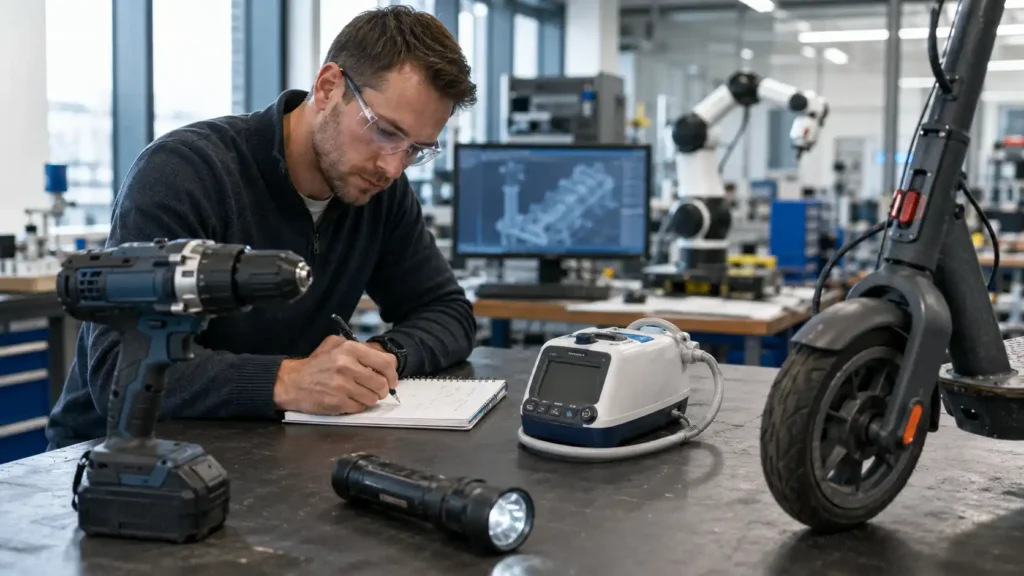
A 21700 cell may suit equipment needing more cell volume than an 18650 design. For power tools, medical devices, lighting and other OEM projects, compare the exact cell’s current, usable energy, dimensions and protection requirements rather than selecting by format alone.
Start with the device load and available space, then compare the exact cell models. This guide covers chemistry, current limits and protection for OEM battery-pack projects.
What is a 21700 Li-Ion Battery?
The name “21700” describes a nominal cylindrical format: approximately 21 mm in diameter and 70 mm long. This slight increase in size over the traditional 18650 cell (18mm x 65mm) provides more internal volume, but performance still depends on the cell model.
Advantages of 21700 Over 18650 Batteries
- Capacity: Compare actual model data at the intended current. Familiar capacity ranges are examples, not fixed upper limits for either format.
- Energy: More cell volume can provide more stored energy. It does not automatically establish higher energy per kilogram or per litre.
- Temperature: Resistance, current and cooling determine temperature rise. Compare the cell’s operating limits and validate the pack or device, rather than inferring life from dimensions.
Understanding 21700 Battery Chemistries
Cell chemistry influences voltage, energy and thermal behaviour, but electrode design and the finished cell also matter. The designation ICR 21700 is commonly associated with lithium cobalt oxide (LiCoO2). Check the manufacturer’s full specification rather than using the prefix to infer a current rating or a safety approval.
Use these common chemistry designations to organise a comparison, then check the voltage, current and test conditions for each actual model:
| Battery Type | Chemistry | Key Features | Application Checks |
|---|---|---|---|
| ICR 21700 | LiCoO2 (Cobalt) | Compare usable energy and the specified continuous current. | For electronics, lighting or medical equipment, confirm the exact device requirements. |
| IMR 21700 | LiMn2O4 (Manganese) | Current capability and temperature limits must come from the model specification. | For tools or robotics, check the load profile and complete-device protection. |
| INR 21700 | NiMnCo (NMC) | Model-specific trade-off between capacity and current. | Check voltage, thermal management and current requirements for the intended pack. |
| IFR 21700 | LiFePO4 (Iron Phosphate) | Generally lower nominal voltage; cycle life and energy depend on the model and test conditions. | For storage or backup systems, verify charging voltage and system compatibility. |
Chemistry labels are a starting point, not a complete model specification. Confirm the actual chemistry, voltage, current limits and available evidence for the chosen cell.
How to Choose the Right 21700 Battery
When engineering a new product or sourcing replacements for a fleet, consider these two critical factors:
1. Capacity vs. Discharge Rate
For high-power loads, select a model whose continuous and peak ratings cover the actual load at the expected temperature. For low-current devices, compare usable energy to the device cutoff. Do not select a cell solely because it carries an IMR, INR or ICR label.
2. Protected vs. Unprotected Cells
- Protected 21700 Batteries: An added protection board can disconnect under specified fault conditions. Confirm its current limits, actual length and compatibility with the complete device.
- Unprotected 21700 Batteries: These lack an added individual protection board. Their current is still limited by the cell specification; an appropriate pack or device protection system is required.
Source Reliable 21700 Cells with Hysincere
Request documentation for the exact cell, pack and target market. A management-system certification does not certify every product, and a test report for one model does not automatically cover a modified pack.
Hysincere develops and assembles battery packs using selected purchased cells. Send your voltage, energy, current, temperature, space and interface requirements so that cell options and pack design can be reviewed together. Confirm model availability and applicable documentation before ordering.
Discuss Your Cell Selection and Custom Battery Requirements
Share voltage, capacity, continuous and peak current, dimensions, cycle life, temperature, certification, and annual-volume requirements so Hysincere can evaluate suitable cells and battery-pack options.
Choosing the Right 21700 Li-Ion Battery: A B2B Engineering Guide FAQ
What does the 21700 designation tell me?
It describes a cylindrical cell format approximately 21 mm in diameter and 70 mm long. Actual dimensions, including the terminal or an added protection board, must be checked. The designation does not specify capacity, current or chemistry.
Is a 21700 cell always better than an 18650 cell?
No. A larger cell can contain more active material, but usable energy, current capability and temperature rise depend on the particular model and load. Compare cells under the same operating conditions and check the available space.
How do I compare chemistry and protection options?
Use the exact model’s datasheet to check voltage, charging limits, continuous and peak current, and temperature limits. Chemistry abbreviations are not a complete specification. An unprotected cell still has current limits and requires suitable protection in the pack or device.
This article is intended for technical reference and preliminary project evaluation. Battery compatibility, charging limits, current capability, temperature range, BMS behavior, certifications, and installation requirements vary by model and application. Final selection and system configuration must follow the selected product datasheet, equipment-manufacturer requirements, and system-validation results.